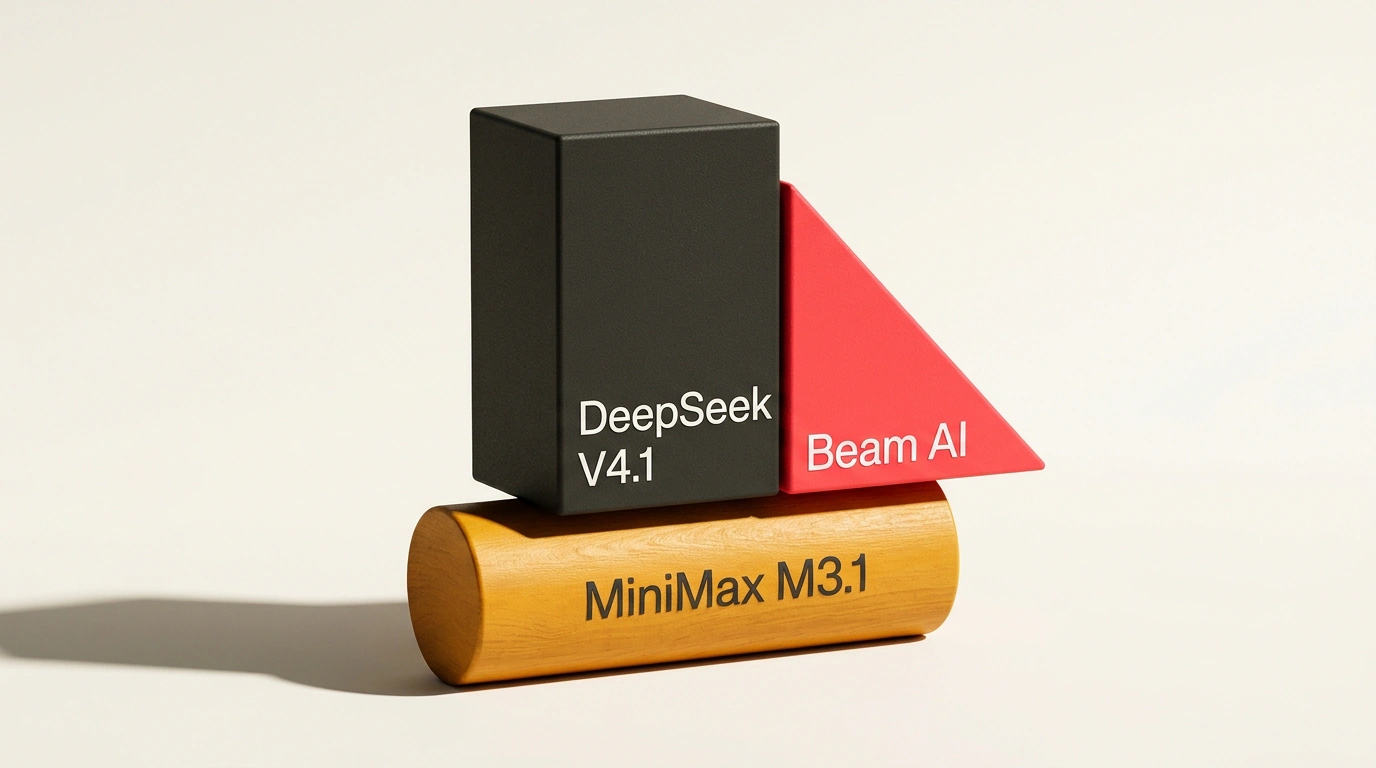
If you've been following autonomous AI agents, you've probably noticed how industry priorities shifted over the past few months. The race for bloated, trillion-parameter monoliths gave way to pragmatism. When an agent loops through hundreds of steps an hour—scraping web pages, formatting JSON, hitting external APIs, and validating regexes—feeding every tiny step to a flagship model like Claude Opus or GPT-5 is financial suicide.
Modern pipelines split into two tiers: high-level planning goes to the heavyweights, while all the grunt work goes to lightweight, fast, open solutions. Today we're looking at three fresh fall 2026 releases that slash the cost of agentic loops.
DeepSeek V4.1 Flash
Chinese lab DeepSeek updated its lineup with DeepSeek V4.1 Flash (build 1017). Its standout feature is pairing open weights under a permissive MIT license with a massive 1-million-token input context and up to 128,000 output tokens (available via the Token Harbour gateway). We already compared the architecture and economics of this family in DeepSeek V4.1 Flash 1017 vs. Claude Opus.
The model was tuned specifically for concise, strictly structured responses without empty filler intros. That makes it an ideal candidate for parsing giant documentation dumps or multi-hour system logs.
A welcome bonus for developers is the Token Harbour gateway, which offers free access to the model through a standard OpenAI-compatible endpoint with weekly quota resets:
import os
from openai import OpenAI

# Connect to the Token Harbour gateway via the standard SDK
client = OpenAI(
    api_key=os.environ.get("TOKEN_HARBOUR_API_KEY"),
    base_url="https://tokenharbour.ai/v1"
)

# Call DeepSeek V4.1 Flash in streaming mode
stream = client.chat.completions.create(
    model="deepseek-v4.1-flash:free",
    messages=[
        {"role": "system", "content": "Ты агент-парсер. Извлекай только JSON без markdown-блоков."},
        {"role": "user", "content": "Нормализуй входящий поток логов и найди невалидные HTTP-статусы."}
    ],
    temperature=0.1,
    max_tokens=2048,
    stream=True
)

for chunk in stream:
    token = chunk.choices[0].delta.content or ""
    print(token, end="", flush=True)
Beam AI
The second notable contender is Beam AI, a specialized open MoE model from Reflection AI (led by Misha Laskin and Ioannis Antonoglou). The architecture totals 501 billion parameters, with only 23 billion active per request for agentic tasks.
The weights are published under the Apache 2.0 license. What's really interesting, though, is the training: Beam was trained on over 100 million autonomous agent trajectories. As a result, it handles complex web browsing, Linux terminal work, and IDE interactions right out of the box, posting strong numbers on SWE-bench and Terminal-bench.
Beam AI also includes a built-in reasoning effort dial, letting you balance instant replies for trivial actions against deeper reasoning when writing code.
Here is how you call the model with reasoning parameters via a standard curl request to a local or cloud inference server:
curl -X POST https://api.reflection.ai/v1/chat/completions \
  -H "Content-Type: application/json" \
  -H "Authorization: Bearer $BEAM_API_KEY" \
  -d '{
    "model": "beam-ai-moe-23b",
    "messages": [
      {"role": "user", "content": "Исследуй структуру директорий и найди утечки памяти в скрипте worker.py"}
    ],
    "reasoning_effort": "medium",
    "max_tokens": 4096
  }'
MiniMax M3.1 Flash
Rounding out our trio is MiniMax M3.1 Flash, featuring a five-level reasoning dial and a 3x speed boost on routine work. Before its official announcement, the model ran in stealth under the codename "Space Bunny Alpha" on OpenRouter, where it topped token volume charts on day one.
In production, M3.1 Flash runs three times faster than the base M3 release, sustaining generation speeds above 120 tokens per second. Its signature feature is a 5-position reasoning depth switch. For basic email sorting, you set it to level 1 (minimum latency); for a smart-contract security audit, you crank it to level 5 so it builds thorough proof chains. On top of that, it handles external tool calling cleanly without breaking argument schemas.
Bottom line: how to divide the workload in your project
This trio marks a real turning point in applied AI economics. Instead of locking yourself into one pricey provider, a smart engineer assembles a modular stack:
- DeepSeek V4.1 Flash takes over reading giant knowledge bases, docs, and long traces thanks to its free million-token window.
- Beam AI becomes your go-to worker for autonomous web browsing and sysadmin loops.
- MiniMax M3.1 Flash handles lightning-fast message triage and tool routing.
Combining all three cuts your reliance on closed ecosystems and lets you run reliable agent pipelines at a tenth of the operating cost.