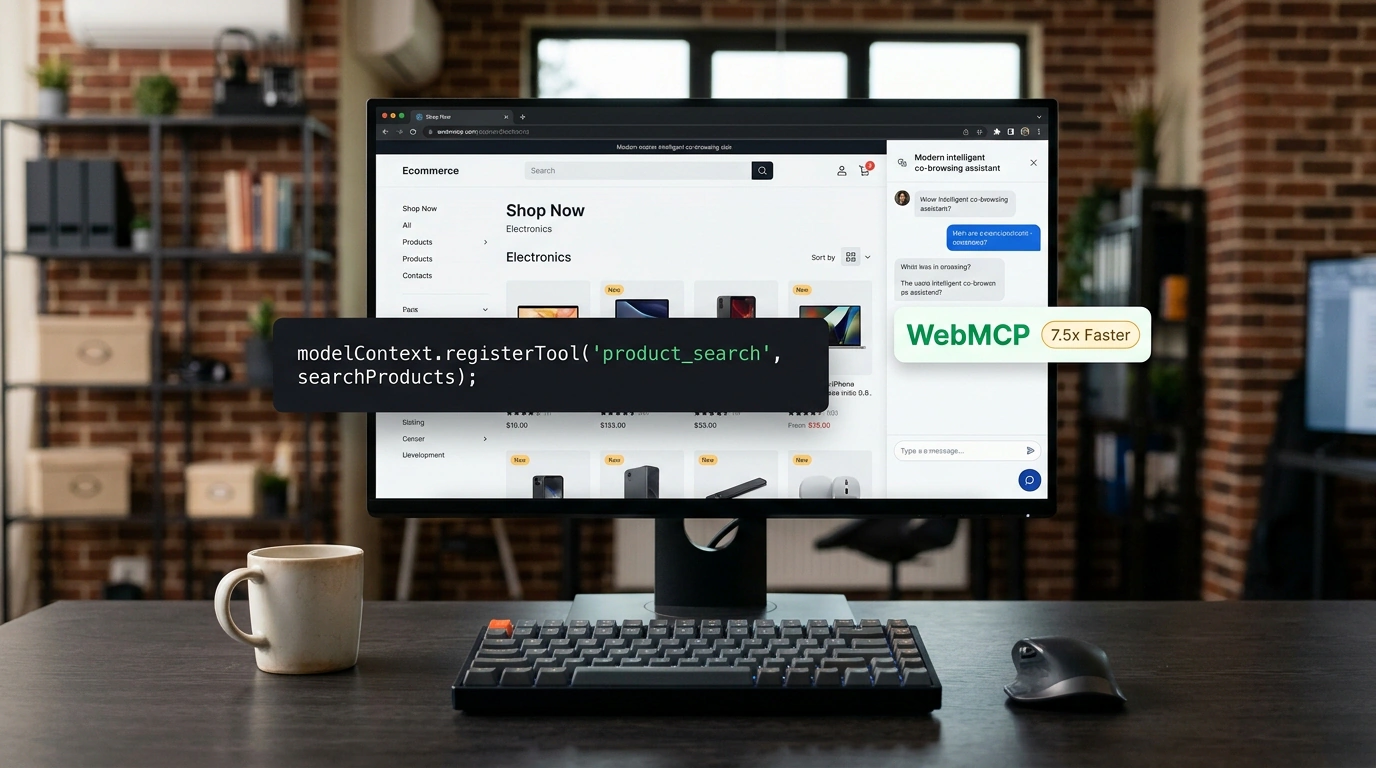
You have probably seen the flashy demos of agentic browsers: an AI opens a tab, snaps a screenshot of the UI, chews through vision tokens for seconds on end, spots the "Buy" button, and clicks at calculated pixel coordinates. It looks like magic from the future—until you peek under the engineering hood, where things get ugly fast.
That approach is painfully slow, breaks at the slightest tweak to CSS markup, and burns dollars on image inference. Worse yet, it cuts the user out of the loop entirely. Shopify's Principal Architect and W3C Working Group co-chair Yoav Weiss published a manifesto for WebMCP (Web Model Context Protocol), explaining why the future belongs to co-browsing rather than blind auto-clickers.
Three Paths for an Agent on the Web
Weiss outlines three architectural models for integrating AI agents with websites:
- Direct Backend (MCP Servers): the agent talks straight to server APIs, bypassing the browser. The catch is that the user loses visual control, active sessions, and their shopping cart, becoming a passive bystander.
- Embedded Interfaces (MCP Apps): slices of web pages are streamed directly into the assistant's chat UI.
- Co-Browsing: the agent works side by side with the human right inside the open browser tab. You keep your hands on the steering wheel, see every action happen, and let the agent handle the tedious navigation and data gathering.
To make co-browsing fast and rock-solid, a site simply registers typed functions directly in the page's JavaScript context:
// Registering a product search tool in the store catalog
document.modelContext.registerTool({
  name: "searchProducts",
  description: "Поиск товаров в магазине с фильтрацией по параметрам и бюджету",
  inputSchema: {
    type: "object",
    properties: {
      query: { type: "string", description: "Поисковый запрос" },
      maxPrice: { type: "number", description: "Максимальная цена в рублях" },
      category: { type: "string", description: "Категория товара" }
    },
    required: ["query"]
  },
  execute: async ({ query, maxPrice, category }) => {
    const results = await window.storeCatalog.search({ query, maxPrice, category });
    return {
      count: results.length,
      items: results.slice(0, 5).map(item => ({
        id: item.id,
        title: item.title,
        price: item.price,
        inStock: item.inStock
      }))
    };
  }
});
Instead of scanning pixels and parsing the DOM tree, the model receives a clean JSON schema and invokes a native page method. Adding items to the cart works the exact same way:
// Registering a tool to add an item to the current session's cart
document.modelContext.registerTool({
  name: "addToCart",
  description: "Добавление выбранного артикула в корзину активного пользователя",
  inputSchema: {
    type: "object",
    properties: {
      productId: { type: "string", description: "Идентификатор товара" },
      quantity: { type: "integer", minimum: 1, default: 1 }
    },
    required: ["productId"]
  },
  execute: async ({ productId, quantity }) => {
    return await window.storeCart.addItem(productId, quantity);
  }
});
47x Cheaper and 7x Faster
The real-world numbers are eye-opening. In benchmarks by nekuda.ai, native calls via WebMCP ran 2.5 to 7.5 times faster and up to 47 times cheaper than traditional vision-based auto-clickers.
In a live test by the Shopify Checkout team, checkout flows completed 2.7 times faster and 58% cheaper, hitting 60 successful runs out of 60—whereas conventional browser scripts flaked out and managed only 56 out of 60.
Answering Skeptics From Apple WebKit
The Apple WebKit team previously voiced concern that WebMCP might split the internet into a "web for humans" and a "web for robots." Yoav Weiss offers a sharp rebuttal: websites already fend off bots with draconian CAPTCHAs. An explicit open standard—paired with authorization mechanisms (Web Bot Auth) and third-party iframe restrictions via Permissions Policy—turns agents into legitimate citizens of the open web.
We already explored WebMCP's architecture and the ChatGPT Sites platform, and Weiss's latest argument drives the point home: the web will thrive in the AI era only when it learns to speak typed interfaces with models without kicking the human out of the browser.