In promotional demo videos, autonomous marketing looks deceptively simple: the author types a single command in the terminal, and the algorithm supposedly brings in customers around the clock without human involvement. Behind the scenes of real ad accounts, however, that kind of improvisation usually ends in a quiet disaster. Left without guardrails, an agent starts hammering platform servers like a machine gun, quickly gets banned for suspicious activity, or burns cash on creatives where white text completely disappears against a light background.
I had long wondered: how are systems actually built under the hood when they can run paid traffic for weeks without manual babysitting? Entrepreneur Greg Eisenberg from Late Checkout studio and growth engineer Cody Schneider, creator of Graphed and Swell AI, clearly demonstrated the answer by breaking down their live ad-buying pipeline. I studied their setup and cross-checked it against HubSpot's GTM Engineering principles: a reliable autopilot rests not on a "magic prompt," but on a combination of an isolated raw data warehouse, one-way access to ad accounts, and a separate auditor agent for creative review.
Raw Data Warehouse and One-Way Access to Ad Accounts
The first thing naive automation trips over is trying to read statistics directly from ad networks. Picture an intern barging into accounting every second for a fresh statement: security will show them the door before they even open the folder. Meta and Google Ads protective filters react the exact same way. When a general-purpose agent like GrokBot or Dots pulls campaign reports directly, it hits strict rate limits, violates API rules, and gets the account frozen. On top of that, raw exports clog the model's context memory with noise, and the platforms themselves eagerly take credit for other channels' sales, inflating conversion numbers.
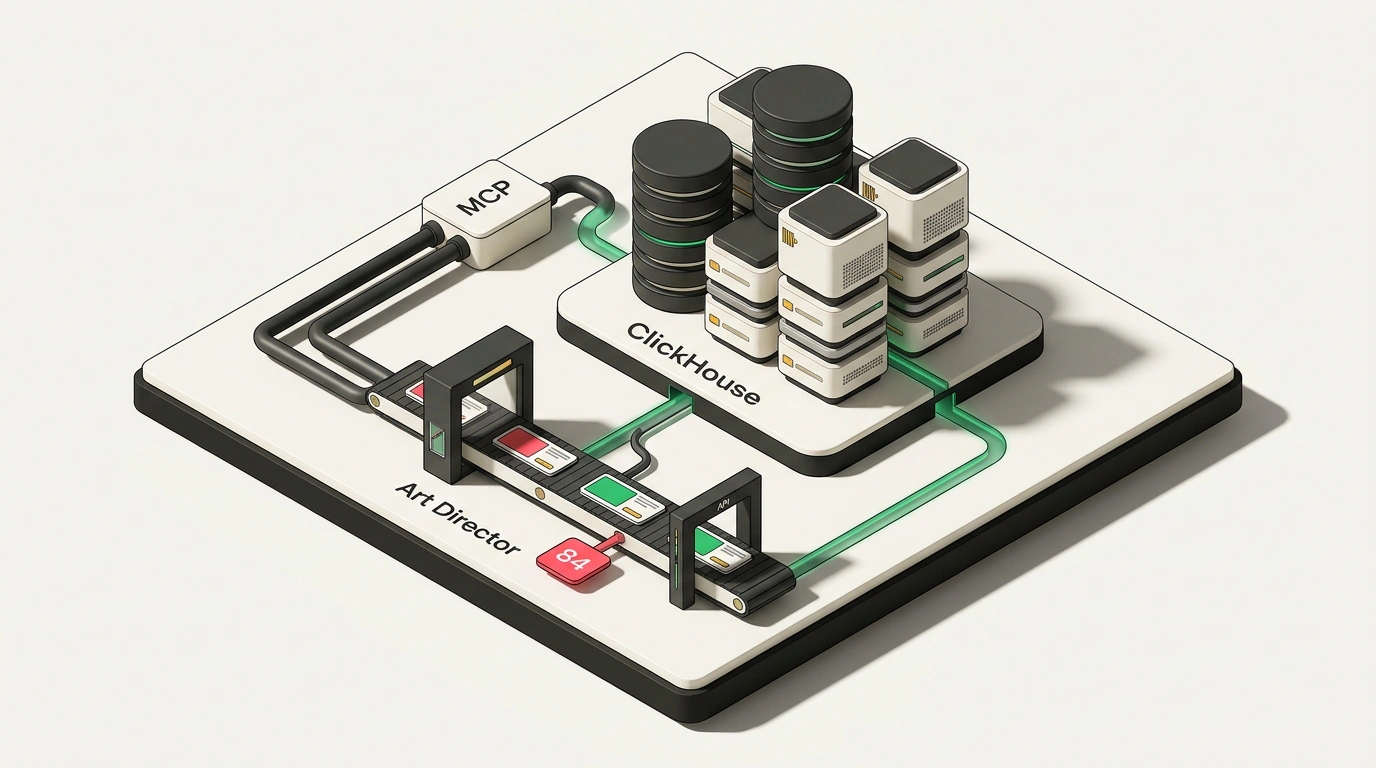
To eliminate this blind spot, a unified data warehouse built on ClickHouse or PostgreSQL in the Railway cloud is placed between the business and the model. The open-source Airbyte connector quietly pulls clicks from ad accounts, website analytics from Google Analytics, deals from HubSpot, and actual payments from Stripe. The agent connects to the database via the Model Context Protocol (MCP) such as Graphed MCP and freely runs SQL queries without any risk of corrupting tables.
This separation solves two engineering problems at once:
- Unlimited, undistorted reads. The agent can query the warehouse as often as it likes, tying every ad impression to actual cash register revenue and customer lifetime value (LTV)—the total amount a buyer brings in over the course of their subscription.
- One-way channel into ads. Tokens for the Facebook Marketing API and Google Ads API are strictly write-only: the script never reads reports from there, only uploading finished ads or turning off unprofitable campaigns.
Add external API tools—the OpenRouter model gateway, FAL audio transcription, and contact databases like Apollo or Git Leads—and routine audits speed up hundreds of times. For example, Schneider's search agent checks 5,000 keywords in 20 seconds, matching a phrase's buying intent against the landing page copy before a single cent is spent on a click. We covered how to assemble such multi-layered environments in detail in our overview of agentic operating system architecture.
Creative Assembly Pipeline and the Creative Director Agent Filter
Once the agent sees an honest link between the offer and revenue in the warehouse, the bottleneck shifts to producing the ads themselves. Manual production of banners and videos by designers, copywriters, and actors takes weeks, whereas a fresh creative burns out in the feed in 3–5 days.
In an autonomous pipeline, the media factory moves onto programmatic rails. From a website URL, the agent reads brand fonts and color palettes, studies real audience pain points on Reddit, and checks a swipe warehouse—a collection of proven ad examples that keeps the model from sliding into bland templates. Banners are generated via graphic services like Kai AI, while short user-generated videos (UGC) with a synthetic presenter follow a step-by-step assembly: a photo of a real-looking persona is used as the base (to avoid the "plastic skin" effect), speech is synthesized, and it is aligned to text timestamps. If the voice mispronounces a brand name—saying "Calendla" instead of "Calendly"—a script patches the slip-up, and Mirage Tesseract overlays subtitles and motion graphics. A finished video costs around $5 compared to $150–$500 when commissioned from human creators, and the whole batch is assembled in under 15 minutes; when live shots holding a physical product are needed, the agent itself assigns briefs to creators via the Tribe and Sideshift marketplace APIs at around $40 per video.
Store the generation JSON parameters for every video and banner in the warehouse alongside the ad ID: this lets the agent quickly pinpoint which exact hook or angle brought in the highest-value customers.
You might fairly ask: "AI models constantly produce garbled tiny text and weird slogans—does that really go straight into ad rotation?" Without a censor, that is exactly how budgets burn. That is why an independent Creative Director Agent is placed in front of the ad account. This multimodal auditor is loaded with brand guidelines, legal stop-words, and classic advertising principles like David Ogilvy's books. It evaluates contrast, font legibility, and defects frame by frame: only creatives scoring above a set threshold—say, 85 out of 100—make it to publication.
Take a real-world task for a B2B SaaS end-to-end analytics team that needs to test new angles without waiting two weeks for contractors. At the start, the product has a payment database and a goal to lower subscriber acquisition cost.
The agent queries ClickHouse and finds that customers searching for "report automation" bring the highest long-term revenue. Targeting that pain point, the pipeline produces 10 ad variations: 5 static banners and 5 short videos. Next, the Creative Director Agent steps in: it rejects 4 creatives for tiny text that is unreadable on a smartphone screen, and filters out 4 more due to weak contrast on the call-to-action button. Only 2 finalists survive—the script uploads them via API into a test campaign capped at $50 per ad.
After 24 hours (the test window typically runs up to 48 hours), the agent reconciles ad spend against actual signups in ClickHouse, ignoring inflated social network reports. The variation with a direct side-by-side comparison of two interfaces drops the cost per qualified lead by 34%, while the second lags behind. The script immediately turns off the weak combination and shifts the budget to the winner: in one day and with $100 in test spend, the team found a working offer without paying the ad network for eight failed drafts.
Programmatic Budget Brakes and Where Autopilot Breaks Down
When a winning creative cuts lead cost by more than a third in a single day, it is tempting to hand the algorithm an unlimited corporate card—and that is where the biggest risks begin. In marketing engineering, models are trusted only with creative judgment, while hard-coded software controls the money.
The test ceiling per ad combination is locked within $100. The system always keeps an armed kill switch that pauses delivery if the cost per action (CPA) crosses a critical threshold, and the agent itself is allowed to raise daily budgets by a maximum of 20% per day. This circuit breaker works much like the two-loop control architecture with drafts, isolating the neural network from directly spending large sums and protecting against automating losses as analyzed in the article on calculating AI ROI in marketing.
Beyond financial guardrails, algorithmic ad buying still has three vulnerabilities:
- Platform anti-fraud bans. Bulk-uploading hundreds of ads via API triggers Meta and TikTok defense mechanisms, risking an ad account freeze.
- Hallucinated features and fake slang. If the knowledge base lags behind a recent release, the generator can easily promise a nonexistent feature or spit out awkward colloquialisms.
- Viewer fatigue from synthetic media. Audiences develop banner blindness faster to template AI avatars, requiring regular rotation of visual styles and live shoots.
You don't have to spin up cloud databases and issue API keys today—test the "Creative Director Agent" link manually right now. Take a couple of your current ad banners or a screenshot of your website's hero section, write down a short list of stop criteria—is the headline readable on a phone at arm's length, does the CTA button have enough contrast, are there any empty promises—and ask a multimodal model to run a strict review that only lets a flawless version through. In just a few minutes with zero budget risk, you will spot hidden flaws in your offers and get a ready-made quality filter for your future pipeline.