At the Ling 3.2 Flash launch, engineers from Chinese giant Ant Group—part of the Alibaba ecosystem—ran a live test. They wired the neural network directly into the Blender 3D editor interface: the algorithm rendered a scene from multiple angles, spotted geometry flaws on its own, rewrote the script, and verified the frame without human hints.
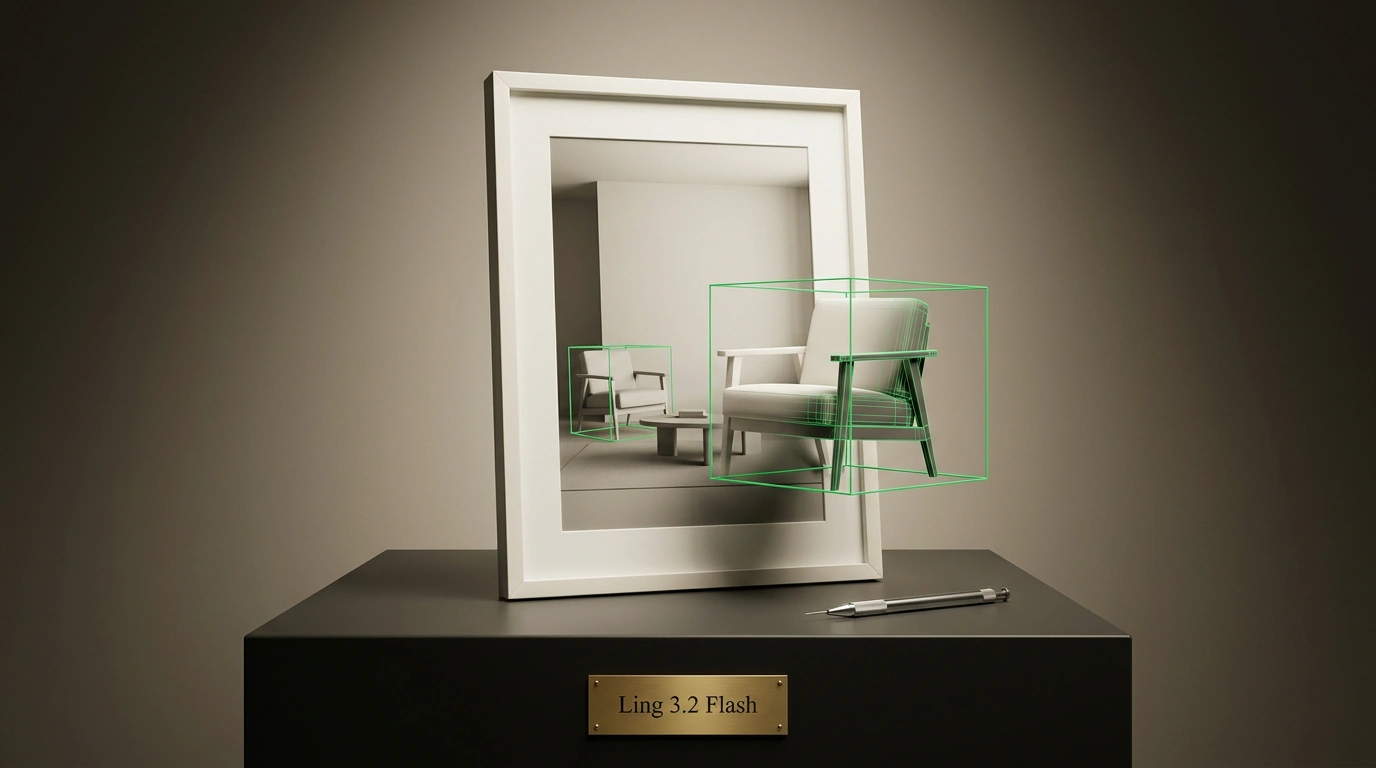
You might ask: "Neat trick for 3D artists, but what does that have to do with web development?" The link is direct. Ordinary multimodal networks see a photo as a flat collage of patches, so trying to build a 3D storefront from a room photo yields a soup of warped proportions. Spatial perception changes how websites are built: by reading depth and physical object placement behind pixels, the network turns live photos straight into a working 3D interface.
How a Unified Modality Space and Sparse Architecture Read Volume
Going from a flat picture to accurate code became possible because the creators of the BaiLing family removed external visual adapter-translators that lose perspective on the way to the text core. Text, code, photos, video, and spatial coordinates live in a shared latent space from the start: the encoder estimates frame depth, distances between objects, and the risk of physical collisions.
A Mixture-of-Experts architecture helps preserve geometric intuition alongside layout knowledge. Out of a total pool of 560 billion parameters, the router wakes up only 25 billion active weights per step—like a large engineering firm where a compact crew of specialists works on your specific assembly. That explains both the speed of a lightweight network and the Flash name. I recently covered that same foundation in Ling 3.1 Flash on AutomationBench, and now it gains a 1 million-token window for hour-long videos and hundreds of schematics.
In practice, this setup removes an old headache for online furniture stores. Suppose from a photo of a living room—a sofa against the wall, a coffee table in front of it, and a floor lamp in the corner—you need to build an interactive 3D catalog so a shopper can spin the room with a mouse and check real dimensions.
A standard 2D network sees a flat collage: the tabletop overlaps a cushion, so in the web scene the table fuses into the sofa and wood grain smears in the shadows. Ling 3.2 Flash computes spatial coordinates for each object, separates the foreground from room depth, and translates proportions and upholstery textures into code. Next, Observe-Act-Verify loop tokens kick in, just like in the Blender test: after assembling the storefront, the network inspects the render, notices the lamp leg clipping through the floor, and fixes the layout itself.
Instead of a rough draft needing rework, the store gets a ready-made interactive catalog with real furniture dimensions straight from an interior photo. Days of modeling shrink into fast 3D card assembly from a camera shot.
Design Arena Layout Tests, Blueprint Audits, and the Entry Barrier
That sense of volume showed up in the November 5 release benchmarks. In Ant Group's own tests, the newcomer beat Claude Opus 5 on document understanding, visual reasoning, and image-to-web-UI translation. I view corporate self-reports with a skeptical eye—just like claims of outperforming Gemini Pro-class models on Chinese navigation tests, those numbers await independent international verification.
In frontend work, however, an external referee already exists: on Design Arena, the model took 10th place for building responsive animated websites from a screenshot alongside flagships from Meta, Anthropic, and DeepSeek. On engineering blueprints, combining 3D vision with long context works too—comparing a factory walkthrough video against a BIM model and CAD drawings, the network catches a 15-centimeter air-duct offset and cable-clash risk, while from a quarterly financial summary its agents assemble a report, slide deck, and video brief in one go.
At launch, Ling-3.2-flash opened for free for two weeks, yet production faces a steep infrastructure barrier. Self-hosting requires keeping the entire half-trillion parameter array on a cluster of NVIDIA A100 or H100 GPUs, while Ant Group's cloud targets the Chinese enterprise market with corporate verification, latency, and layout privacy concerns. While some labs synthesize physics from scratch—like interactive 3D worlds in Google Genie 4—Chinese engineers are digitizing reality.
Over the next year or two, this will reshape frontend work: instead of manually moving products into flat browser grids, storefronts will be assembled through a smartphone camera. Once spatial networks grow lighter and step outside closed clusters, a 3D product card from a showroom video will become as routine as coding a landing page from a sketch, and web-developer tools will converge with the "eyes" of warehouse robots on a shared understanding of physical space.