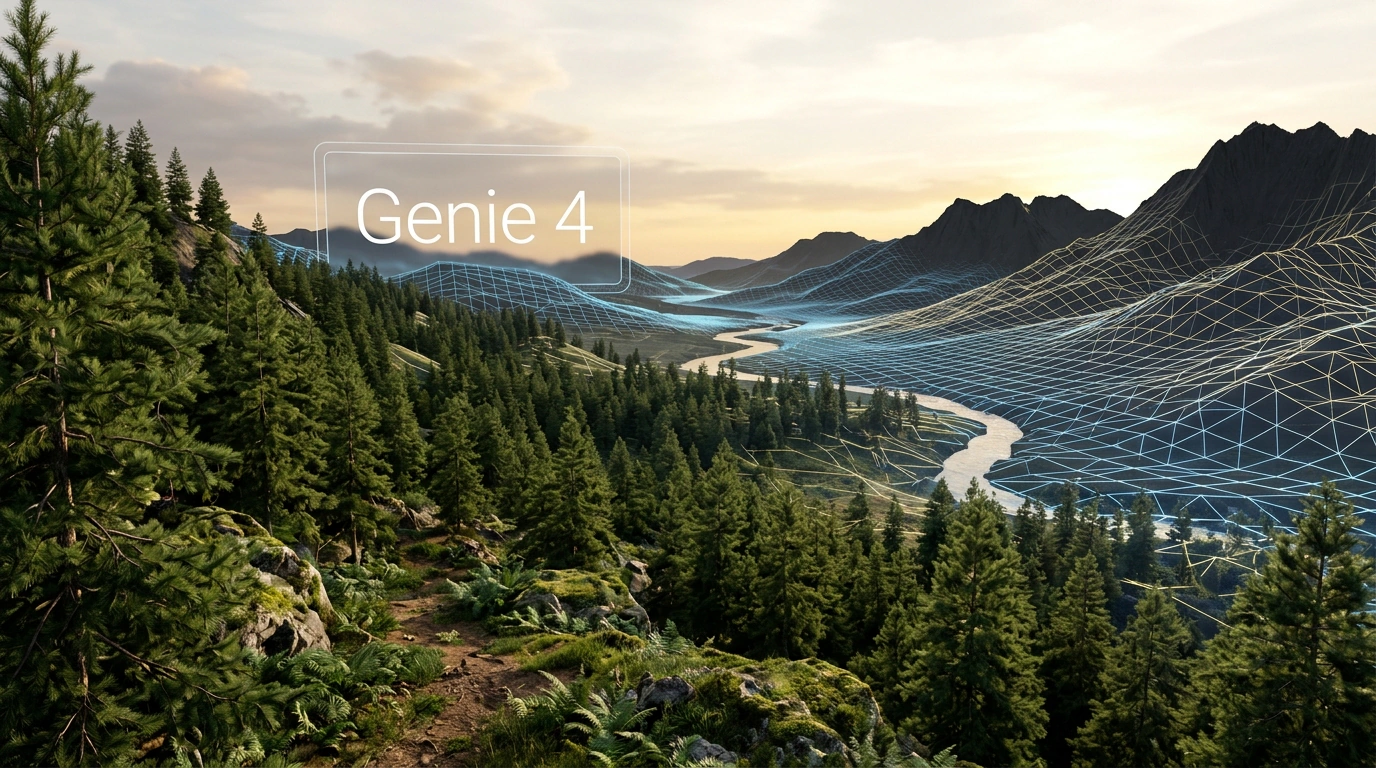
Generative neural networks of recent years have trained us for flat media consumption. First we marveled at Midjourney images, then we learned to edit short diffusion clips in Runway and Sora. Yet for all their visual beauty, those videos remained "canned goods": you hit Play, passively watch a five-second scene, and have no way to peek around the corner of a house, touch an object, or stray from the director's predetermined trajectory.
On October 27, 2026, the Google DeepMind research lab crossed that barrier by unveiling the Genie 4 world model. It is a fundamental qualitative leap: instead of generating pixels, the algorithm creates a full-fledged interactive 3D space in real time. You enter a couple of sentences of text—and five seconds later you find yourself inside a live 3D simulation where the wind blows, waves lap, and collision physics actually work.
From flat images to living physical environments
What is the fundamental difference between classical diffusion and a World Model? An ordinary neural network only predicts the color of the next pixel based on statistical patterns from its training set. It doesn't understand that an apple will fall down due to gravity, or that a wooden wardrobe is still standing behind the character's back.
A world model builds an internal spatiotemporal representation of reality. When you write the prompt "a pine forest at dawn by a mountain lake with an old wooden pier," Genie 4 doesn't just render a pretty postcard. It generates spatial topology, computes a terrain elevation map, places physical tree colliders, and in 3–5 seconds launches continuous interactive rendering at a steady 30 frames per second in 1080p resolution.
Latent Action Model architecture and occlusion maps
The most astonishing engineering detail of Genie 4 is how the model learned to understand controls. The developers didn't label movements manually or write controller scripts.
Training relied on millions of hours of gameplay and real-world recordings without teacher hints (Unsupervised Action Discovery):
- Spatiotemporal Latent Action Model: the transformer extracted movement invariants in space on its own. It learned vector coordinates for commands like "step forward," "turn camera," and "jump," linking them to patterns of perspective shift.
- Geometry preservation via Occlusion Maps: the curse of early neural simulations was forgetting objects. The moment you looked away from a building and turned back, the house turned into a tree or vanished. Genie 4 uses a differentiable depth-prediction block, keeping geometry consistency above 94.6% when returning to a previously visited point in the world.
Spatial audio and dynamic world mutation
Immersion in a virtual environment is impossible without realistic acoustics. In Genie 4, video and audio tracks are generated from a single latent vector of multimodal diffusion:
- The system synthesizes true 6-channel spatial audio (Ambisonics / Dolby Atmos).
- When you walk along a wooden pier, the sound of footsteps is perfectly synchronized with physical contact between sole and planks, while the lapping of waves shifts in volume and phase depending on the virtual observer's head position.
The second unique capability is dynamic environment mutation right during a session. While inside the world, you can type a directive into the command line like "make it snow and add howling wind." The model doesn't restart the simulation from scratch: it seamlessly transforms latent parameters, snow begins settling on tree branches, lighting temperature shifts to cool tones, and the audio engine mixes in blizzard noise.
Comparison with game engines and the compute price tag
Does Genie 4 mean the imminent death of traditional game engines like Unreal Engine 5 or Unity? Of course not, and it's important to understand the boundaries of applicability here.
In Unreal Engine, developing a virtual world takes months of work by an entire studio: 3D modelers polish meshes by hand, animators rig character skeletons, and programmers write quest logic. In return, that world is completely deterministic: every polygon and physical law is strictly controlled by the creator.
Genie 4 comes from the opposite direction: it gives you fantastic speed for getting a first prototype in seconds. But the price for that is having no direct access to a polygon mesh and gigantic hardware demands. Running the model in real time at 30 FPS requires powerful cloud Google TPU v5p tensor processors; on consumer GPUs, such inference is not yet possible.
Furthermore, strict story scripting is still hard to implement in a world model: if you need a door to open with one specific key, a neural simulation may behave variably and draw a lock of a different shape. Therefore, the near future of the technology isn't a full replacement of engines, but a symbiosis: generating initial game levels, procedurally populating background locations, and instant prototyping of virtual scenes for film and metaverses.
Nevertheless, the industry's direction is obvious: in the coming years, interactive worlds will become the new standard for generative media, opening the door to personalized gaming spaces created right as the story unfolds.
