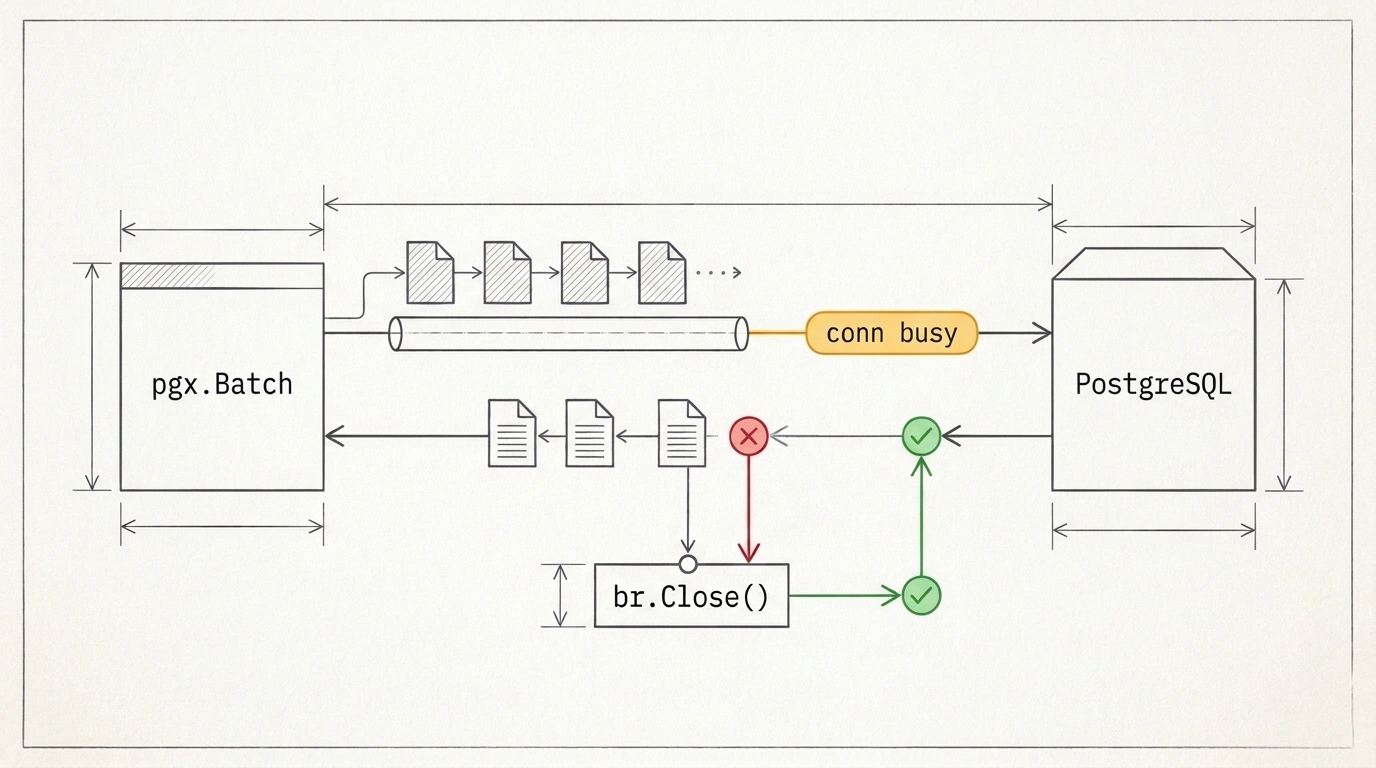
When a Go backend runs a chain of similar SQL operations, the first instinctive urge is to bundle them into a batch and send them in a single network round-trip. The pgx driver by Jack Christensen provides an excellent tool for this—the pgx.Batch struct. Instead of sequential network calls, queries fly to PostgreSQL in a pack, saving precious milliseconds of network latency.
But if you're migrating to pgx from the standard database/sql package, an unpleasant surprise awaits: a connection from the pool suddenly gets stuck in the conn busy state, and puzzling errors about prepared statement deallocation start popping up in the logs. We've already looked at connection pool queue behavior in Go, but in pgx, batch queries have their own strict specifics.
Let's examine how a batch lifecycle works under the hood and why a standard defer br.Close() call hides a subtle trap here.
The Busy Connection Trap: Why defer br.Close() Isn't So Simple
After calling pool.SendBatch(ctx, batch), the driver grabs a physical TCP connection and puts it into an exclusive busy state. The BatchResults interface begins receiving results sequentially. And here lies the key detail: even if you've read the data you need from the first SELECT via br.QueryRow().Scan(...), the connection cannot be used for any other operations until br.Close() is called.
In Go, it's idiomatic to release resources with a deferred defer resource.Close(). However, BatchResults.Close() has a fundamental difference: it returns an error.
// Doing this is dangerous: socket drain errors will be lost
br := pool.SendBatch(ctx, batch)
defer br.Close()
The Close() method doesn't just close a network descriptor. It sequentially drains all remaining response bytes from the PostgreSQL server out of the socket buffer for every query in the batch. If the third query out of five failed with a foreign key violation or a syntax error, Close() is the method that reads that message from the database and surfaces the error.
If you write a plain defer br.Close(), your function will assume the operation succeeded, even though a failure occurred in the database and the batch's implicit transaction rolled back.
Idiomatic Pattern: Named Return and Safe Draining
To avoid losing the completion error and guarantee the connection returns to pgxpool.Pool, Go uses an idiomatic pattern with a named error return value:
package repository

import (
    "context"
    "fmt"

    "github.com/jackc/pgx/v5"
    "github.com/jackc/pgx/v5/pgxpool"
)

type AccountCredit struct {
    AccountID int64
    Amount    int64
}

func ProcessCreditsBatch(ctx context.Context, pool *pgxpool.Pool, items []AccountCredit) (err error) {
    batch := &pgx.Batch{}
    for _, item := range items {
        batch.Queue(
            "UPDATE accounts SET balance = balance + $1, updated_at = NOW() WHERE id = $2",
            item.Amount,
            item.AccountID,
        )
    }

    br := pool.SendBatch(ctx, batch)

    // Capture the batch close error via the named err variable
    defer func() {
        if closeErr := br.Close(); closeErr != nil && err == nil {
            err = fmt.Errorf("pgx batch close error: %w", closeErr)
        }
    }()

    for i := 0; i < len(items); i++ {
        cmdTag, execErr := br.Exec()
        if execErr != nil {
            return fmt.Errorf("query %d failed in batch: %w", i, execErr)
        }
        if cmdTag.RowsAffected() == 0 {
            return fmt.Errorf("account %d not found", items[i].AccountID)
        }
    }

    return nil
}
This pattern gives you a double guarantee. First, the connection is guaranteed to return to the pool even in the event of a panic or early return. Second, if the database fails during socket finalization, the error won't vanish into thin air—it will properly bubble up to the business logic layer.