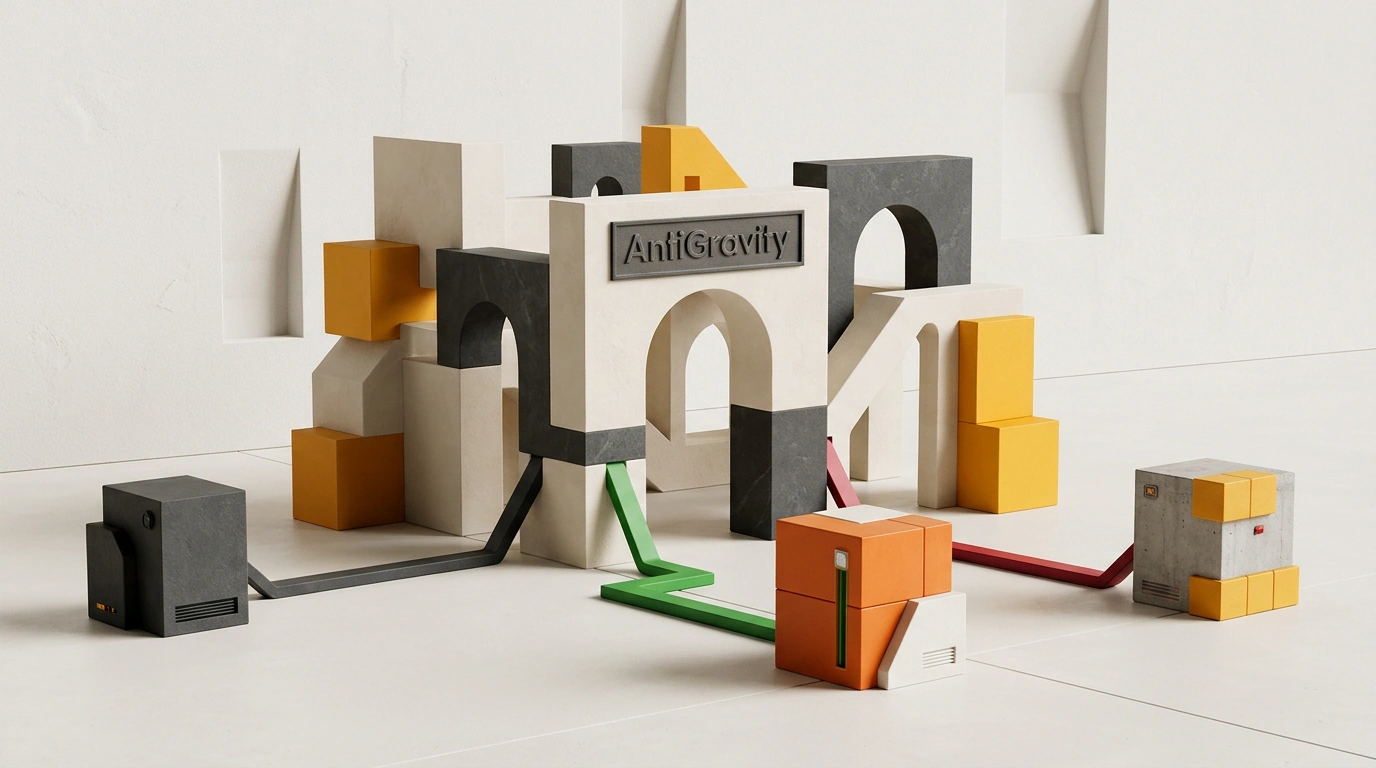
In the world of software development, the era of lone-wolf engineers is long gone: a serious product is always built by a team where everyone has a specialization. The architect designs inter-service connections, the frontend engineer builds UI components, the backend engineer configures databases, and the technical writer proofreads documentation. Yet when we turn to AI assistants, most developers stubbornly try to cram all heterogeneous tasks into a single chat window of one solitary model.
Every neural network today has its own distinct profile and strengths. Claude excels at holding the complex architectural logic of large files and spotting subtle regression bugs; Gemini, with its gigantic 2-million-token context, easily digests entire libraries of manuals and specs; Codex or DeepSeek Flash write component boilerplate at lightning speed; and a local model protects sensitive keys and corporate secrets. AntiGravity AgentOS 2.0 unifies this scattered zoo into a single command dispatcher where models collaborate on a shared codebase like a real distributed engineering team.
From a single model to a coordinated engineering team
The main innovation of AntiGravity 2.0 is a decisive move away from linear chat toward an operating environment with tabbed project organization (Tabbed Agentic Workspace).
Every service being built (whether a client portal, a FastAPI microservice, or an interactive analytics dashboard) lives in an isolated tab with its own file tree, list of running terminals, and revision log. You can run three projects in parallel, and the agents inside them won't mix up environment variables or overwrite a neighbor's work. Close a tab or the browser, and at any moment you can return to a frozen state: dialogue contexts, created artifacts, and running local processes wait for you at the exact point where you left off.
Multi-model specialization: Claude, Gemini, and Codex in one lineup
Instead of trying to craft one overloaded prompt, AntiGravity uses dynamic responsibility routing:
- Claude 3.5 Sonnet / Opus: acts as Chief Architect and strict reviewer. It takes a high-level task from a human, writes component architectural specs, formulates API contracts, and validates pull requests before merging.
- OpenAI Codex / GPT-4o Code: takes on the role of Component Builder for routine tasks. It receives isolated layout files, unit test writing, and routine event handler wiring based on handed-down specifications.
- Google Gemini 2.0 Pro: works as a Context Scout. When you need to check compatibility with a fresh third-party library update or pull examples from a massive SDK, Gemini instantly scans hundreds of pages of documentation thanks to its huge attention window.
- Local open models: pick up work with local databases and configs without going out to the external network.
Isolated worktree architecture and Context Fabric
The biggest fear when multiple agents work on one repository simultaneously is a race condition. If two bots start editing App.tsx or a database migration schema at the same time, the codebase instantly turns into a mess of unresolvable conflicts.
AntiGravity solves this through Git Worktree Isolation. Every subagent physically works in its own branch and isolated filesystem directory. It writes code, runs local tests, and only when checks pass does the AntiGravity master dispatcher perform an automatic merge.
The connecting link is the Context Fabric bus: agents exchange not raw walls of text, but standardized references to generated artifacts (OpenAPI schemas, TypeScript interfaces, test dumps). In practical benchmarks, this approach reduces merge conflicts to less than 3%, while the time to build a complex service (Python backend + React frontend) drops from 12 hours to a record 45 minutes.
Project configuration and practical orchestration
Project management in AntiGravity is described by a declarative antigravity.workspace.json manifest where access permissions are clearly separated:
{
  "$schema": "https://antigravity.dev/schemas/workspace-v2.json",
  "workspaceName": "EnterpriseClientPortal",
  "orchestrator": {
    "engine": "antigravity-core",
    "strategy": "consensus-review"
  },
  "agents": [
    {
      "id": "arch-claude",
      "model": "anthropic/claude-3-5-sonnet",
      "role": "Architect & Reviewer",
      "permissions": ["read_all", "write_specs", "approve_merge"]
    },
    {
      "id": "coder-codex",
      "model": "openai/gpt-4o-code",
      "role": "Component Builder",
      "worktree": "./worktrees/frontend",
      "permissions": ["write_code", "run_tests"]
    },
    {
      "id": "scout-gemini",
      "model": "google/gemini-2.0-pro",
      "role": "Docs & Context Scout",
      "permissions": ["search_web", "write_docs"]
    }
  ],
  "pipelines": {
    "build_feature": [
      {"step": "spec", "agent": "arch-claude"},
      {"step": "implement", "agent": "coder-codex"},
      {"step": "document", "agent": "docs-gemini"},
      {"step": "verify", "agent": "arch-claude"}
    ]
  }
}
Launching a feature-development pipeline is done via the AntiGravity CLI with one command:
antigravity workspace run --pipeline build_feature --spec "Add OAuth2 authentication and user profile"
Of course, the convenience of teamwork comes at a price: calling three commercial models simultaneously increases token consumption. Therefore, it is critical to set strict budget limits in the manifest for each step. But if you need to ship a complex project quickly without tedious routine, the AntiGravity multi-model orchestrator delivers a qualitatively different level of speed and reliability.
