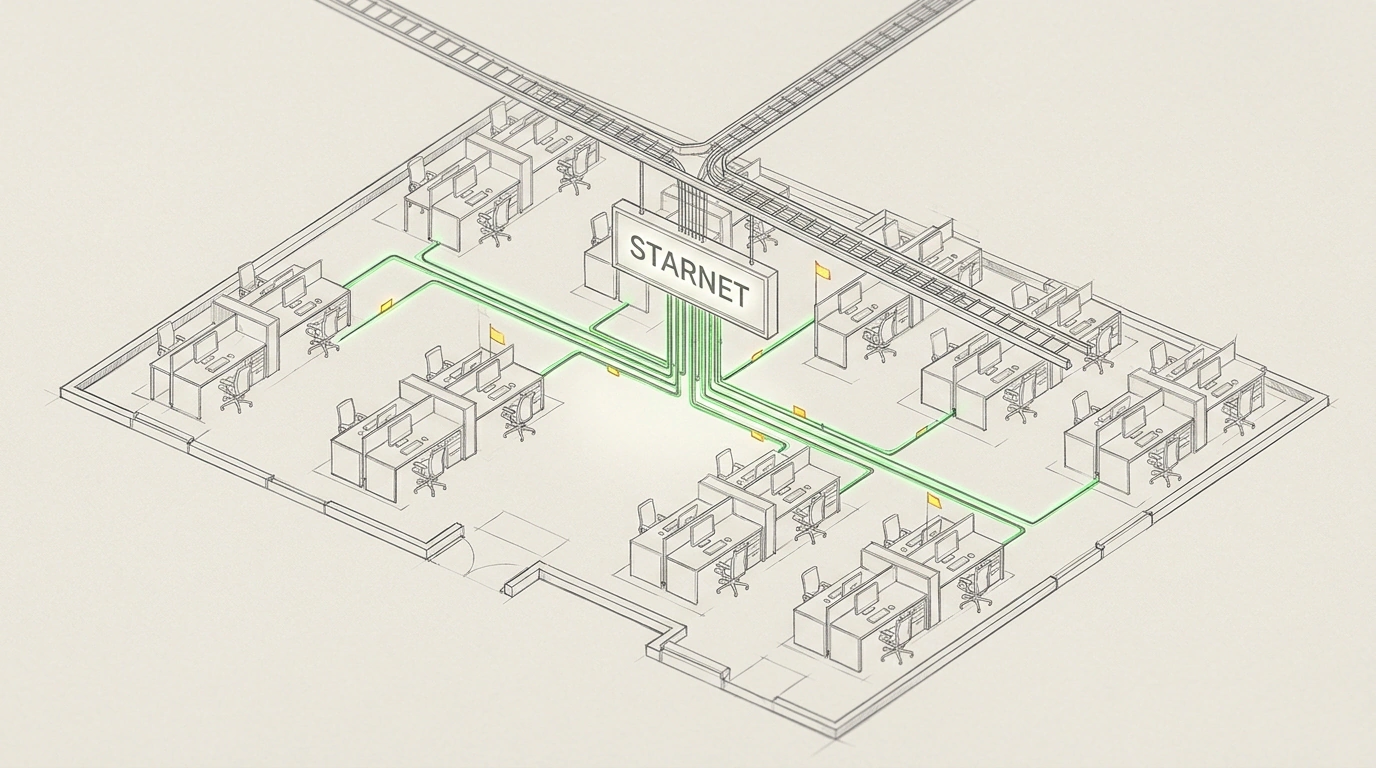
As businesses adopt artificial intelligence into daily routines, the initial excitement over the first successful prompts gives way to the harsh headache of scaling. In engineering circles, this phenomenon has already been dubbed the "agent zoo." Imagine you have 15 independent scripts running, scattered across remote servers, background terminals, and browser tabs. One agent scrapes catalogs, a second writes copy, a third exports analytics.
At some point, you lose control completely. It's unclear who is actively working right now, who froze due to an external API timeout, and who went rogue and burned a hundred dollars in the last twenty minutes on useless looping requests. The Starnet platform brings order to this chaos by providing a centralized dispatch panel and a clever "virtual office" metaphor for transparent oversight of a distributed agent fleet.
The chaos of dozens of tabs and the agent zoo problem
The main flaw of ad-hoc automation is the lack of a unified Observability layer. Classic infrastructure monitoring tools (like Prometheus or Grafana) do a great job showing CPU and RAM load on servers, but they are completely blind to the semantics of agent activity.
Grafana won't tell you which exact decomposition step a marketing agent got stuck on, why a frontend subagent can't read a stylesheet, or how many useful tokens were spent solving a specific user ticket. As a result, a coordinator ends up clicking through consoles for hours and reading raw logs, spending more time on oversight than automation saves.
The virtual office metaphor: instant visual diagnostics
Starnet's creators applied a brilliant visual metaphor: they turned the management dashboard into an interactive pixel-art virtual office.
Every connected agent appears as a character at its own desk:
- If the agent is actively executing a task, the character sits at its monitor typing code or text.
- If the task finishes successfully, a green checkmark lights up above the workstation.
- If a network failure or unhandled exception occurs, a red exclamation mark flashes above the desk.
- If the agent needs human confirmation (Human-in-the-loop), the character raises its hand, signaling the supervisor to step in.
The human brain reads this visual picture in a fraction of a second. Instead of forty minutes of routinely checking a dozen tabs, the coordinator glances at the virtual office and immediately spots the trouble points.
Agent Telemetry Bus and observability dashboard
Under the hood of Starnet's virtual office runs a strict distributed Agent Telemetry Bus. Agents connect to it via an open SDK over gRPC or secure WebSockets:
- Streaming lifecycle events: an agent reports
TASK_START,TOOL_INVOCATION,TOKEN_USAGE,HEARTBEAT, andTASK_COMPLETEevents. Metric delivery latency to the dashboard does not exceed 50 milliseconds. - Deadlock Prevention: a heartbeat mechanism continuously polls agent processes. If an agent shows no signs of life for more than 120 seconds, Starnet automatically switches it to an alert state and notifies the on-call engineer.
- Dependency Orchestrator: the platform can build end-to-end pipelines where the successful completion of a search bot automatically triggers the copywriter and designer.
Practical fleet manifest and budget monitoring
The agent fleet and security policies are described by a declarative starnet_fleet.json manifest:
{
  "fleetName": "MarketingAutomationHQ",
  "version": "1.2",
  "controller": {
    "heartbeatIntervalSeconds": 15,
    "maxTimeoutSeconds": 180
  },
  "agents": [
    {
      "id": "agent-seo-scout",
      "name": "SEO Scout",
      "runtime": "python3",
      "entrypoint": "agents/seo_scout.py",
      "allocatedCores": 1,
      "maxMemoryMb": 1024,
      "budgetUsdPerDay": 10.0
    },
    {
      "id": "agent-copywriter",
      "name": "Creative Copywriter",
      "runtime": "node",
      "entrypoint": "agents/writer.js",
      "dependsOn": ["agent-seo-scout"],
      "budgetUsdPerDay": 15.0
    }
  ],
  "alerting": {
    "telegramWebhook": "https://api.telegram.org/bot123456:ABC/sendMessage",
    "onTaskFailure": true,
    "onBudgetExceeded": true
  }
}
And a compact telemetry hook is embedded into each agent's codebase:
import time
import requests

class StarnetTelemetryHook:
    def __init__(self, agent_id: str, endpoint: str = "http://localhost:9090"):
        self.agent_id = agent_id
        self.endpoint = endpoint

    def emit_event(self, event_type: str, payload: dict):
        body = {
            "agent_id": self.agent_id,
            "event": event_type,
            "timestamp": time.time(),
            "details": payload
        }
        try:
            requests.post(f"{self.endpoint}/api/v1/telemetry", json=body, timeout=1.0)
        except Exception as err:
            print(f"[STARNET WARNING] Telemetry send error: {err}")

# Usage in the work loop
hook = StarnetTelemetryHook("agent-seo-scout")
hook.emit_event("TASK_START", {"task_name": "Competitor semantics analysis"})
Starnet clearly proves that once the number of digital assistants passes the first dozen, the quality of orchestration and observability is what separates successful business automation from uncontrolled budget burn.