If you've ever tried running a local language model on a home workstation or an ordinary office laptop, you've probably hit the iron wall of video memory. Over the past few years, the industry has trained us to follow a brute-force, extensive rule: if you want a neural network to understand complex tables better, parse accounting reports, or reliably trigger API handles, get ready to download models with 27, 32, or 70 billion parameters. And that immediately means buying top-tier cards like an RTX 4090, wrestling with quantization, or paying endless bills for cloud clusters.
But on October 30, 2026, the SenseNova research division of Chinese company SenseTime showed that scaling laws can be hacked from a completely different angle. They released SenseNova Loop 9B Preview as open source under the permissive Apache 2.0 license. Physically, it has only 9 billion parameters, yet on practical business benchmarks it confidently outperforms open transformers with 27 billion weights, including established hits like Gemma 2 27B and Qwen 2.5 14B. Let's break down how this recursive magic works and where the engineering trade-offs are hidden.
Why giant weights hit a dead end
In a classic transformer, every layer of the neural network is unique. Imagine a long assembly line of 32 or 48 independent workshops: a token enters the first workshop, passes through it, moves to the second, the third—and so on in a straight line all the way to the exit. No worker in this factory ever sees the part twice. To make such a system "smarter," engineers traditionally just built more workshops, increasing the length of the factory and the number of hired workers.
As a result, we ended up with monsters that physically don't fit into memory. Even in half-precision BF16 format, a 27-billion-parameter model requires more than 55 GB of pure VRAM. Quantization helps, but under heavy compression down to 4 bits, subtle logical connections start to drift in many networks.
The SenseTime team asked a simple yet bold question: what if, instead of endlessly expanding the workshops, we make the most experienced group of workers inspect a complex part twice? That exact idea underpins the concept of recurrent depth, or a Looped Decoder.
Looped Decoder: how to make 9 billion parameters think twice
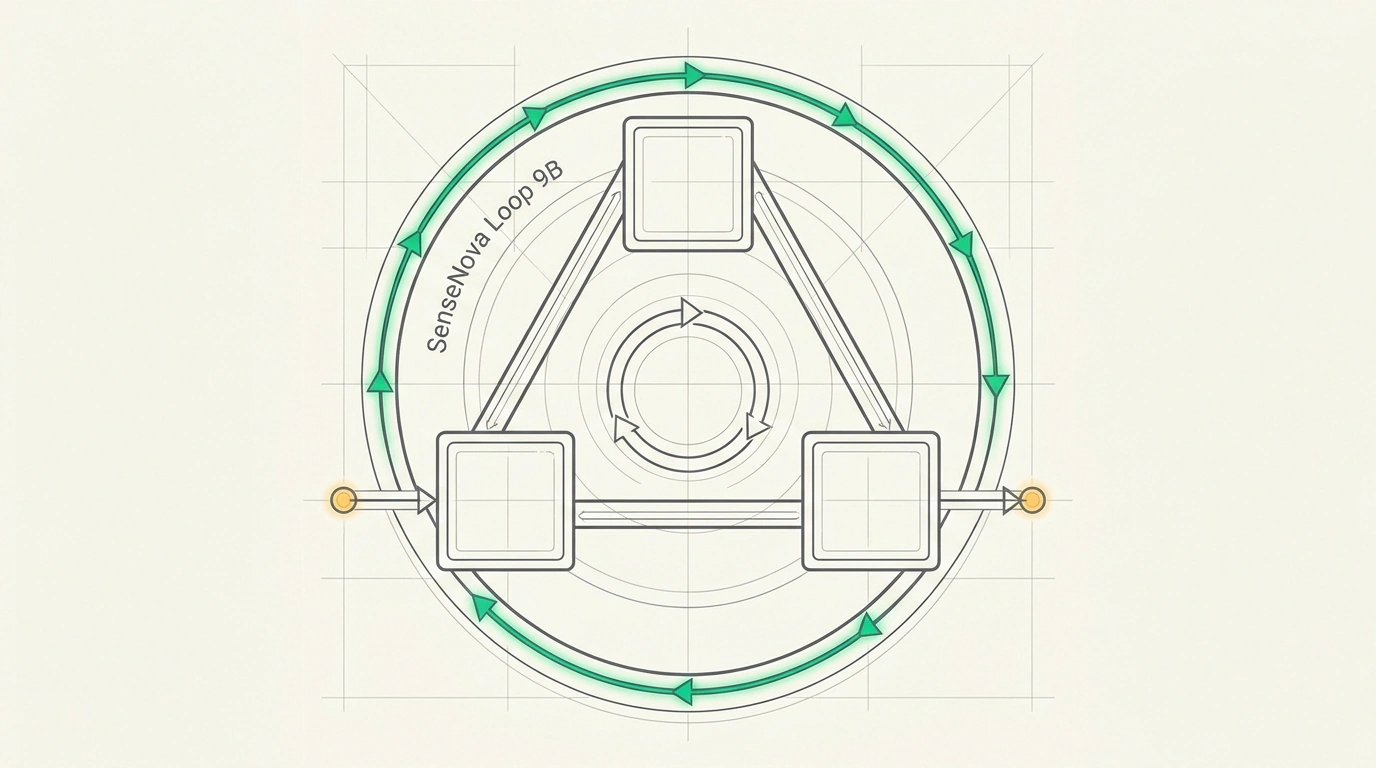
Under the hood of SenseNova Loop 9B Preview, there are physically exactly 32 layers. However, they operate completely differently from a typical Llama or Mistral:
- Input block (layers 0–3): these first four layers work linearly. They take the embeddings of incoming tokens, project them into multidimensional space, and form an initial representation of the task.
- Recurrent block (layers 4–27): this is the main technological heart. This 24-layer block executes twice in a row using the exact same weights (weight sharing across loop iterations). That is, the token's hidden states pass through layers 4 to 27, and then the result returns to the input of layer 4 and runs the same path a second time.
- Output block (layers 28–31): the final four layers and the projection head take the enriched context and decode the final probability of the next token.
Let's count the effective depth of a forward pass. We have 4 initial layers + 24 layers of the first loop + 24 layers of the second loop + 4 final layers. That's 56 computational layers per token!
You're probably wondering right now: if the same weights are run twice, why don't the hidden states explode and turn into endless noise? In early research attempts to loop transformers, that is exactly what happened—gradients degraded and the context fell apart. To overcome this effect, the developers used a dual-stream mechanism called mHC (Manifold-Constrained Hyper-Connections). These are two parallel residual stream buses with mathematical manifold constraints that keep vector representations within a stable corridor and smoothly pass the accumulated context between the first and second passes.
In addition, every four layers in the model alternate: linear attention is followed by full quadratic attention. Thanks to this hybrid mechanism, SenseNova Loop can maintain a context window of up to 262,144 tokens without requiring terabytes of graphics memory for the KV cache.
Business benchmarks: when smaller means faster and more accurate
The best part about this release is that the creators didn't compete in abstract synthetic quizzes, but published measurements on real-world applied scenarios:
- Financial analysis and working with tables (Financial QA & Tabular Reasoning): the model beat Gemma-2-27B by 4.2% and Qwen-2.5-14B by 6.8%. It confuses rows in complex estimates far less often and doesn't lose numbers in balance sheets.
- External tool calling (Tool Calling): when solving multi-step agentic tasks, first-attempt API call accuracy reached 78.4%, compared to 71.2% for standard open 9-billion-parameter models.
- Memory appetite: in BF16 format, the entire model takes up only about 19 GB of VRAM. And if you apply 4-bit AWQ quantization or the GGUF format, the weights shrink to a laughable 6.5 GB! This means a full-fledged working model with 27B-level reasoning easily fits into the memory of a single consumer GPU or a laptop with 16 GB of RAM.
Practical deployment and inference pitfalls
Since the model is released under the Apache 2.0 license, you can embed it into commercial products and run it on your own servers without legal risks. However, it's important to understand the cost of the trade-off here.
There are no free lunches: physically there are 9 billion weights, but the number of arithmetic operations performed on each token is the same as in a 16-billion-parameter model. Because of the repeated pass through the middle layers, generation latency is roughly 1.6 times higher than in a regular linear network of the same size. On an NVIDIA RTX 4090 with 4-bit quantization, the model delivers a comfortable 42 tokens per second, but if your task requires instant streaming of hundreds of messages simultaneously, you need to factor this in.
The second nuance is quantization. Because layers 4 through 27 operate in two different dynamic ranges (coarse context on the first pass, detailed on the second), naive round-to-nearest (RTN) rounding can break the logic. Therefore, you should only use calibrated methods such as AWQ or GPTQ.
SenseNova Loop 9B proves that the era of mindless parameter-count inflation is giving way to architectural ingenuity. If you need a compact local analyst for documents and tables that won't devour all your system memory, this model is definitely worth a look.
