You've probably felt that familiar skepticism looking at yet another triumphant AI benchmark chart. Press releases proudly boast 90% scores on MMLU or GSM8k, yet the moment you put the model on a real office task, it trips on step three, mixes up spreadsheet columns, or hallucinates API arguments. That disconnect between academic scores and real-world work has always bugged me. Which is why the latest numbers for the open-weight Ling 3.1 Flash model on the specialized AutomationBench suite caused such a stir.
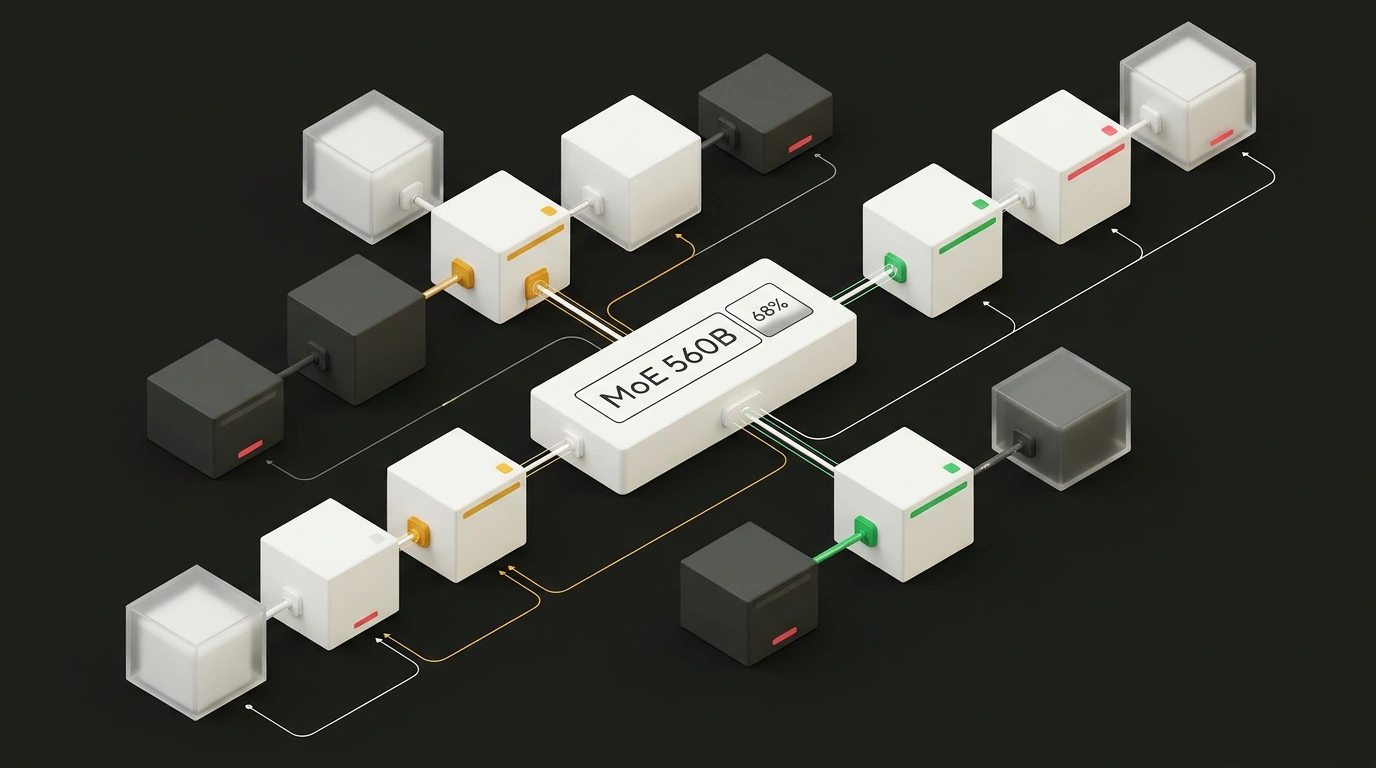
A minor checkpoint update—numbered 1019—bumped the model's success rate by 6 percentage points, from 62% to 68%. Six percent might sound modest on paper, but in complex multi-step automation it's a seismic shift: an open Mixture-of-Experts (MoE) model has pulled right up alongside heavy proprietary flagships, while running with sub-second latency and a fraction of the inference cost.
What AutomationBench Is: Why Synthetic Tests Lie About Agents
To see why this matters, let's look at how AutomationBench actually works. It was built by engineers at Zapier—the platform handling millions of daily integrations across thousands of cloud apps. Unlike school-exam benchmarks, AutomationBench simulates the messy, day-to-day work of employees across six core business areas: sales, marketing, operations, customer support, finance, and HR.
There are no abstract trivia questions here. Models are fed end-to-end production scenarios:
- pull incoming leads from a web form;
- validate phone numbers and email addresses;
- check a CRM via REST API for duplicates;
- calculate a discount using a multi-tier pricing grid;
- generate an invoice in an accounting system;
- post a structured summary to a team chat.
The nasty trap in these workflows is error propagation. If a model botches a JSON syntax detail or drops a required parameter on step two, the entire twenty-step pipeline derails. Historically, only a handful of closed heavyweights like Claude 3.5 Sonnet or GPT-4o could reliably carry these chains to the finish line. Ling 3.1 Flash just proved open-weight models can hold focus across the whole route too.
MoE 560B Architecture: How 25 Billion Active Parameters Hold the Chain
The Ling family is developed by InclusionAI, a research lab under Ant Group. Architecturally, Ling 3.1 Flash is a massive Mixture-of-Experts model with 560 billion total parameters. Don't let that colossal number intimidate you, though: for any single token processed, exactly 25 billion parameters ("active experts") are switched on.
That design delivers the best of both worlds:
- Breadth and depth of knowledge: the full 560B parameter pool stores a huge knowledge base of API schemas, data standards, and programming logic.
- Blazing inference speed: your GPUs only multiply matrices for 25B parameters, keeping generation latency on par with much smaller models.
Paired with a 1-million-token context window and hardware optimizations (as we saw in our breakdown of the earlier Ling 3.1 Flash version), the model ingests OpenAPI specs and tool definitions effortlessly. It doesn't drift when passing state between steps—continuing the broader trend toward building fast open models for agents—and cleanly maps input variables to target function arguments.
The Overthinking Phenomenon: The Hidden Cost of Accuracy
There is one catch in this success story that every engineer should know about. Digging into inference logs from checkpoint 1019 revealed an interesting side effect of heavy agentic fine-tuning: the model can get noticeably verbose.
Before emitting a compact API tool call, Ling 3.1 Flash runs through a long internal Chain-of-Thought, narrating every intermediate step to itself: "First I'll check the email format... then match it against a regex... then hit the search endpoint..." On one hand, talking itself through the logic is exactly what keeps it from making silly mistakes. On the other, token spend on internal reasoning jumps by 1.5x to 2x.
If you're plugging Ling 3.1 Flash into high-volume automation pipelines, set a strict max_tokens cap on internal reasoning and instruct the model in your system prompt to emit tool calls without lengthy preambles.
What 68% Means for Local Business Automation
Until recently, companies wanting autonomous AI agents in accounting, logistics, or customer support faced an ugly choice: either pay steep cloud API bills while sending sensitive client data to external servers, or run local open models and watch them fail on step six.
Hitting 68% on AutomationBench shows that the gap between proprietary giants and open weights is closing fast. A model in this class can be deployed inside a private corporate perimeter (on-premise) on your own server cluster with 4-bit quantization. You get a dependable autonomous worker that keeps trade secrets off third-party clouds, skips recurring per-seat fees, and reliably executes complex multi-step workflows.