Every major language model announcement in AI splits the community down the middle in seconds. One camp immediately quotes the creators' triumphant marketing charts and declares victory over human engineers, while the other digs up one failed prompt with an Olympiad logic puzzle and calls the whole thing vaporware.
That exact script played out with the recent release of the flagship Kimi 3.1 (Kimi K3.1 Pro) from Shanghai-based lab Moonshot AI. Social feeds erupted into a heated debate: some engineers criticized the model for relatively pricey inference tokens and unremarkable bug-fixing scores, while others praised its UI layout quality and agentic behavior in the terminal.
Tech lead and System Design & Highload channel author Aleksey Rybak suggested looking at the release coolly—without hype or spin. Let's unpack what is actually happening under Kimi 3.1's hood, why one-dimensional benchmarks no longer tell the story, and what tectonic shift is taking shape in open-weights models.
The Trap of One-Dimensional Tests: Three Roles in Real Engineering
The biggest methodological mistake in most amateur evaluations is trying to score a complex model on a single numeric scale like HumanEval or GSM8k math problems.
In real engineering workflows, when we embed autonomous AI agents into the AI Software Development Life Cycle, a neural network never acts like a spherical algorithmist in a vacuum. It wears fundamentally different hats, and each role demands almost opposite strengths:
- Product Engineer (Product Discovery): here the model needs analytical thinking, the ability to untangle conflicting specs, spot edge cases, and break epics into testable user stories.
- UI/UX Designer: here aesthetics matter—understanding spatial grids, responsiveness, typography, and modern design systems.
- Systems Engineer / Pipeline Builder: here you need strict syntax precision, REST/gRPC API integration, database migration generation, environment management, and CI/CD scripting.
This is where Kimi 3.1 delivered its biggest surprise. In blind user voting on LMSYS Design Arena, Kimi 3.1 became the first open Asian model whose generated interfaces users consistently pick on par with Anthropic's proprietary Claude models. Unlike static benchmarks that models can be tuned to memorize (dataset overfitting), you can't fake blind votes from live designers and frontend developers.
What Independent Artificial Analysis Benchmarks Showed
To cut through subjectivity, let's look at measurements from the research platform Artificial Analysis, which tested Kimi K3.1 Pro across standardized test suites:
- Global Intelligence Index: the model scored 55.1 points, landing solidly at #4 worldwide among more than 200 commercial and open models, right behind Claude Opus and Claude Sonnet.
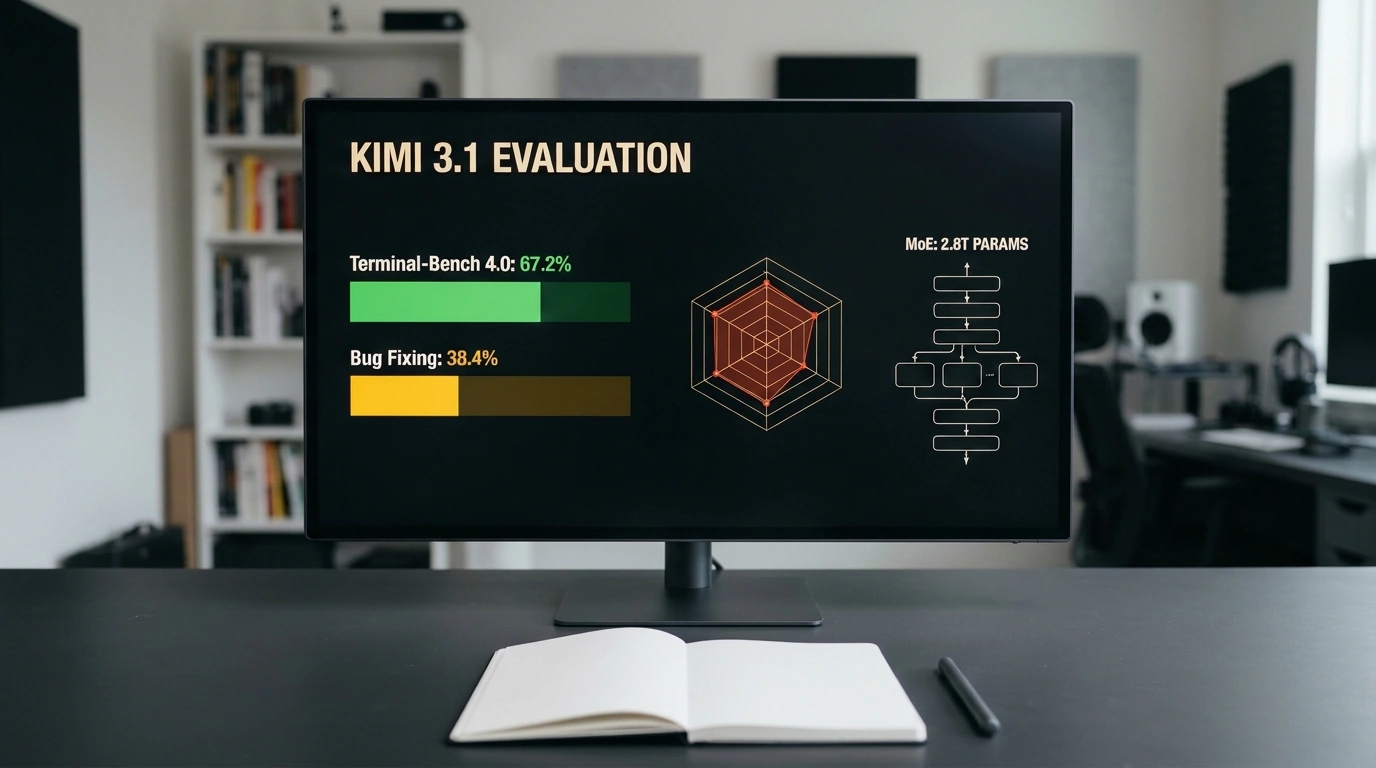
- Terminal work (Terminal-Bench 4.0): here is the headline breakthrough of the release. On tasks involving real OS control via the shell, chaining Bash commands, deploying packages, and running tests, Kimi 3.1 hit a record 67.2% success rate. By comparison, the previous-generation Kimi K3 scored just 12.6% on the same test!
- Complex long-horizon workflows (AutomationBench and GDPval-AA): in multi-step agentic workflows, the model earned an Elo rating of 1846 (a net +312 Elo jump over its predecessor), showing strong instruction adherence over long trajectories.
- Academic Olympiads: on the ultra-hard Humanity's Last Exam benchmark, scores edged up more modestly from 47% to 52%. That modest gain is what disappointed researchers hoping for an Olympiad math miracle.
Architecture: 2.8 Trillion Parameters and a 1 Million Token Context
Behind those numbers sits serious architectural engineering. Kimi K3.1 Pro uses a sparse Mixture-of-Experts (MoE) design:
- Total parameters: a massive 2.8 trillion weights.
- Active parameters per token: 104 billion parameters, giving the model deep breadth of knowledge without crippling per-token generation speed.
- Context window: 1,000,000 tokens with solid retrieval density and minimal "lost in the middle" degradation (Needle in a Haystack).
Yet the biggest news is the release policy. Moonshot AI announced plans to open the model weights to the community, making Kimi 3.1 the most powerful open model on the planet. If you want to trace how this family evolved, check out our earlier deep dive into Kimi K3 and its architectural nuances.
The Main Tectonic Shift: The Gap Is Collapsing
Aleksey Rybak rightly points to a broader market trend: the distance between closed US tech giants and fast-following global labs is collapsing rapidly.
We're watching the classic open-source spiral play out again:
- First, an expensive closed-source leader appears with a monthly subscription.
- Next, open models catch up in baseline quality, shrinking the gap to statistical noise.
- In the third phase, quantization improves until companies can run comparable weights on their own servers and workstations (on-premise), solving data-privacy and compliance risks in one stroke.
Kimi 3.1 is clear proof that the era of a two- or three-vendor closed monopoly in enterprise software development is drawing to a close.