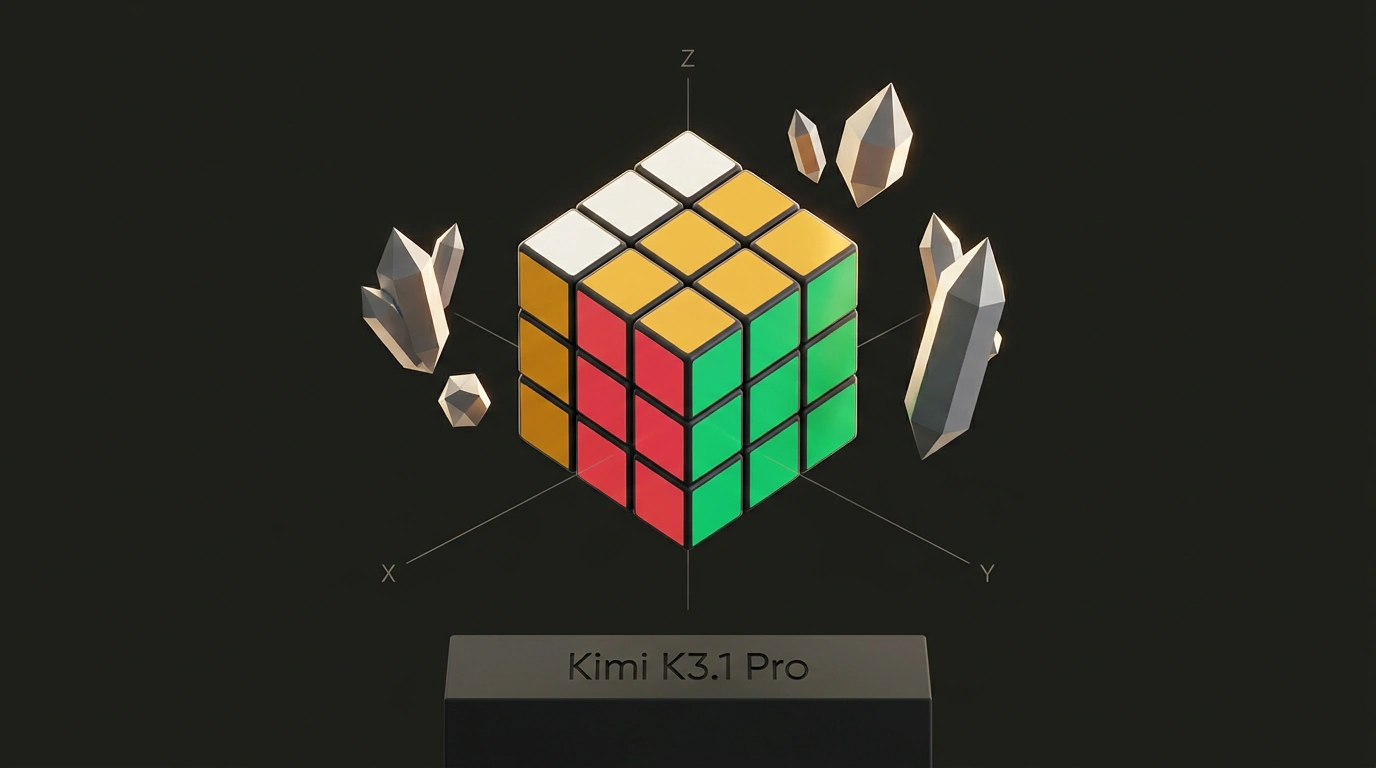
For a long time, spatial reasoning was the Achilles' heel of large language models. They could write sonnets and generate flat images without breaking a sweat, yet ask them to mentally rotate a 3D object or track coordinates, and they hit a wall. A series of independent tests on Moonshot's flagship Kimi K3.1 Pro model points to a genuine leap forward: AI is moving from manipulating flat text to reasoning about 3D geometry and procedurally building entire worlds.
Spatial Reasoning Benchmark
Solving a Rubik's Cube has long served as a litmus test for AI spatial imagination. Earlier models either got stuck in endless loops or tried to cheat by simply reversing the scramble sequence step by step.
In an independent stress test by Matthew Berman, Kimi K3.1 Pro was handed a randomly scrambled cube represented purely as orientation matrices for its faces—with no move history at all. Kimi showed real algorithmic reasoning: it constructed a complete 3D mental model of the cube, mapped out an optimal layer-by-layer solve path, and output an error-free sequence of 3D rotations. In virtual simulation, the cube solved on the first try without a single collision or geometry glitch.
Procedural 3D Art in Blender
The second test checked how well that spatial intelligence pairs with professional software. Instead of generating flat images, Kimi acted as a technical 3D artist inside the open-source Blender editor.
Given a text description ("A neon canyon with crystal cliffs, floating islands, and glowing fog"), the model wrote a clean, syntactically valid Python script for Blender's built-in bpy module. The script cleared the default scene, generated procedural meshes with a Displace modifier, wired up Principled BSDF node shaders with light emission, and positioned a cinematic camera:
# prompt_builder.py: Request to Moonshot Kimi for generating a Blender scene
import os
import requests

api_key = os.environ.get("MOONSHOT_API_KEY")
headers = {"Authorization": f"Bearer {api_key}"}

prompt = """
Write a Python script for Blender 4.2+ using the bpy module.
Scene: A crystal cave with floating glowing crystals.
Requirements:
1. Clear default scene meshes.
2. Procedurally generate terrain with a Displace modifier.
3. Add crystals with an emission material (Cyan, Strength = 5.0).
4. Set a camera at a 45-degree angle and soft World background lighting.
Return ONLY executable Python code.
"""
The script runs headlessly from the Blender CLI without any manual polygon wrangling:
# Run Blender in the background to render the generated script
blender --background --python generate_scene.py --render-output //render_frame --render-frame 1
Across Julian Goldie's test series, the model generated six complex, standalone 3D scenes while spending just $8.80 total on tokens.
Game Level Architecture
The third test scaled the challenge up to a real video game prototype. Kimi K3.1 Pro was tasked with building a multi-zone game world: five distinct biomes (from underground caverns to mountain ridges), a dedicated boss-fight arena, and a dynamic day-night cycle with automatic shadow and sun-angle recalculation.
The model pulled off the whole environment using its built-in 3D Make tooling. The resulting level exports straight to open formats like glTF and FBX for Unreal Engine 5, Unity, or three.js. That opens the door to automated level whiteboxing: an indie developer can get playable game geometry in half an hour instead of waiting weeks for 3D modelers.
Kimi K3.1 Pro's results show that the era of LLMs as blind text manipulators is winding down. Understanding 3D coordinates, geometry, and physical interactions lays the groundwork not only for a shake-up in game dev and film, but also for the spatial intelligence robots will need to navigate the real physical world.