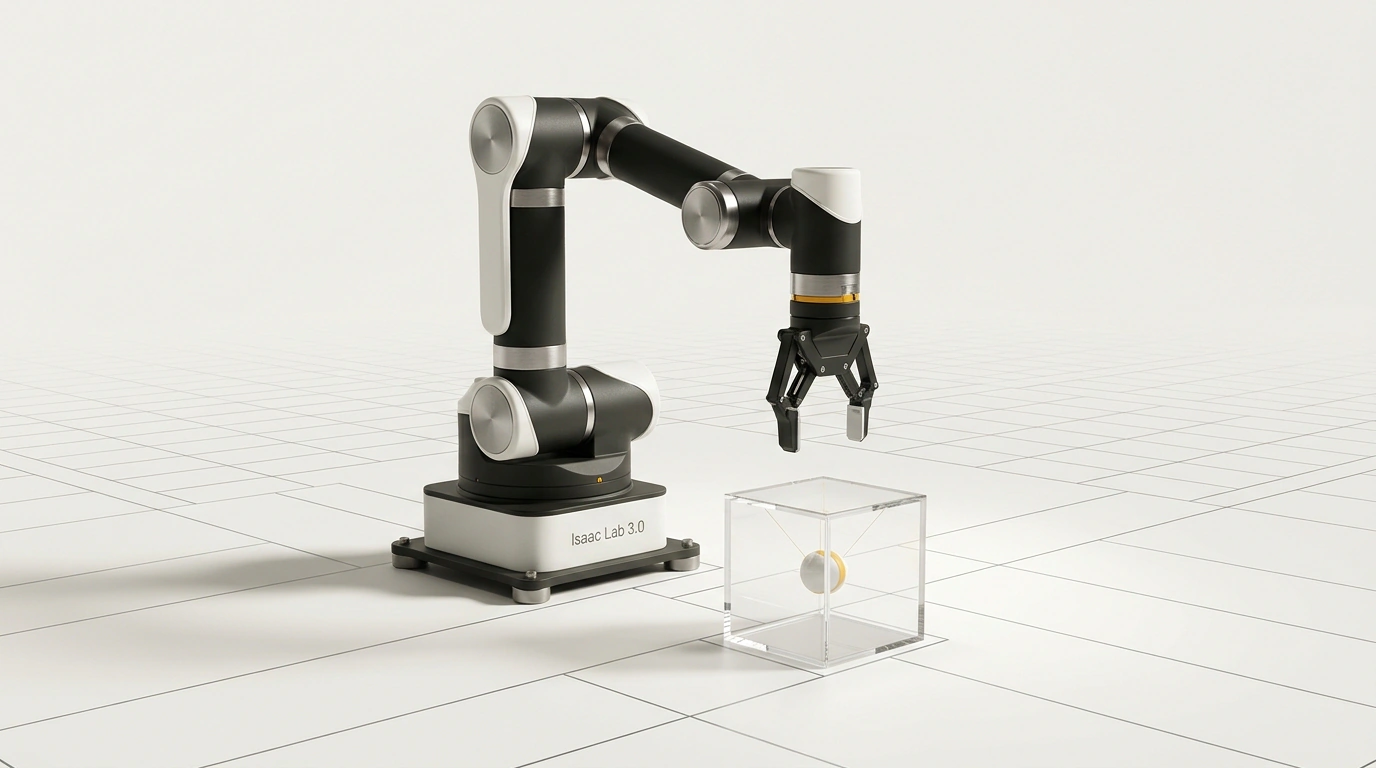
Have you ever wondered why language models like GPT or Claude advance at breakneck speed while walking humanoid robots and mechanical arms still struggle to open a simple doorknob? It comes down to basic physics. To teach a neural network language, you can feed it terabytes of books from the internet over a couple of weeks in a data center. To teach a bipedal robot how to balance on a slick floor, it needs millions of real steps in physical space.
In the real world, one second of time takes exactly one second. A robot falls, bends its servos, smashes sensors worth tens of thousands of dollars, and goes into the repair shop for weeks. Training physical AI on live hardware is painfully slow and prohibitively expensive. That's why the general availability release of NVIDIA Isaac Lab 3.0 (v3.0.0) marks a watershed moment for robotics: it gives engineers a pipeline where robots live through centuries of training in a single workday.
The Physical World Trap: Why Robots Break Faster Than They Learn
In Reinforcement Learning, an agent learns through trial and error. It tries a movement, gets penalized for falling, and gets rewarded for holding balance or grasping an object. Mastering fine motor skills—like rolling an apple between robotic fingers or climbing stairs with a payload—takes billions of attempts.
Running those experiments on physical testbeds hits hard walls:
- Mechanical wear: bearings, gearboxes, and linkages wear out long before the policy converges on a stable trajectory.
- Limited scenarios: a lab can't easily replicate every kind of ice, mud, wind gust, and random collision.
- Cost of failure: one sudden wrong move from a robotic arm can smash expensive equipment nearby.
The only way out is moving the training loop into virtual simulation. But classic simulators like Gazebo and Webots computed physics sequentially on the CPU, topping out at a few dozen frames per second. Isaac Lab changes the compute paradigm entirely.
Isaac Lab 3.0 Architecture: Multi-Backend PhysX, Newton, and Kit-Less Mode
Isaac Lab's (evolved from Orbit) core architectural edge is end-to-end GPU parallelism on NVIDIA hardware. Every rigid body, contact point, joint, and friction calculation runs as CUDA tensor matrix ops directly in GPU VRAM. Simulation speed crosses an astonishing 135,000 physics frames per second on a single RTX card.
Version 3.0 reaches General Availability with three major upgrades:
- Multi-Backend Physics: researchers are no longer locked into a single solver. You can use the classic NVIDIA PhysX 5 engine or the new Newton backend—combining MuJoCo-Warp and VBD algorithms to accurately model soft bodies, deformable sponges, cables, and fabrics.
- Kit-Less Execution: previously, the simulator required booting the heavy Omniverse Kit GUI shell. Now parallel training runs straight from a terminal in native Python, freeing up gigabytes of VRAM for neural network weights.
- Unified CLI: training and policy evaluation commands are standardized around
isaaclab trainandisaaclab play, with built-in support forrsl_rl, TorchRL, and Stable Baselines 3.
The Sim-to-Real Bridge: How Domain Randomization Transfers Motor Skills to Real Hardware
You're probably thinking: "Sure, the robot runs great in a virtual world, but won't it faceplant in real life the moment it hits dust on the floor or joint backlash?" That skepticism is spot-on—roboticists call it the Reality Gap.
The fix is a clever mathematical technique called Domain Randomization. While 4,096 virtual robot clones march through parallel worlds, the simulator continuously randomizes physical parameters for each one:
- floor friction triples for one robot and turns ice-rink slick for another;
- link and chassis masses fluctuate by ±15%;
- artificial white noise is injected into gyroscope and LiDAR readings;
- electric motor responses get a random 10–30 millisecond delay.
Instead of learning to move in pristine lab conditions, the neural network learns to operate in constant, unpredictable chaos. When that trained policy is flashed onto a real robot's microcontroller, the physical world feels like just another variation of its virtual training ground—and the robot steps forward steadily.
Step-by-Step Setup and Running 4,096 Agents on a Single GPU
We've already looked at industrial simulation in Omniverse and how generative 3D environments in Odyssey-3 work. Running Isaac Lab 3.0 requires an RTX 4080/4090-class GPU or a data-center A100.
Install the framework in an isolated virtual environment:
# Clone the official Isaac Lab repository
git clone https://github.com/isaac-sim/IsaacLab.git
cd IsaacLab

# Install the core framework and training tasks with rsl_rl support
pip install --upgrade pip
pip install -e source/extensions/omni.isaac.lab
pip install -e source/extensions/omni.isaac.lab_tasks[rsl_rl]
Next, configure your parallel environment in franka_env_cfg.py to set the number of concurrent robots and the physics step:
from omni.isaac.lab.envs import ManagerBasedRLEnvCfg
from omni.isaac.lab.utils import configclass

@configclass
class FrankaCabinetEnvCfg(ManagerBasedRLEnvCfg):
    """Environment configuration for Franka Emika manipulator RL training."""
    def __post_init__(self):
        super().__post_init__()
        # Run 4096 parallel manipulators in a unified space
        self.scene.num_envs = 4096
        self.scene.env_spacing = 2.5
        # Simulator physics step at 120 Hz
        self.sim.dt = 1.0 / 120.0
        self.sim.render_interval = 4
Then kick off training with a single standardized command:
# Launch parallel simulation without GUI overhead (Kit-less)
isaaclab train --task Isaac-Cartpole-Direct-v0 --num_envs 4096 --headless
Watch out when migrating older pipelines from 2.x: Isaac Lab 3.0 changed orientation quaternion component order to the standard (x, y, z, w) convention, so check your transformation matrices before running old configs.
Virtual simulation is dismantling the biggest bottleneck in physical robotics. In just a few hours, a GPU cluster can produce controller weights ready to operate safely in the real world.