If you want to hand off part of your coding work to an AI agent today, you face an awkward fork in the road. Path one is local agents like Windsurf, Claude Code, or Codex running on your laptop. They are fast and see your whole repo, but they sit right next to your SSH keys and passwords, and work stops the second you close the lid. Path two is the new wave of persistent cloud agents like OpenAI Dots, Anthropic Claude Duet, and xAI's GrokBot. They run 24/7 in the cloud, but they are built as general-purpose personal assistants, locked to one vendor's models, and stuck in Linux sandboxes where you can't even build a basic iOS app.
On November 17, 2026, Cognition launched Devin Bots to bridge that exact gap. Instead of a one-off helper for a single prompt, you get a persistent cloud manager that spins up its own team of child agents, delegates work, and only interrupts you when it actually needs a decision.
From Autocomplete to "Boss of Bots"
At launch, Cognition co-founder Walden Yan traced the company's progression: autocomplete and chat in Codeium, local agents in Windsurf, cloud Devin in 2024, and now persistent agents. These bots don't die when you close a browser tab; they manage a project over days and weeks.
Instead of tiny tickets, you give a bot a long-term goal like "keep the Android app at parity with iOS." From there, it plans steps, launches parallel child Devin sessions, nudges stalled branches, and pulls everything together. Bots can even collaborate: a QA bot tests a build in a real browser, spots a bug, and hands it straight to a developer bot. Inside Cognition, bots already configure other bots. A normal session can propose creating a new helper too, though it won't start without human approval.
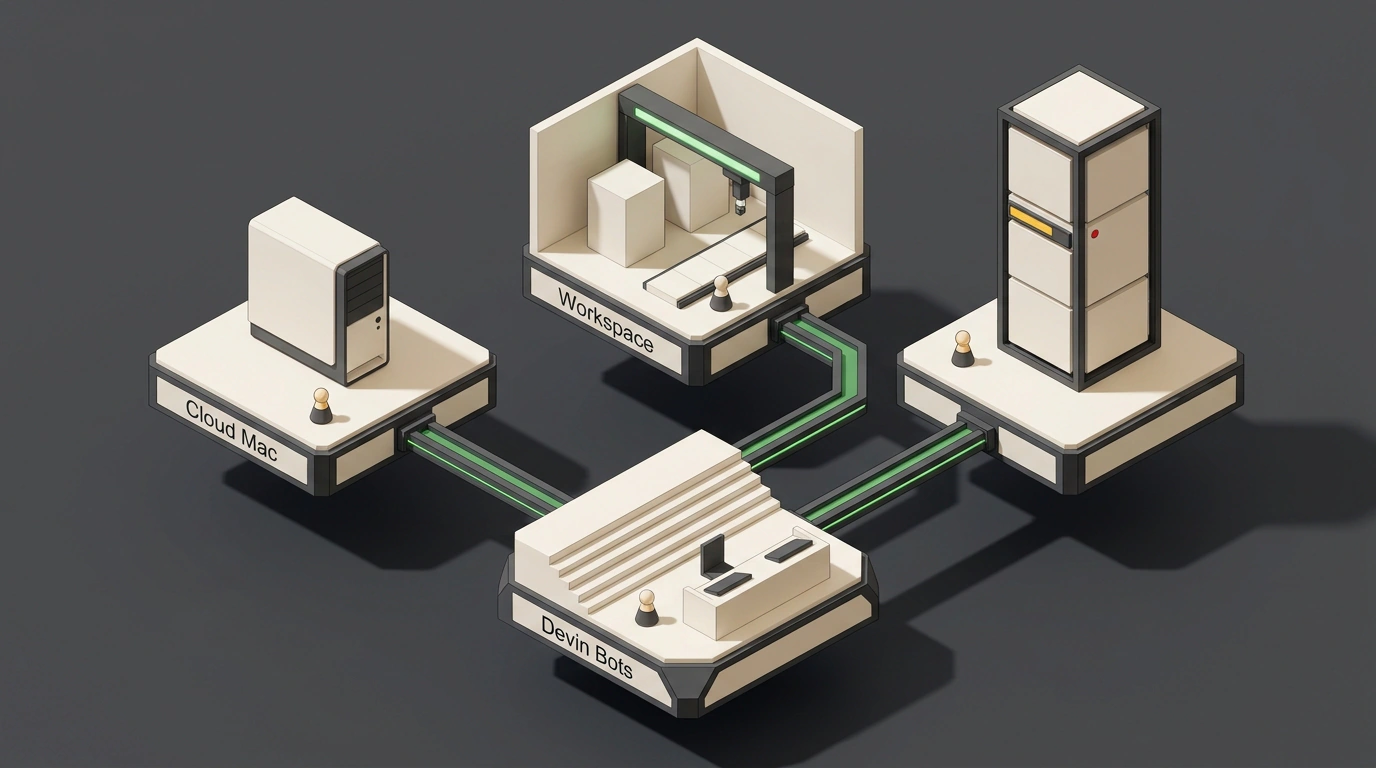
Devin Bots launch promo illustration: persistent cloud manager bots coordinating agent teams (Source: devin.ai)
To keep you from drowning in dozens of chat threads, anything requiring attention lands in a single Needs you inbox. Four card types show up there: a decision with the bot's recommendation, a pull request (PR) review and merge, a request for new permissions or secrets, and brief status reports.
Now let's look at the headline numbers with a sober eye. Cognition's internal data claims beta testers merge 4.5x more PRs per message, with some engineers jumping from 50 to nearly 2,000 PRs a week. Fortune reported 10x usage growth during two weeks of early access across customers like Decagon, Fireworks AI, and Reducto. Those numbers sound impressive, but there are no independent benchmarks yet—vendor beta metrics always highlight best-case workflows, and raw PR counts say little about change complexity.
Isolated Cloud VMs and Cloud Macs for iOS
A local agent on your laptop is convenient right up until one bad terminal command. Cognition CEO Scott Wu bet on strict isolation: every child Devin session runs inside its own cloud virtual machine. Bots have zero access to an engineer's laptop, local passwords, or SSH keys.
Each bot gets its own scoped secrets and permissions granted through Needs you cards. All bot code goes through the exact same CI (Continuous Integration—automated build and test) checks as human code. If company policy bans public clouds, Devin Outposts lets you run those same sessions on your own hardware: local Mac minis, corporate Kubernetes, or a private VPC.
The biggest engineering feature in this release is Cloud Macs. Cloud agents have been stuck on Linux for years, helpless on Apple targets. Cognition built a fleet on Amazon EC2 Mac instances powered by Apple Silicon. According to the AWS Architecture Blog, a cloud macOS instance boots in under a minute with iOS Simulator ready to go.
In practice, the workflow feels almost magical. You spin up a Software Factory bot, link it to iMessage in a few clicks, and ask it to build an iOS app. The bot boots a Cloud Mac, compiles the project, and uploads the build straight to TestFlight—Apple's official beta-testing platform outside the App Store. All you do is sign into your Apple Developer Account once, tap the iMessage link, and install the build on your iPhone. No local MacBook or heavy Xcode required.
Devin Bots pipeline simulator: model, environment, and Needs you inbox
Click through the dropdowns to see how cleanly one pipeline separates the manager model, child session power, and build hardware. That modularity sets an engineering platform apart from all-in-one chat assistants.
Any Model, iMessage, and Editable Memory vs. Competitors
The second major edge of Devin Bots is BYOM (Bring Your Own Model). Competitors lock you into their own ecosystems: OpenAI Dots only runs OpenAI models, Claude Duet only runs Anthropic models, and GrokBot is tied to current Grok releases. Here, you pick freely between Gemini 4 Neon, GPT-6.2 Astra, and Claude Fable 5.2, or even connect a personal ChatGPT account. You can also set Normal and Ultra modes independently for the manager and its child sessions.
The communication layer is surprisingly polished too. Shortly before launch, Cognition acquired The Interaction Company, the startup behind the iMessage assistant Poke. Its tech is now built right in: alongside the web UI and dedicated per-role Slack bots, you can link an agent to iMessage in seconds. Settings also expose visible, editable memory—if a bot remembers something wrong, you open the file and delete it by hand. For external tools, you get 235 integrations plus MCP support. That's fewer connectors than broad platforms like Dots, but it covers the entire engineering stack: GitHub, GitLab, Bitbucket, Linear, Jira, Slack, PagerDuty, and Databricks.
| Feature | Devin Bots | OpenAI Dots | Claude Duet | GrokBot (xAI) |
|---|---|---|---|---|
| Primary Focus | Engineering teams & code | Broad tasks & admin work | Docs, analysis, briefings | Team Slack, X & meetings |
| Model Choice | Gemini 4 Neon, GPT-6.2 Astra, Claude Fable 5.2 + ChatGPT | OpenAI models only | Anthropic models only | Grok models only |
| iOS Builds / Cloud Macs | Yes (Amazon EC2 Mac + TestFlight) | No (cloud Linux / own PC pool) | No | No |
| Channels & Memory | Web, Slack, iMessage; visible editable memory | ChatGPT, strong live voice & computer use | Claude, MCP, weaker live voice | Slack dashboards, auto-joins Zoom/Meet |
The table draws clear lines. If you want a personal assistant with live voice and email triage, OpenAI Dots wins. If your work revolves around documents and decks, Claude Duet is an easier fit. Devin Bots owns the niche for teams building CI pipelines and managing fleets of coding agents.
Availability and Where to Draw the Line
The platform is live inside the Devin web app, and the official documentation offers role templates and a prompt marketplace. Out of the box, you get starters for backlog grooming, CI maintenance, release prep, Product Engineer, QA Engineer, and Data Analyst.
Even so, don't hand your entire engineering workflow to autonomous bots on night one. Here are the practical boundaries to watch.
- Unclear quota burn: there is no separate pricing calculator for Bots at launch. Bots draw from your existing Devin plan limits (available on higher tiers like Teams and Max), and a dozen parallel
Ultrasessions plus Cloud Macs can burn through quota fast. - Shared memory visibility: a shared bot's memory files are visible to everyone with access to that bot. Don't drop sensitive data into shared threads.
- Lost links on archive: archiving a bot deletes its Slack app and its links to other bots; unarchiving means setting those connections up again.
The smartest start is one clear template, like triaging failing CI tests or cleaning up the backlog. Set strict approval gates in Needs you, watch the quality of child-session PRs for a couple of days, and only then decide whether to hand over releases and Cloud Macs.