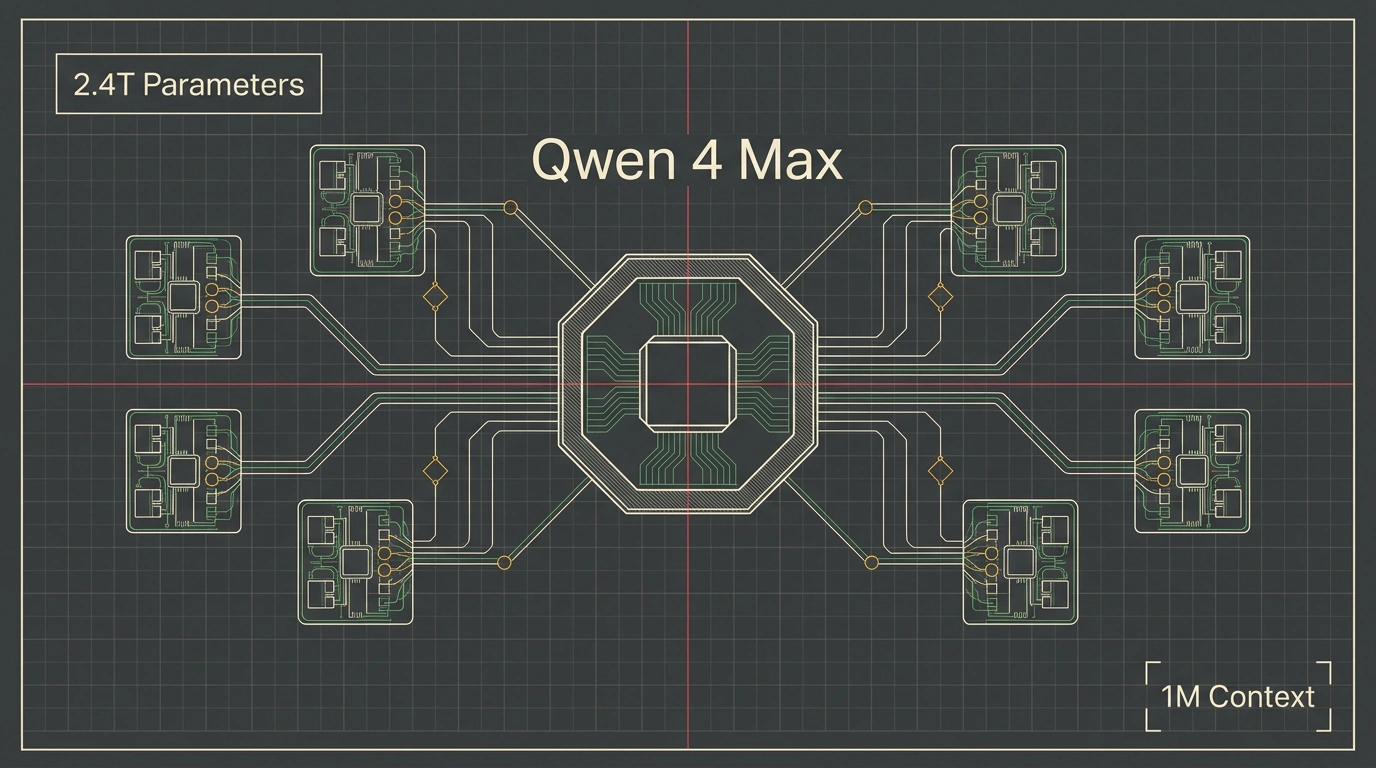
Should you move your production AI agents off pricey Western flagships onto Alibaba's new Qwen 4 Max? In November 2026, Alibaba rolled out the production release of its top model (previewed November 11, generally available November 16) built around three pitches: a huge sparse architecture, a flat-rate 1M-token context window, and a low API bill. Let's see where the math holds up and where marketing runs ahead of reality.
Under the Hood: 2.4 Trillion Parameters and 1M Context
The total parameter count sounds intimidating—2.4 trillion parameters. Fortunately, you don't heat up an entire data center for every prompt: Qwen 4 Max uses a Mixture-of-Experts (MoE) design. Picture a large engineering firm: hundreds of specialists are on staff, yet only the experts needed for the task walk into the meeting room. For each token, the model activates just 71 billion parameters (down from 95 billion in Qwen 3.8 Max), while a separate 328-billion-parameter N-gram embedding block speeds up common word patterns.
To keep long prompts from bogging down, Alibaba engineers combined Qwen Sparse Attention (QSA), Gated DeltaNet (GDN), and a four-branch Gated Residual (GR) block. The network compresses active memory instead of recalculating old parts of the conversation over and over.
As a result, Qwen 4 Max supports a 1-million-token context window—enough working memory to hold a large codebase or an archive of project docs in one request. Standard mode allows up to 991K input tokens and 131K output tokens; deep-thinking mode allows up to 983K input and 262K combined output including reasoning. It also has native vision, reading images, diagrams, and video directly without an external converter.
Independent Benchmarks vs. the Press Release
Promo materials talk up 48-hour autonomous science experiments. Strip away the hype and check the numbers. On the independent Code Arena leaderboard, the model debuted at #6. Qwen 4 Max performs especially well in web development, frontend work, and agentic coding—where the model plans steps, calls tools, tests its code, and finishes the job.
Alibaba's internal Work360 benchmark (26 domains, 182 subdomains, and 721 professional fields) looks even rosier: the company claims high-effort token usage dropped ~35% and average cost per complex task fell nearly 60%, from $4.43 down to $1.67 compared to Qwen 3.8 Max. Still, those are vendor-run tests.
Independent reviews cool things down quickly: in deep terminal coding across large repos and certain visual understanding tasks, Qwen 4 Max still trails fall Western leaders like Gemini 4 Neon, Claude Fable 5.2, and GPT-6.2 Astra. A strong workhorse? Yes. An undisputed champion at everything? No.
Pricing, APIs, and Where It Fits Best
The model's biggest selling point is its pricing in Alibaba Cloud Model Studio (formerly DashScope). On the international Singapore node, a flat rate covers the entire 1M context with no tiered markup for long prompts, while Chinese and select global nodes are slightly cheaper in RMB (10 yuan per 1M input tokens and 30 yuan per 1M output tokens).
Qwen 4 Max pricing on the international node (Singapore)
With caching that cheap, it shines when an agent repeatedly queries one large context: log analysis, auditing hundreds of doc pages, or multi-step automation on a tight budget. New accounts get a free 1M-token quota for 90 days, and Batch mode gives a 50% discount for background jobs. Beyond Alibaba Cloud, the model is live on QwenWork, Qoder, QwenStudio, Together AI, and OpenRouter.
Migration is painless for developers: the API natively supports OpenAI (Chat Completions and Responses) and Anthropic Messages protocols, so you can drop it into harnesses like Claude Code without rewriting your client. Web search, tool calling, and JSON Schema structured outputs are all supported.
Now for the limits. Qwen 4 Max weights are closed, so you can't self-host the flagship for full privacy (Qwen Research only plans to open weights for smaller fourth-gen models later). On top of that, the API encrypts chain-of-thought (CoT) reasoning: users only see a brief summary, while the full reasoning trace passes between turns in encrypted form. If your team needs transparent audits of every reasoning step or peak accuracy in heavy terminal coding, cheap tokens won't make up for those gaps.