On its very first day trading on Nasdaq, Anthropic's valuation soared toward $1.8 trillion. Entering the market, its traditional debt looked tiny for a company that size—around $6 billion backed by over $130 billion in cash and investments. Yet by Friday, the stock tumbled from $111.50 almost back down to its IPO price, stopping just five cents shy of breaking below $83.
The answer sits inside its Form S-1 prospectus, the mandatory filing every company submits to the U.S. securities regulator before going public. Buried inside was a number that gave Wall Street cold feet: $900.9 billion in commitments for compute capacity and infrastructure through 2045. If you pay for a Claude subscription, your monthly card charge is now part of that equation.
Anthropic brand visual—the first independent AI lab to list on Nasdaq under the ticker ANT (Source: anthropic.com)
A Record $81B Raise and a Cold Shower on Day Two
Anthropic became the first independent AI lab to hit the public markets (OpenAI has filed paperwork, but its listing is expected later). It picked a short ticker: ANT. Shares were originally pitched at $70–$78, then raised to $83 on red-hot demand. Selling roughly 980 million shares brought in $81.3 billion, smashing all IPO records. Seven strategic chip and cloud suppliers, including NVIDIA and Google, added another $26 billion alongside it, putting more than $107 billion in the bank.
Thursday looked like a victory lap. Trading opened at $111.50, and by evening Anthropic was the seventh most valuable company in the United States. Friday flipped the script: ANT dropped as low as $83.05 before closing near $88. Anyone who bought emotionally at Thursday's open lost about a fifth of their money in 24 hours.
NVIDIA pulled the trigger. CEO Jensen Huang unexpectedly stepped down following a board investigation into a personal matter, with CFO Colette Kress named interim CEO. Over seven weeks, shares in the AI chip leader fell roughly 46%. On Friday, NVIDIA dragged the entire sector down again, and Anthropic fell right along with it.
$6B in Debt vs. $900B in Promises and Circular Financing
To understand why ANT tracks chipmakers so nervously, look at the balance sheet. Anthropic carries almost no bank loans and sits on a mountain of cash. The catch hides in long-term compute commitments—multi-year leases for servers, data centers, and AI accelerators. Accounting rules may keep them separate from traditional debt, but the bills still come due on a strict schedule.
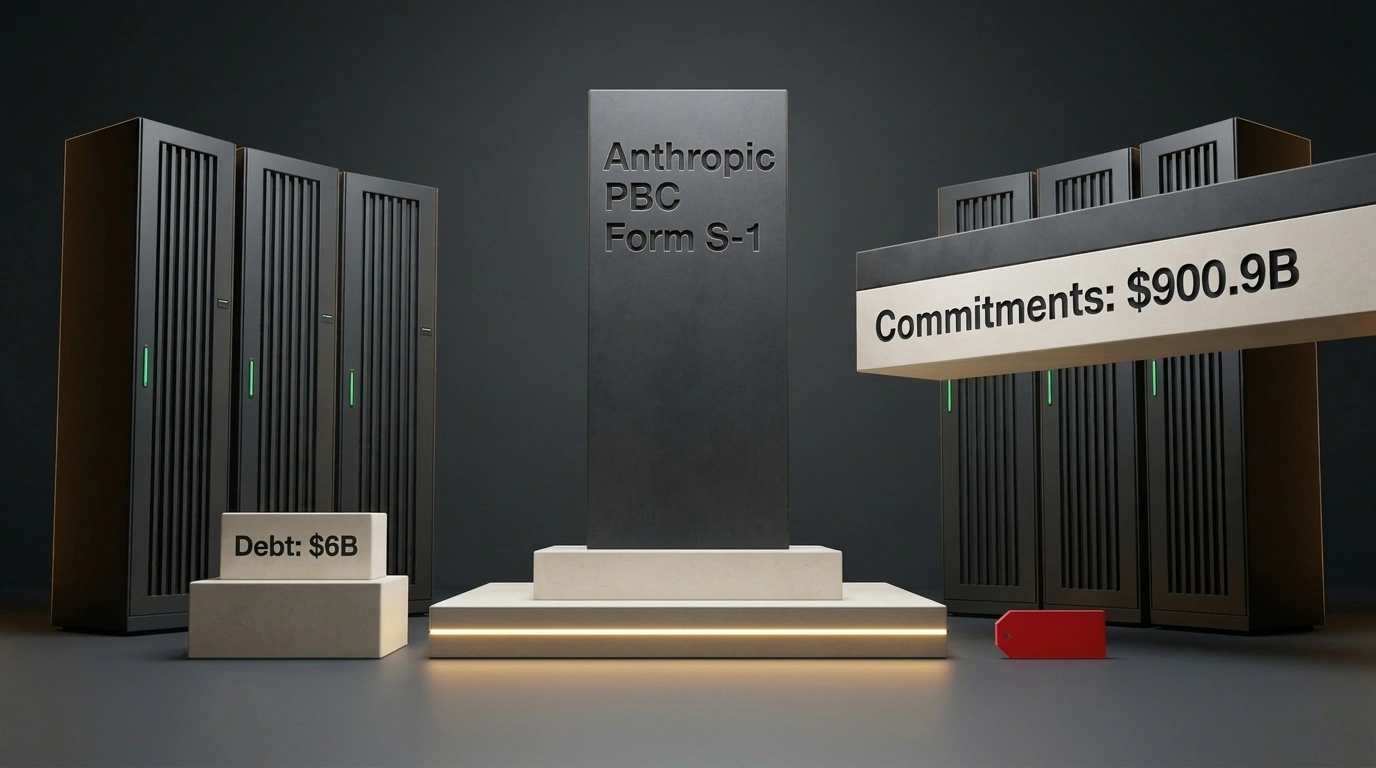
Anthropic debt, IPO proceeds, and compute commitments
The chart makes the imbalance obvious. Traditional debt looks like a rounding error next to a twenty-year server tab that dwarfs every dollar raised on Nasdaq. Nor can Anthropic wait decades to pay: a huge chunk of that bill is due within the next twelve months.
Think of it like signing a twenty-year lease on a massive skyscraper while betting on explosive headcount growth. If the business actually fills those floors, locking in prices early looks brilliant. If demand slows down, empty floors wipe out profits fast.
Even more revealing is how cash circulates inside the industry. Financiers call it circular financing: hardware and cloud vendors invest in or lend to an AI lab, which then spends that exact money renting their servers. Around Anthropic, the loop is crystal clear:
- Amazon and Google hold major stakes in Anthropic, rent it cloud clusters, and buy Claude for their own teams.
- Broadcom leases chips to Anthropic and agreed to provide up to $42 billion in credit to pay for that same capacity.
- Seven hardware and cloud providers bought $26 billion in shares alongside the IPO (similar to NVIDIA's discussed plans to invest up to $100 billion in OpenAI tied to GPU purchases).
This merry-go-round has grown to macroeconomic scale. Harvard economist Jason Furman calculated using U.S. Bureau of Economic Analysis data that spending on server hardware, software, and data centers accounts for around 4% of U.S. GDP—yet it drove roughly 92% of total U.S. GDP growth in the first half of the year, while the rest of the economy grew just 0.1%. On the way up, circular financing enriches everyone in the loop. If one link sneezes, the shockwave hits everyone at once.
Four Signals from the S-1: From Strict Limits to a War on SaaS
An IPO prospectus is valuable because companies can't feed investors marketing fluff without risking real lawsuits. Anthropic spelled out four risks that directly affect every Claude subscriber and API builder.
First, strict usage limits are not going away. The filing admits that demand constantly outpaces pre-bought compute. To keep services running under load, Anthropic has to buy short-term compute at much higher spot prices, and that spending is about to rise. Per-task costs will keep falling and models will get smarter, but don't expect generous unlimited tiers on Pro, Max, or Ultra anytime soon. Servers are still scarce.
Second, Anthropic openly warned that it competes with its own customers and plans to push harder. Wall Street has already felt those punches. After Claude's legal contract plugins launched, Thomson Reuters stock plunged 16–17.5% in a single day, its worst session ever. The announcement of Claude Code Security for finding vulnerabilities and writing patches erased over $15 billion in market value from cybersecurity stocks, knocking CrowdStrike down 8–11% across trading windows. Claude Design for UI generation cost Figma roughly 7% in a day. Now Anthropic sits on ~$100 billion in fresh cash that the S-1 explicitly allows it to spend on acquisitions.
Third, the era of the simple chatbot is ending. The S-1 outlines a shift toward autonomous virtual collaborators working inside corporate email, issue trackers, and databases, targeting over a billion knowledge workers by 2028. Feature competition is moving out of the chat box and into background agents wired into work tools.
Fourth, hypergrowth will inevitably cool down. Revenue jumped over 1,000% year-over-year last quarter, and the filing frankly admits that pace can't last forever. On top of that, the insider lockup period expires in May, allowing early investors and employees to sell shares. Combined with its tight link to semiconductor stocks, ANT won't be a calm ride.
What This Means for Claude Subscribers and Retail Investors
The revenue breakdown in the S-1 clears up any illusions fast. Roughly 74–75% of Anthropic's revenue comes from just over 11,900 enterprise customers spending more than $100,000 a year. The remaining quarter comes from around 40 million smaller users on Pro, Max, Ultra, and modest API plans.
Will shareholders force Anthropic to hike retail subscription prices tomorrow to cover that annual server bill? Wall Street can't force that directly. The founders kept 50.1% voting control through a special share class that holds through new stock issues, and a separate mission trust appoints a majority of the board. Still, harsh data-center math will squeeze margins. Retail plans probably won't break overnight, but message limits will stay tightly metered so enterprise clients never wait in line for compute.
If you're tempted to buy ANT on the dip, look at the history first. University of Florida finance professor Jay Ritter tracked all U.S. IPOs since 1980 and found that buying at the first-day close and holding for three years lags the broader market by roughly 20 percentage points on average. Large companies with fast-growing revenue tend to do better than that average, and Anthropic's growth is genuinely rare. Even so, 20% single-day swings will likely stick around at least until May's insider lockup expires. For most of those 40 million subscribers, investing time in learning tools like Claude Code pays off in the very first month—no matter what Nasdaq or NVIDIA's boardroom does next.