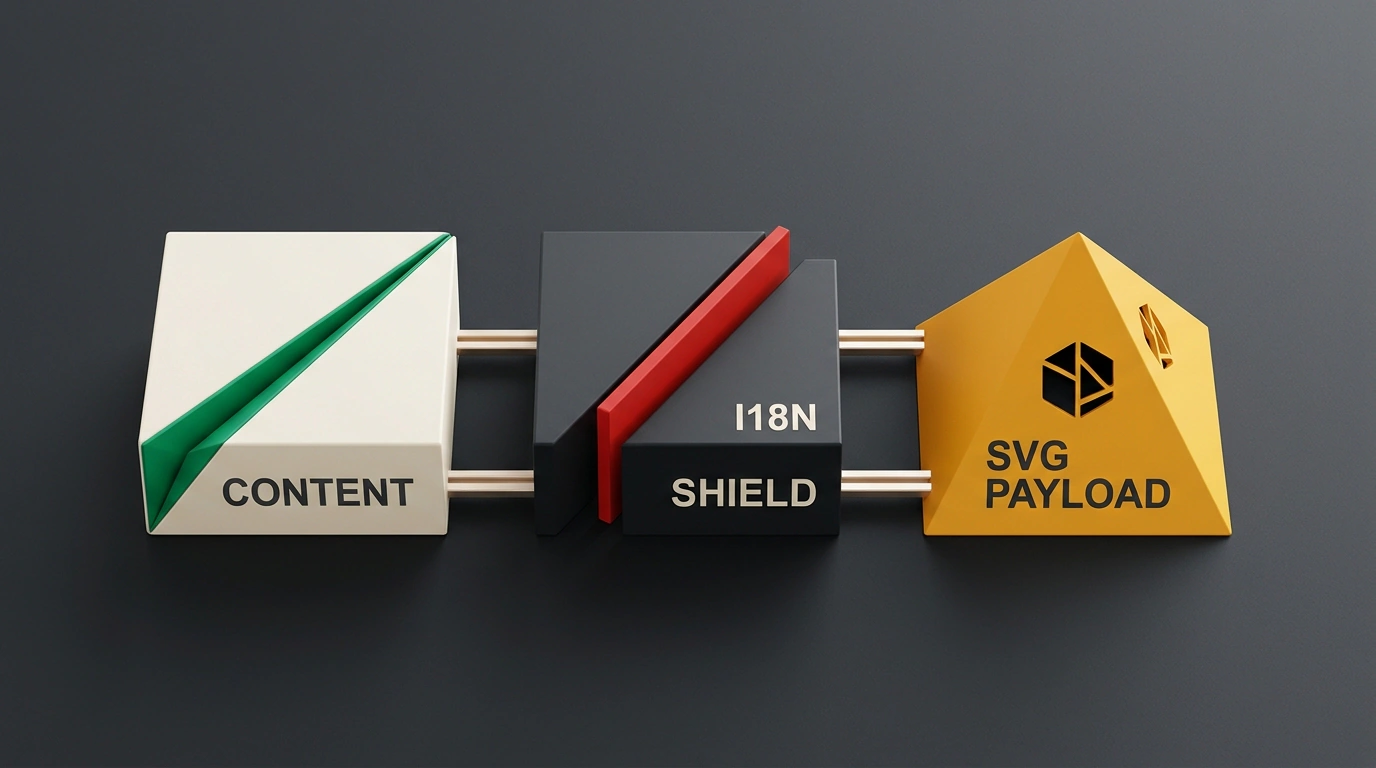
Every Vue and Nuxt dependency update brings the same dilemma. You can freeze versions for months and let small slowdowns and vulnerabilities pile up, or install fresh patches right away and risk breaking a release.
Three November updates to Nuxt Content, Vue i18n, and Nuxt Icon fix hidden issues without breaking APIs. Let's look at what changed under the hood and where these patches actually matter.
Nuxt Content 3.17: Nuxt 5 Support and Non-Blocking Database Startup
Version 3 of the module packs Markdown files into a local SQLite database compiled to WebAssembly. When a visitor opens site search, the browser spins up that database in memory and builds an index. On sites with lots of articles, synchronous startup locks the main thread, freezing tabs and blocking taps on budget phones.
In Nuxt Content 3.17.0, the client engine yields to the main thread while loading the database and search index. Initialization runs in short slices so the browser can still paint frames and handle clicks.
The release also adds Nuxt 5 compatibility, nuxt/server event handling, and batched development cache writes. Query validation now caps LIKE pattern length to block ReDoS attacks, and the Git module passes credentials when reading remote hashes. If you use Nuxt Studio previews or syntax highlighting, check the content section of nuxt.config.ts against the Nuxt Content documentation:
export default defineNuxtConfig({
  modules: ['@nuxt/content'],
  content: {
    preview: {
      api: 'https://api.nuxt.studio'
    },
    build: {
      markdown: {
        highlight: {
          theme: 'github-dark'
        }
      }
    }
  }
})
Here modules registers the module, preview.api links the project to Nuxt Studio, and highlight.theme sets the code block theme. After upgrading to 3.17.0, you don't need to touch this config: non-blocking WASM startup and LIKE limits work out of the box.
Freeing up the main thread helps large blogs and knowledge bases read on mobile devices most. Nuxt 5 and nuxt/server support is forward-looking prep, as Nuxt 5 itself is still in preview.
Vue i18n 11.4.22: Fixing XSS Vulnerabilities When Closing Tags in escapeParameter
An unclosed tag inside a translation file can open the door to mXSS (mutation XSS). A sanitizer checks the HTML string in one form, then the browser tries to repair broken markup and rebuilds the DOM tree. That mutation can turn harmless text into executable script.
Maintainers patched vulnerability GHSA-4fx6-3h3f-fh66 across two releases. In Vue i18n 11.4.21, arrays and objects passed as translation parameters are escaped as text once cast to strings, while formatter functions still receive their original types. Then Vue i18n 11.4.22 taught sanitizeTranslatedHtml to close unclosed tags and strip unmatched closing tags, mirroring browser behavior.
Unclosed <form> elements—as well as <foreignObject>, <desc>, and <mi> tags outside SVG or MathML contexts—now become plain text, while valid translations stay untouched. To make sure protection is active, check the escapeParameter option in your createI18n config:
import { createI18n } from 'vue-i18n'

export const i18n = createI18n({
  legacy: false,
  locale: 'ru',
  fallbackLocale: 'en',
  escapeParameter: true,
  messages: {
    ru: {
      welcome: 'Привет, <b>{name}</b>!',
      unclosedAlert: '<span class="alert">Внимание! Текст без закрывающего тега'
    }
  }
})
Setting escapeParameter: true sends parameters and markup through the updated sanitizer. In welcome, any non-string {name} is escaped first, and in unclosedAlert, the parser appends a closing </span> so broken markup can't leak across the page.
This update is critical if your locales contain HTML or come from an external CMS. If your translations only store plain text without raw HTML, mXSS won't trigger, though the patch still clears security audit warnings.
Nuxt Icon 2.6.3: Inlining SVGs in the Payload Without useAsyncData Overhead
During server-side rendering, Nuxt gathers data via useAsyncData and embeds it in the payload—a JSON state snapshot inside HTML so the browser skips duplicate requests during hydration. Previously, every <Icon> component spun up its own useAsyncData instance, flooding pages with dozens of extra cache keys.
In Nuxt Icon 2.6.3, loaded SVGs go straight into the payload without creating a separate useAsyncData call per icon. Any custom Iconify API host is now detected as the default provider, and API errors use Nitro's h3 package. Your component templates need zero changes:
<template>
  <div class="icon-bar">
    <!-- The icon renders on the server and goes into the payload without useAsyncData overhead -->
    <Icon name="lucide:check-circle" size="24" class="text-green-500" />
    <Icon name="lucide:alert-triangle" size="24" class="text-yellow-500" />
  </div>
</template>
name, size, and class pass the icon name and styling just as before. On the server, Nuxt inlines the finished SVG into the payload, shrinking serialized state and letting client hydration run without extra request coordination.
SSR pages packed with tables, menus, and dozens of icons will feel the speedup most. In a pure client-side SPA with no server payload, speed barely changes, though the custom Iconify API host fix is still useful there.