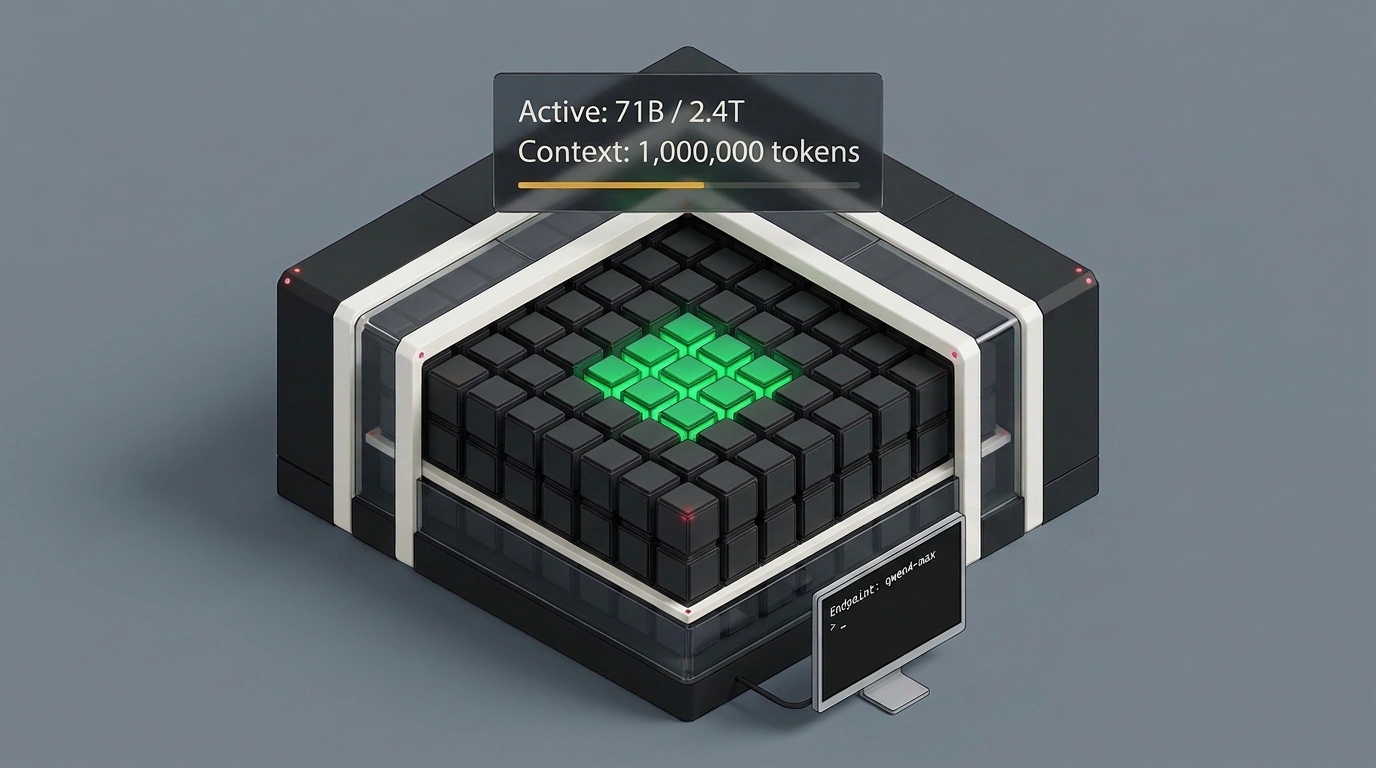
On November 16, Alibaba launched its flagship Qwen 4-Max, and two paradoxes stand out right away. The network grew to 2.4 trillion parameters, yet in practice it uses roughly half as many tokens as Qwen 3.8 Max from three months ago. The second surprise is even bigger: after training the market to expect strong open weights for local runs, Alibaba locked this flagship behind a cloud API.
How 2.4 Trillion Parameters Work and What's Off About the Benchmarks
Let's look at the architecture to see where the efficiency comes from. Under the hood sits a sparse Mixture of Experts design. Picture a huge clinic with two thousand doctors: when you walk in with a sore knee, two specialists step in rather than the entire staff. On each token, only 71 billion of the 2.4 trillion parameters activate, down from roughly 95 billion in the previous flagship. Another 328 billion live in N-gram embedding layers—a fast lookup table for common syntax patterns so the network doesn't waste compute on boilerplate.
The context window stretches to one million tokens—specifically 991,000 input tokens and 393,000 output tokens. At that scale, ordinary models often lose details buried in the middle of a long file. To keep attention sharp, Alibaba engineers added Gated DeltaNet layers and Qwen Sparse Attention. Vision is native: the model reads UI screenshots and video directly, though it replies only in text and doesn't generate images.
Launch charts show strong numbers. A breakdown on Julian Goldie SEO cites factory cases at SANF and Pacific Union where CNC programming for metal cutting dropped from 475 minutes to 24 minutes. On the Work360 long-horizon benchmark, it scored 52.69 compared to 47.74 for Qwen 3.8 Max. It ranked sixth globally on the blind frontend Code Arena, fourth for slides and fifth for spreadsheets on Design Arena, and jumped from 39.6 to 60.0 on Healthbench Professional.
Now compare the claims with reality. Both the factory case and Work360 tests were run by Alibaba itself, with no independent replications yet. Early tester timings—like a coding task dropping from 17 to 2.5 minutes or an animation from 19 to 12 minutes—are only rough data points. Vendor benchmarks often test clean LeetCode-style puzzles, whereas real projects with third-party libraries still need strict type instructions.
Pricing in QwenCloud is straightforward. Input costs $1.50 per million tokens, output costs $4.50, and cached input drops to $0.075 per million. For long sessions against a single repo, caching drives most of the savings.
Thinking Mode, Staged Delivery, and Hidden Pitfalls
Let's see what happens inside on a hard task. Qwen 4-Max includes Thinking Mode with a reasoning budget of up to 262,000 tokens. Before outputting code or a diagram, it tests hypotheses, checks edge cases, and catches contradictions. That helps in math proofs, contract reviews, and microservice design.
The default setting is easy to trip over, though. Reasoning has three levels—low, medium, and extra high—and extra high is on by default. As Julian Goldie put it, running max reasoning on minor edits is like calling an architecture committee to pick a button font. On small requests, the model gets wordy and wastes time.
Another standout feature is Staged Delivery, backed by Alibaba's open-source Live Delivery plugin. Most models go quiet on big tasks and dump a massive wall of code at the end, where a bug in step two surfaces at step fifty. Here, the model ships a working skeleton along the way, like a builder showing the house frame before laying the roof. With native vision, it can inspect a UI screenshot or 3D scene itself and adjust the layout mid-run based on your feedback.
Two rough edges remain on deep engineering work. During multi-file TypeScript refactors, the model sometimes drifts on type names unless you lock them down in the prompt. The platform also enforces strict cybersecurity filters, so legitimate network audits or pentesting tasks can trigger false refusals.
Connecting Qwen 4-Max to Cursor and Refactoring a Monolith
Let's move from theory to practice. Suppose your repo has an aging 50,000-line Express.js and TypeScript monolith. A small context window forces you to slice modules up and lose cross-file links, when you really want the model to see the whole architecture.
You can connect Qwen 4-Max to Cursor, Cline, Continue, Claude Code, Codex, OpenCode, and QwenCode. The API speaks both OpenAI and Anthropic formats, and the model is also available in Qwen Studio, QwenWork, Coder, OpenRouter, and Vercel. One small catch: the November 11 preview shuts down on November 25, so move active integrations to the main endpoint. Grab a key in your QwenCloud dashboard and add the profile to Cursor:
{
  "cursor.models": [
    {
      "name": "qwen4-max",
      "displayName": "Qwen 4-Max (Alibaba)",
      "baseUrl": "https://dashscope.aliyuncs.com/compatible-mode/v1",
      "apiKey": "sk-your-dashscope-key",
      "contextWindow": 1000000,
      "maxOutputTokens": 16384,
      "supportsThinking": true
    }
  ]
}
Here's what those fields do. baseUrl routes editor requests to DashScope's OpenAI-compatible gateway, while a one-million contextWindow lets Cursor send large file trees without truncation. supportsThinking unlocks reasoning chains, and maxOutputTokens caps each reply at 16,384 tokens.
Now run the 50,000-line monolith scenario. Feed the model your architecture doc and root modules, and ask it to split the logic into services. On the first pass, Thinking Mode spends about 25 seconds mapping dependencies, quietly builds an internal checklist of mismatched types, and outputs a modular refactor without losing context. Follow-up queries against the indexed core hit the cache at $0.075 per million tokens. A 5-million-token-per-minute rate limit lets you run multiple agents at once: one or two on the Light tier, and six to eight on Pro.
If you automate refactoring via scripts, the same setup works through the standard OpenAI Python SDK. Below, we ask the model to migrate a monolithic auth service to distributed OAuth2 tokens with thinking enabled:
from openai import OpenAI

client = OpenAI(
    api_key="sk-your-dashscope-key",
    base_url="https://dashscope.aliyuncs.com/compatible-mode/v1"
)

completion = client.chat.completions.create(
    model="qwen4-max",
    messages=[
        {"role": "system", "content": "You are a systems architect. Think step by step before generating code."},
        {"role": "user", "content": "Refactor monolithic auth service into distributed OAuth2 tokens."}
    ],
    extra_body={"enable_thinking": True}
)
print(completion.choices[0].message.content)
The OpenAI client talks directly to Alibaba's servers by overriding base_url and setting the model to qwen4-max. extra_body toggles reasoning with enable_thinking, while the system prompt sets the architect role. For quick edits, flip the flag to False or lower the thinking level so the model doesn't burn seconds for nothing. The API also includes built-in function calling, strict JSON, batch processing, web search, page extraction, and a code interpreter.
Where the Model Shines and Where It Doesn't Belong
Qwen 4-Max has a clear sweet spot and hard boundaries. It handles legacy repo audits, year-long chat logs, and dense spec bundles inside its one-million-token window. It also holds up well in long agent chains with staged checks, screenshot UI reviews, and cache-heavy sessions.
Avoid using it in three cases right now. If your security policy bans sending code to an external cloud, this closed-weight flagship won't work—and there's no release date yet for open smaller Qwen 4 models. From Europe to DashScope's Asian servers, time-to-first-token runs 200–400 milliseconds, which makes live autocomplete feel sluggish. Finally, leave vulnerability scanning and pentesting to other tools, since platform safety filters often block even legitimate network audit code.