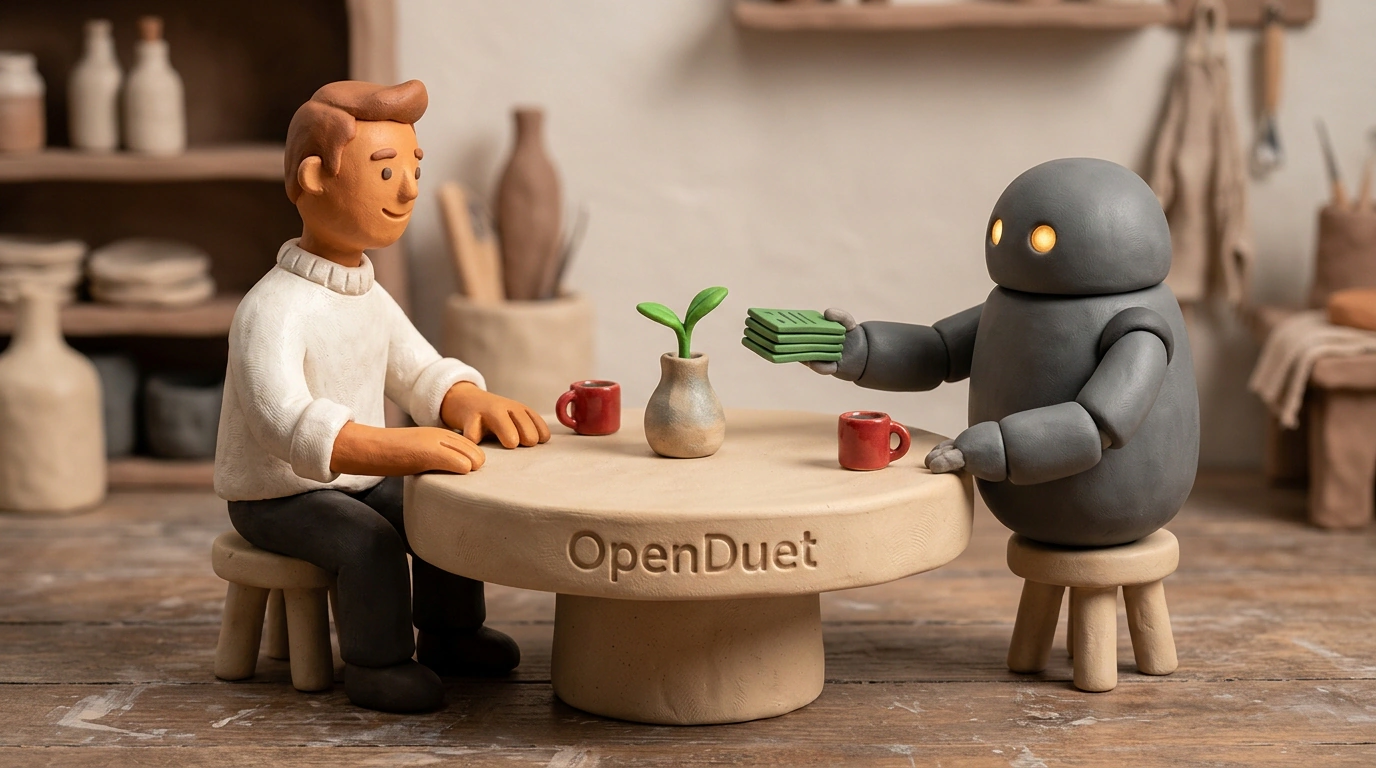
Think about a typical workday with AI assistants. You open a browser tab, stare at an empty input box, and methodically spoon-feed the model context: pasting build logs, forwarding client email snippets, asking leading questions. Until you hit Enter, the artificial intelligence sits in a deep coma. If a database crashes at 3 a.m., a payment gateway drops, or a client cancels a contract in an angry email, a reactive chatbot won't twitch a single transistor. It simply doesn't know how to act first.
The CopilotKit team decided to flip that script upside down. They released OpenDuet — an MIT-licensed open-source framework and full-featured assistant template built around the Proactive Agent Pattern. The project positions itself as an open alternative to proprietary announcements like Anthropic's Claude Duet, putting control over background workflows back into independent engineers' hands.
Anatomy of a Sleeping Agent: What's Wrong with the Reactive Approach
Classic chat interfaces suffer from a fundamental architectural flaw: they are strictly synchronous. The model wakes up on an HTTP request, runs tokens through attention layers, returns a reply, and instantly unloads from memory. It has no persistent lifecycle, no background timer, and no mechanism to watch the outside world in real time.
In practice, this creates a paradox:
- Information blindness. The human ends up acting as the on-call monitor: scanning dashboards, re-checking email, babysitting CI/CD builds.
- Zero initiative. A model can write the perfect script to recover a crashed Kubernetes cluster, yet it will never run it on its own when an outage strikes.
- Session amnesia. Close the chat tab, and the entire chain of intermediate reasoning vanishes. Long research tasks requiring hours of scraping and cross-checking turn into tedious babysitting in front of a glowing monitor.
The proactive pattern demands a completely different foundation. An agent needs a continuous habitat — a Dedicated Agent Computer with persistent access to system utilities, network sockets, and a task scheduler.
OpenDuet Architecture: Background Runtime and Three Pillars of Proactivity
OpenDuet's stack builds on the OpenBot architecture running atop the lightweight Hono server runtime and CopilotKit. Instead of keeping a browser WebSocket alive, the system decouples the user interface from the agent's compute loop. The agent runs continuously server-side, executing an event-monitoring loop even when your client device is offline.
The developers structured proactive assistant behavior around three core UI and logic components:
- Morning Brief. The first thing an engineer sees on login isn't a blank prompt box — it's a prioritized digest of events. Overnight, the agent autonomously reviewed GitHub pull requests, filtered Slack messages, checked calendar conflicts, and flagged critical forks. Items split into two buckets: things needing a human decision right now, and routine chores the agent already closed in the background.
- Background Event Loop. Long-running jobs — load testing, hours-long industry scraping, heavy package compilation — move into an independent worker thread. When a stage finishes or something breaks, the agent pings you via web push notifications, a Telegram bot, or a Slack channel.
- Human-in-the-Loop Approvals. Full autonomy is dangerous: letting a neural network drop database tables or wire payments unchecked is asking for disaster. OpenDuet solves this with delegation cards. Before running a risky operation, the agent pauses and generates a request card with full situational context and three buttons: "Allow once," "Always allow," or "Refuse."
Spinning up a local OpenDuet test bench takes just a few commands:
# Clone the official OpenDuet repository
git clone https://github.com/CopilotKit/OpenDuet.git
cd OpenDuet

# Install project dependencies with a clean install
npm ci

# Initialize environment variables and API keys
cp .env.example .env

# Start the local development server on Hono
npm run dev
In code, proactive behavior is declared cleanly. You define the check schedule, trigger conditions, and the exact actions the model must take when an incident fires.
Here's what an infrastructure reliability watchdog agent looks like in TypeScript:
import { createProactiveAgent } from "@copilotkit/openduet";

export const siteReliabilityDuet = createProactiveAgent({
  name: "ProductionSentinel",
  schedule: "*/10 * * * *", // Check every 10 minutes
  triggers: [
    {
      event: "api_healthcheck_degraded",
      condition: async (ctx) => {
        const res = await ctx.terminal.exec("curl -s -o /dev/null -w '%{http_code}' https://api.service.internal/health");
        return res.stdout.trim() !== "200";
      },
      action: async (ctx, alert) => {
        // Gather diagnostics in an isolated terminal
        const logDump = await ctx.terminal.exec("docker logs --tail 50 core-api-gateway");

        // Generate an operator approval card
        await ctx.notifyUser({
          channel: "telegram",
          priority: "critical",
          title: "Alert: API gateway degradation",
          summary: "Health endpoint returned an error. Captured last 50 lines of container logs.",
          payload: logDump.stdout,
          approvalRequired: true,
          suggestedRemediation: "Restart core-api-gateway container and flush socket cache"
        });
      }
    }
  ]
});
The AG-UI Protocol and Breaking Vendor Lock-In
OpenDuet's biggest engineering asset is architectural neutrality. Proprietary platforms weld users to their own cloud infrastructure and specific model families. OpenDuet implements the AG-UI (Agent-Graphic User Interface) protocol, standardizing how structured UI widgets flow between backend agents and a React frontend.
You can plug any model provider into the brain via the abstract CopilotKit Docs interface:
- Frontier models like Anthropic Claude 3.5 Sonnet or OpenAI GPT-4o for complex multi-step reasoning;
- Local open weights (Llama 3.3, Qwen 2.5, DeepSeek) via Ollama or vLLM — essential for air-gapped enterprise environments with strict data-secrecy rules;
- Hybrid setups, where a cheap local network handles routine background polling and a frontier model is called in only when an incident hits.
Reality Check: Tokens, Alert Spam, and Sandbox Isolation
Moving to proactive agents inevitably introduces new engineering challenges that flashy demo videos gloss over:
- Background polling economics. If an agent forces a heavy LLM to re-read your entire project context every five minutes just to check two statuses, your token budget will vanish in days. Proactivity should run on deterministic hooks and lightweight triggers (cron jobs, webhooks, message-queue events), calling the neural network only after code flags an anomaly.
- Alert fatigue. An overly eager assistant quickly becomes an annoying spam hose. If the bot pings you for every trivial blip, engineers will mute notifications altogether. Strict calibration of sensitivity thresholds and message priorities is mandatory.
- Sandboxes and execution security. Giving an LLM shell access opens a massive attack surface. An OpenDuet agent must live inside an isolated Docker container with stripped privileges, memory caps, and blocked access to internal subnets unless explicitly permitted.
OpenDuet proves that the era of passive chatbots is fading into history. AI's true value unlocks when the system becomes a genuine teammate, taking the grind of nonstop digital babysitting off your shoulders.