Since the landmark 2017 paper "Attention Is All You Need," the AI industry has lived under a strict technological monopoly. Self-Attention inside the Transformer architecture became the foundation for every frontier network without exception — from GPT-4o to Claude and Gemini. Scaling worked like clockwork: stack more layers, buy clusters of H100 accelerators, and watch intelligence climb.
Yet that winning formula hits an immovable physical wall: quadratic growth in attention compute and an insatiable appetite for GPU memory. Every generated token forces the model to store key and value vectors in a Key-Value (KV) Cache. At long context lengths, that cache balloons to tens of gigabytes, turning deployment on edge devices — smart glasses, autonomous drones, or compact microcomputers — into an impossible engineering puzzle.
Liquid AI, a startup founded by researchers from MIT's CSAIL lab led by Ramin Hasani, Mathias Lechner, and Daniela Rus, has challenged the prevailing dogma. They unveiled their third-generation foundation model family, LFM3 (Liquid Foundation Models). The release proves that a compact non-transformer network in the 2-billion-parameter class can compete head-to-head with transformers six times its size. Let's unpack the math behind this architecture and what it means for edge AI.
Liquid Neural Networks and the Tri-Hybrid Architecture: Math Beyond the Transformer
At the heart of Liquid AI's work is the concept of Liquid Neural Networks (LNN). Unlike classic artificial networks whose synaptic weights are frozen after training, liquid networks are modeled as continuous dynamical systems governed by nonlinear differential equations. Their hidden states and time constants adapt on the fly to shifting input streams right during inference.
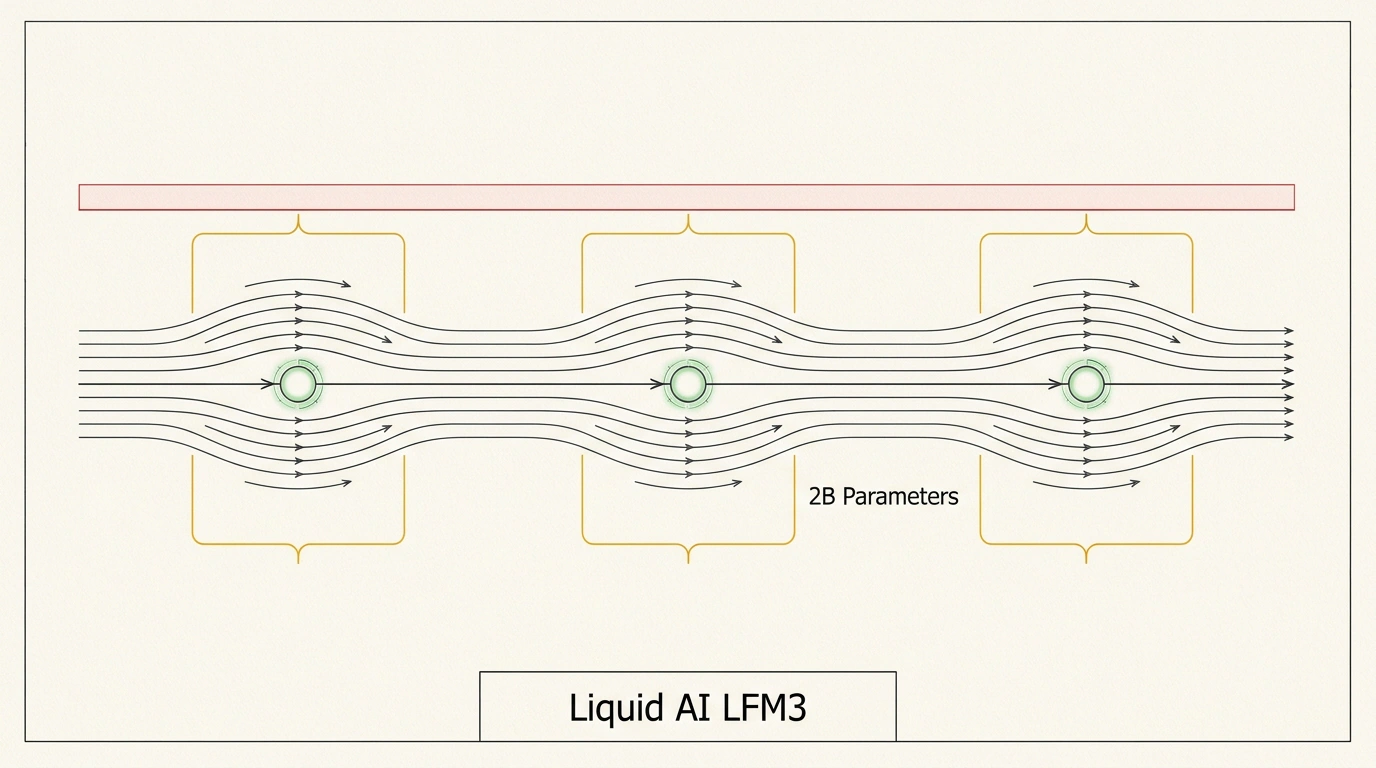
LFM3's major breakthrough is replacing uniform attention layers with a Tri-Hybrid Architecture. Instead of forcing every token to attend to every preceding symbol, each compute block splits into three complementary components:
- Gated short convolutions. They capture local morphological and syntactic patterns between neighboring tokens. Convolutions run in constant time and require no intermediate cache.
- Sliding-window attention. Attention stays, but operates only over a tight local horizon of a few hundred tokens, handling precise agreement between nearby concepts.
- Global linear memory compression. Rather than inflating a giant KV cache, long-term memory lives in a compact mathematical State Space, continuously integrating the gist of what's been read through differential equations.
This hybrid design slashes KV cache size by over 70% compared to a standard transformer. We previously detailed how this mechanism compresses hardware footprints in our piece on the multimodal Liquid AI LFM 3 family.
The LFM3 Lineup: A 2B Vision Model vs. 12B Giants and an Ultra-Light Agent
The LFM3 family is built on a single unified core, LFM3-1.7B-Base, spanning six specialized models:
Flagship of the multimodal branch is LFM3-VL-2B (actual weight 1.9B parameters). To stress-test it, developers ran an extensive evaluation across 62 independent computer vision benchmarks. The results turned heads: the compact network matched the average recognition and spatial reasoning quality of classic 12-billion-parameter transformers. It reads analog dial gauges accurately, tracks traffic dynamics in live video streams, and handles robotic arm navigation with ease.
The text model LFM3-1.7B made a similar leap in agentic workflows:
- Supports a context window up to 256,000 tokens;
- In 4-bit quantization (GGUF, Apple MLX, ONNX Runtime), the entire model sits in just 1 gigabyte of RAM;
- Expressly optimized for frequent Tool-Calling, strict JSON parsing, and web navigation.
The lineup also includes LFM3-Audio-2B, the end-to-end multimodal LFM3-Omni-2B, and specialized deterministic classifiers d1-2B. We explored how those compact decision arbiters work in our article on Liquid AI d1 dynamic decision models.
The Edge AI Revolution: Why Energy Efficiency Beats Brute Force
LFM3 reshapes the balance of power in embedded systems and IoT:
- Full Edge AI autonomy. A robot vacuum, inspection drone, or pair of smart glasses no longer depends on cellular signal stability or cloud server latency. Modern assistant-grade intelligence runs locally on inexpensive mobile chips.
- Power efficiency. In portable gadgets, every watt-hour of battery counts. Liquid architecture's linear layers need far fewer compute cycles per generated token, preventing device overheating and extending battery life.
- Server infrastructure throughput. In cloud clusters, eliminating the heavy KV cache lets a single NVIDIA A100 or H100 GPU host 5–10x more concurrent user sessions, cutting inference costs by an order of magnitude.
Capability Limits and Practical Trade-Offs
Even with a major architectural win, there are no miracles — liquid networks come with real-world boundaries:
- Factual knowledge capacity. A 1.7–2B parameter model mathematically cannot store all of Wikipedia or millions of scientific monographs inside its weights. For factual lookups, it needs external search or a knowledge base.
- Deep logical deduction. On unconventional math Olympiad problems or multi-page architectural essays, LFM3 trails heavy frontier reasoning models like GPT-5 or Claude Opus.
- Software ecosystem support. Integrating custom kernels for liquid differential layers requires optimized libraries, though baseline support in ONNX and MLX takes the edge off.
The Liquid AI LFM3 family makes one thing clear: the era of blindly piling on parameters is winding down, giving way to sleek dynamic architectures where internal organization matters more than raw network mass.