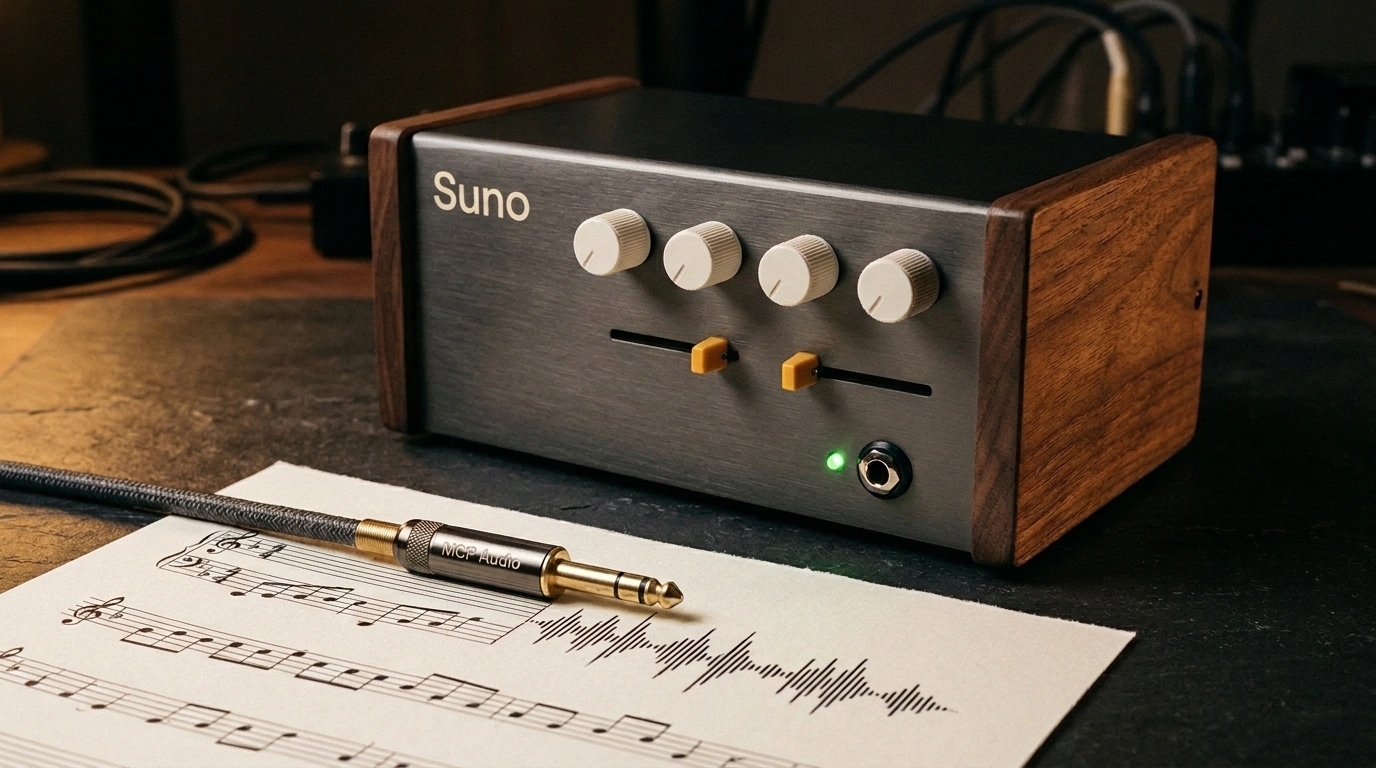
If you've ever assembled multimedia content with AI — a promo clip, a podcast, or audio for an indie game — you've probably cursed how fragmented modern AI tools are. You wrote the script in one chat, generated the voiceover in a third-party service, and then had to open Suno's website for background music, manually typing prompts, picking genres, waiting on renders, and downloading MP3s to disk.
In late October 2026, that zoo of interfaces took a giant leap toward unification. Suno (suno.com), the leader in vocal synthesis and complex orchestrations, rolled out an official integration built on the open Model Context Protocol (MCP). We previously discussed how this protocol is becoming the primary standard for autonomous models talking to the outside world in our breakdown of moving from web chat to Claude Code CLI and coordinator architecture. Now generative audio has joined the open ecosystem too.
What MCP Changes: From Web Forms to Programmatic Tool Calls
Proposed by Anthropic's engineers, the Model Context Protocol is often compared to USB-C for artificial intelligence. Before it existed, every service developer cobbled together proprietary plugins, flaky webhooks, or complex REST API setups.
The Suno MCP integration turns music generation into standard Tool Calling:
- End-to-end conversation context: Claude Desktop, Cursor, or terminal agents gain native access to
create_track,extend_track, andseparate_stemstools. - Keyless authorization: instead of insecurely pasting secret API tokens into plain JSON configs, permissions are delegated through an OAuth web gateway. On first use, the agent opens your system browser to link your Suno profile.
- Uses your existing plan: requests deduct credits directly from your active user subscription (including daily free allowances), requiring no separate API balance deposit.
We recently saw a similar standardization wave in voice tech with the launch of the official ElevenLabs MCP server. The audio stack for agentic systems is taking shape right before our eyes.
Client Configuration and Programmatic Calls: How It Works
Connecting Suno MCP to Claude Desktop takes about a minute via the system claude_desktop_config.json file:
{
  "mcpServers": {
    "suno": {
      "command": "npx",
      "args": [
        "-y",
        "@modelcontextprotocol/server-proxy",
        "--endpoint",
        "https://api.suno.com/mcp"
      ],
      "env": {
        "SUNO_AUTH_MODE": "oauth_browser"
      }
    }
  }
}
After restarting Claude Desktop, Suno's functions appear in your available tools list. You can simply type in chat: "Write lyrics for an upbeat indie-rock track about late-night coding in Zig and generate a two-minute song right away." The model drafts the verse and chorus, adds genre tags, and invokes the Suno server.
For developers building custom automated content pipelines, calling the server via the official SDK is completely transparent:
import { Client } from "@modelcontextprotocol/sdk/client/index.js";
import { SSEClientTransport } from "@modelcontextprotocol/sdk/client/sse.js";

async function generateSoundtrack(lyrics: string, genreTags: string) {
  const transport = new SSEClientTransport(new URL("https://api.suno.com/mcp/sse"));
  const client = new Client({ name: "content-pipeline", version: "1.0.0" }, { capabilities: {} });
  await client.connect(transport);

  const result = await client.callTool({
    name: "create_track",
    arguments: {
      prompt: lyrics,
      tags: genreTags,
      make_instrumental: false,
      model_version: "v4"
    }
  });

  console.log("Audio stream ready:", result);
}
New Workflows: From Chat Composer to Media Content Factory
A direct programmatic bridge to Suno unlocks workflows that used to require an entire production team:
- Autonomous vertical-video factories: a scriptwriting agent drafts the video script, a voice model reads the narration, and Suno MCP matches tempo and key to generate a bespoke backing track, mixing the final video through FFmpeg in minutes.
- Procedural game sound design: indie game writers can compose musical themes for specific locations or combat scenes straight from their code editor, passing character mood and environment into the prompt.
- Iterative track mixing: if the chorus sounds great in a generated track but the verse drags, you can tell the chat directly: "Keep the chorus melody, but rewrite the intro in acoustic blues style." The agent calls
extend_trackwhile preserving the musical motif.
Pitfalls and Engineering Limits
Despite huge potential, the Suno MCP integration comes with technical quirks to keep in mind:
- Generation latency: synthesizing a high-quality two-minute track on v4 takes 20 to 45 seconds. MCP uses Server-Sent Events (SSE) for async waiting, though clients with strict timeouts may drop the connection unless retry policies are configured.
- Credit burn rate: unlike text queries, audio generation eats through subscription balances fast. Handing tool access to a looping agent without a strict generation counter will evaporate a monthly Suno credit pack in half an hour of experiments.
- Copyright filters and moderation: Suno's safety filters strictly block direct references to specific artists (such as "a song in the style of Queen or Metallica") to prevent lawsuits. The agent has to phrase prompts using abstract genre tags (driving rhythm, vintage tube amps, polyphonic vocals).
Suno's integration into the Model Context Protocol confirms 2026's defining trend: the era of isolated neural services is winding down. The winners are protocols uniting text, code, vision, and music into a single open ecosystem.