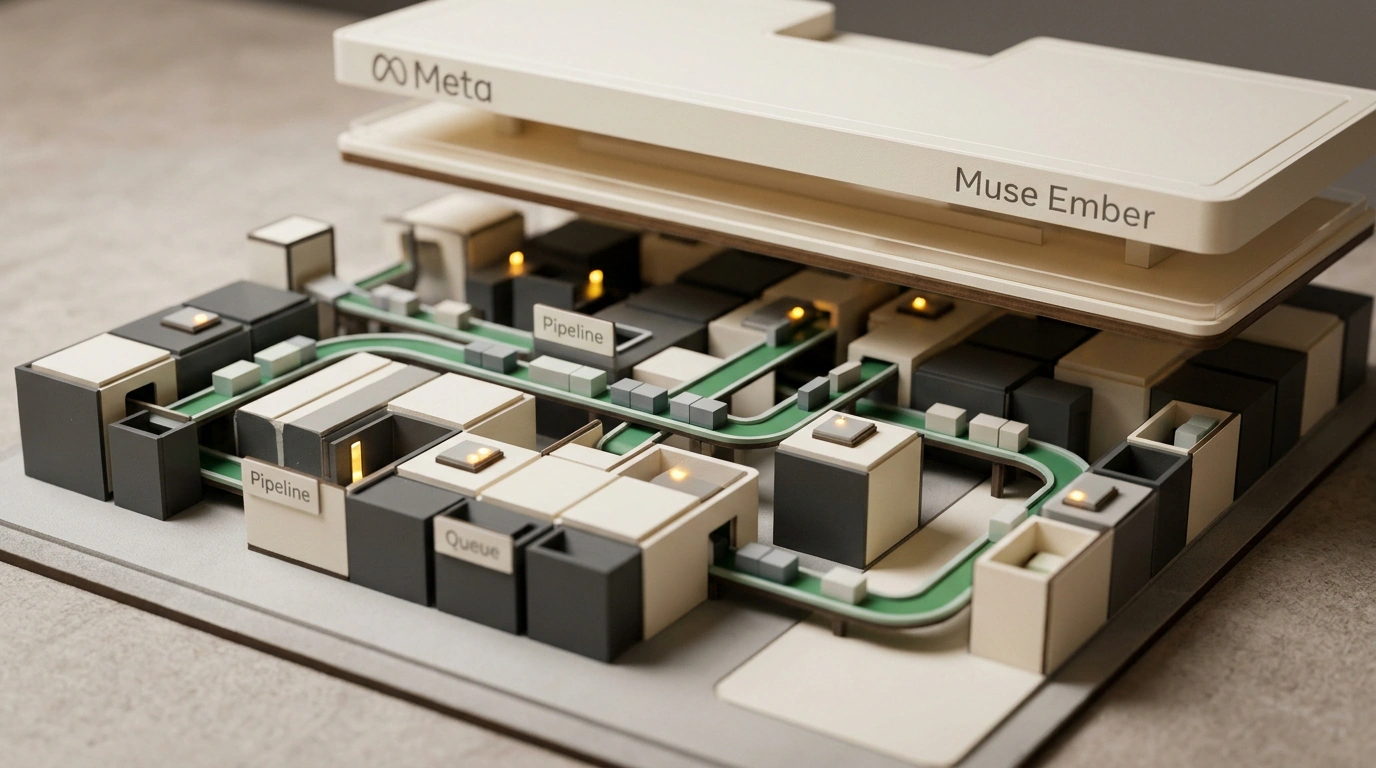
When you chat with an AI in a browser window, you only see the storefront: send a prompt, get a reply a couple of seconds later. Behind the scenes of real business automation, nobody is having polite conversations—background pipelines spend all day parsing emails, cross-checking spreadsheets, and shuttling data between services.
For that heavy lifting, Meta Superintelligence Labs released Muse Ember (muse-ember-1.0) on November 9, 2026. Looking at the announcement, my first question was obvious: why did Meta build a separate engine just for grunt work when the market is already packed with capable general-purpose LLMs?
Why Flagship Models Bankrupt Agent Operators
It comes down to the workload gap between a human chat and an autonomous pipeline. In a chat, you ask one or two questions and close the tab, so the per-call cost of a flagship model barely registers. An autonomous agent tackling a single job, by contrast, spins through hundreds of recursive loops—parsing logs, filtering lists, and calling external tools.
Running that firehose through one flagship model is like delivering letters in a mining dump truck. Sure, a top-tier model will pull phone numbers out of lead forms effortlessly, but across thousands of runs, the API bill eats your margin alive. Meta's engineers split the labor: senior models handle judgment calls, while a cheap execution engine chews through the volume.
How Roles Are Split Across the Meta Muse Family
Meta's blog sums it up in one line: "Muse Wonder plans, Muse Ember handles the volume." The Muse lineup breaks into three tiers:
- Muse Wonder acts as the strategist: it analyzes the goal, sets rules, and decomposes steps (and in consumer apps, builds interfaces in Spaces).
- Muse Spark handles coding and broad agentic workflows.
- Muse Ember serves as the line worker: following an explicit playbook, it classifies entities, triggers APIs, and extracts JSON fields.
Technical Headroom, Pricing, and Trade-Offs
I checked the spec sheet, and the junior model packs serious analytical headroom. Muse Ember features a 1,000,000-token input window and outputs up to 512,000 tokens in one pass—enough to swallow a full site technical audit, backlink profile, and project docs. It's also natively multimodal, reading text, PDF reports, dashboard screenshots, call recordings, and video without extra converters.
The headline hook is pricing around $0.10 per million input tokens (we benchmarked it against rivals in our Muse Ember Pareto frontier review). As Julian Goldie of Julian Goldie SEO demonstrated using Meta's docs, processing 10 million input tokens and 2 million output tokens on standard pricing costs pennies. You do have to respect two constraints, though: Ember doesn't strategize from scratch (give it vague goals without a senior model's guardrails and you'll get shallow output), and it's currently cloud-only via the Meta Model API with no date for local weights.
Lead-Triage Pipelines and Rules for Building Your Own
In a B2B sales workflow Julian Goldie walked through from AI Profit Boardroom, Muse Wonder defines the qualification rubric while Muse Ember runs the conveyor belt. On each loop, Ember reads incoming emails, pulls names and addresses, checks the prospect's site via web lookup, and tags leads as hot, warm, or cold based on intent signals—then updates the CRM and drafts a reply for a fraction of a cent per lead. The exact same setup works for SEO content gaps (comparing competitor URLs against your blog to build a keyword difficulty table) or running code test suites.
To adapt this two-tier pattern without burning cash, stick to three rules:
- Separate planning from execution: keep goal decomposition on a flagship planner, and route repetitive parsing and filtering loops to Muse Ember.
- Feed mixed media directly: lean on the million-token window and native multimodality to pass PDFs, screenshots, and meeting audio in a single call.
- Keep humans in the loop on outbound messages: let the engine sort leads and update CRM fields, but save client replies as drafts so raw boilerplate never goes out unchecked.
Splitting the architect from the tireless line worker removes the cost ceiling and finally makes complex agent pipelines pencil out.