On November 10, 2026, Google Cloud launched Gemini for Healthcare, a multi-agent AI system built for hospitals, clinicians, and insurers. Early preview partners include HCA Healthcare, Northwell Health, Highmark Health, Hartford HealthCare, and insurer Blue Cross Blue Shield of Massachusetts. Engineers started from a scene every patient recognizes: a doctor bouncing between disconnected windows—clinic records, lab PDFs, and insurance rules.
Whenever you hear "medical AI," the obvious worry hits first: are we really letting a model make diagnoses when one hallucinated line on a prescription or a missed allergy could cost a life? After reading Google Cloud's docs and Julian Goldie's breakdown, I noticed a crucial distinction: the platform doesn't treat patients in place of a doctor. It works like an archivist assistant, pulling scattered records into a single timeline with clickable citations while leaving every clinical decision to a human.
The Paperwork Second Shift: Counting the Administrative Toll
A joint study by Google Cloud and The Harris Poll shows just how heavy the load has grown. Practicing physicians and nurses spend 27 to 28 hours a week on reports, charting, and messaging, while clinic admin staff spend up to 36 hours. Over 80% of clinicians report chronic burnout from that paperwork second shift stealing time away from patients.
To be fair—and Goldie rightly flags this—those hours reflect current clinic overload, not proven time saved by the new tool; Google hasn't published post-launch time-savings metrics yet. Still, the survey nails the root problem: patient data is already sitting on servers, just locked inside isolated silos.
Medical Record Synthesis Architecture and Appointment Prep
To pull facts together without hallucinations, the platform centers on Medical Record Synthesis. In plain terms, it's a read-only assistant connected via secure bridges to EHR systems like Epic and Oracle Health, ServiceNow workflows, Continuity of Care Documents (CCD), and external lab PDFs. For each job, the agent follows an expert-authored playbook called a Healthcare Skill.
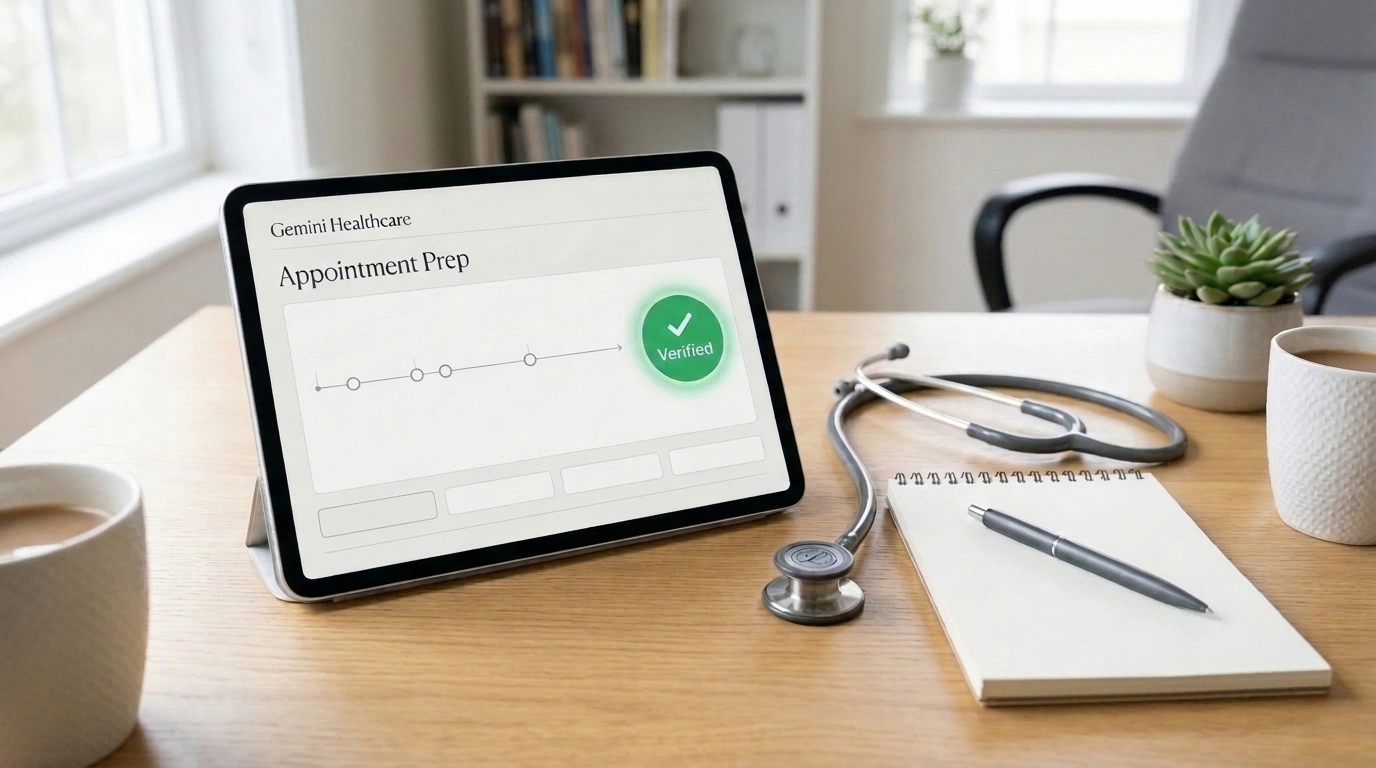
Watch how it plays out before a visit with a patient managing hypertension and diabetes in the Appointment Prep module. Suppose the patient has accumulated 40 pages of lab work over three years. Instead of the doctor flipping through five folders, the agent builds a chronological timeline from oldest to newest, verifies consent forms, and spots declining kidney function. It cross-checks that trend against active medications and allergies, then surfaces a prep card flagging potential drug interactions. Every single line includes a clickable citation back to the source page: one click opens the original lab report.
Automating Prior Authorizations Before the Visit
When a patient with reduced kidney function needs a medication swap or a new scan, clinics hit the wall of Prior Authorization. Before approving payment, the insurer demands proof of medical necessity under the policy's exact rules.
Staff normally spend days chasing down records only to get rejected over a missing form. Here, the agent checks clinical notes against policy criteria, drafts a cited justification packet in minutes, flags missing paperwork, and helps write appeals if a claim is denied. On the insurer side, the system checks requests against coverage rules and translates dense policy language into plain English so members can see which doctors are in-network.
Human-in-the-Loop and a Blueprint for Reliable Agents
Why won't a model hiccup turn into a medical error? The entire platform enforces strict Human-in-the-Loop control. Connectors to Epic and Oracle Health are strictly read-only, and every summary, referral, or prescription is generated as a draft that only takes effect after a physician's digital signature. Every step is logged for audit, patient data is never used to train Google models, and tasks are routed across Google, Anthropic, and OpenAI models—similar to the routing we covered in Vertex AI's Auto mode. Right now, access is limited to Gemini Enterprise Standard and Plus customers in the U.S., and regions outside HIPAA require separate certification.
Even so, Google's architecture offers a universal blueprint for reliable AI agents: connect your data silos, give agents narrow playbooks, require source citations on every line, and keep final sign-off human. Nobody goes into medicine to play courier between browser tabs. Handing the paperwork cross-checks to a verifiable agent gives doctors back the time—and calm—to look at the person across from them instead of a monitor.