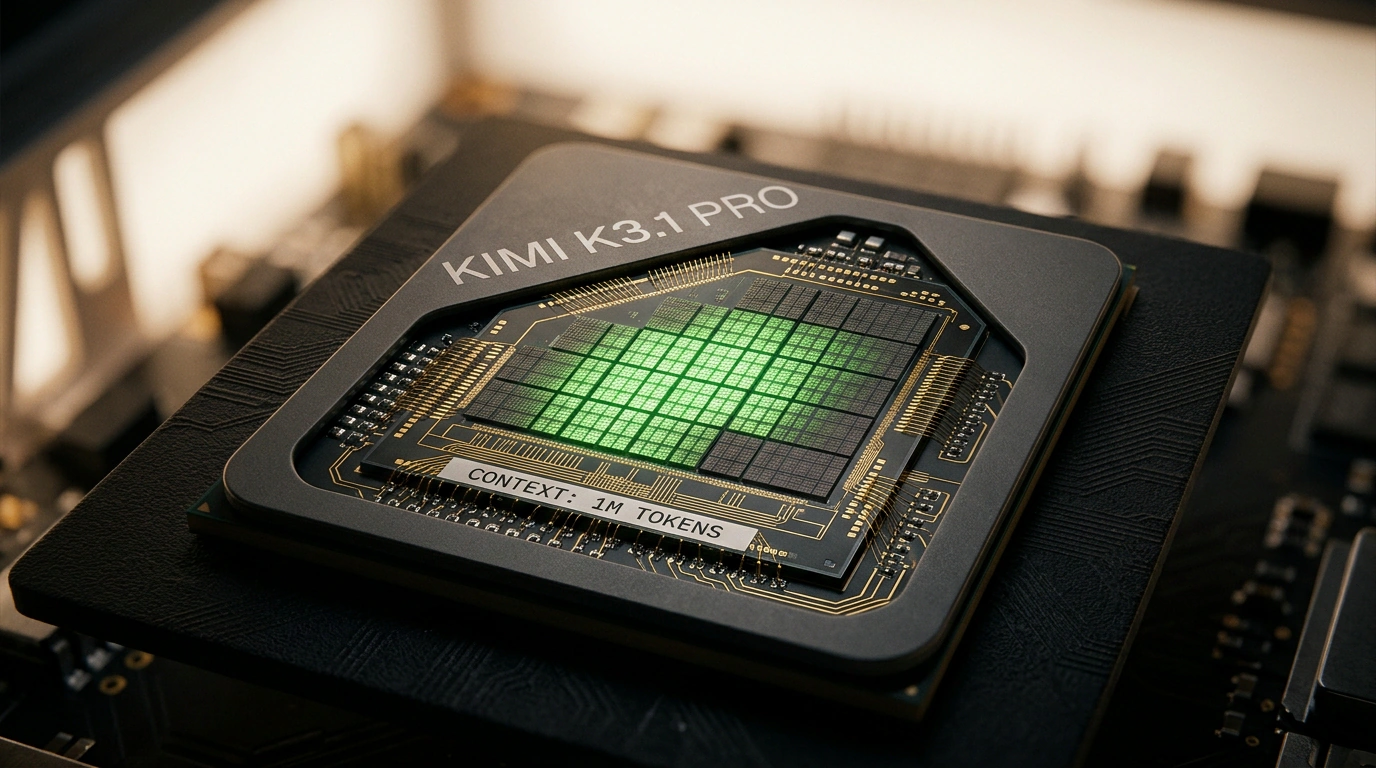
Whenever another AI lab loudly announces a one-million-token context window and a model pushing three trillion parameters, my inner skeptic immediately wakes up. We have seen it way too often: impressive benchmark numbers turn into a sluggish monster in practice—one that loses the thread of the conversation by token twenty thousand or spits out sterile clichés instead of working code.
Yet the Chinese lab Moonshot AI just dropped Kimi K3.1 Pro, and their engineers managed to put together a genuinely intriguing architecture. It is a Mixture of Experts (MoE) model totaling 2.8 trillion parameters, with a compact 104-billion-parameter block activated per token. The headline feature is a native one-million-token context window paired with a deep post-training cycle using synthetic verifiers. I took this setup, loaded it with complex tasks, and tested how it holds up in the real world when you need to build working products, not just chat.
In earlier issues, we already followed how the Kimi K3 lineup and open coding models evolved, but in version 3.1 Pro the model's behavior has changed fundamentally. It now features an always-on reasoning engine, making it act much more like a thoughtful systems architect than a high-speed text generator.
2.8 Trillion Parameters and a Million-Token Context Under the Hood
Let's break down how this beast works under the hood, because there is a subtle balance here between raw power and compute cost. In classic dense models, every single request pushes the signal through every layer of the neural network. With Kimi K3.1 Pro, the MoE architecture activates exactly 104 billion parameters out of the 2.8 trillion. That keeps compute times reasonable while preserving the vast knowledge base of the underlying model.
The real highlight, though, is how you control its thinking depth. The developers exposed a reasoning_effort parameter in the API with three levels: low, high, and max (max is enabled by default). Unlike early attempts to simulate thinking through rigid system prompts, this model has a built-in hidden verifier for reasoning chains. Before streaming the very first character of its reply to you, the model generates hidden self-check tokens, simulates potential failure modes, and only then moves on to assembling the final code or report.
A 1,000,000-token context window isn't just about dumping a massive manual into the prompt. In "Needle In A Haystack" retrieval tests, K3.1 Pro scored over 99.2% accuracy at depths up to 950,000 tokens. In plain terms, if you bury a single config flag or a tiny contract clause in the middle of nine hundred pages of text, the algorithm will find it with near-certainty without losing focus toward the end of the document.
Battle-Testing: 3D Scenes, Code, and Fact Retention
I tested Kimi K3.1 Pro on a task where even industry favorites regularly stumble: building a full-featured browser 3D app using Three.js and WebGL. Usually, models either forget to dispose of geometry buffers or get tangled up in camera transformation matrices, leaving you to hunt down rendering bugs for hours.
I fed the model a text description of an interactive solar system with physically accurate orbit scaling, procedural atmosphere shaders, and mouse controls. Set to reasoning_effort: max, the model spent about 22 seconds on hidden reasoning, then output a completely working, monolithic HTML file with scripts and zero syntax errors. In BenchCAD tests, the model also reliably reconstructs parametric 3D models from two or three flat projections, generating clean vector contours.
On Terminal-Bench—which tests whether a model can handle complex engineering tasks like installing dependencies, editing config files, and running unit tests—K3.1 Pro came remarkably close to Claude Opus 5.5. You notice this especially when refactoring large codebases: you upload an archive with dozens of modules, and the model doesn't hallucinate nonexistent imports because it holds the entire repository structure in active memory.
The Highspeed Variant and Real Compute Costs
For scenarios where waiting 20–30 seconds for reasoning is a dealbreaker, Moonshot AI launched an infrastructure variant called Kimi K3.1 Pro Highspeed. It runs 2.5–3x faster than the standard version thanks to aggressive parallel speculative decoding and optimized key-value caching (KV-cache). If you are building an interactive assistant for a support agent or a live developer console, Highspeed is by far the more practical pick.
Compared to Western counterparts, pricing through the official API and aggregators like OpenRouter looks downright aggressive:
- Standard Kimi K3.1 Pro: $2.00 per 1 million input tokens and $10.00 per 1 million output tokens.
- On a context cache hit, the input price drops to a laughable $0.20 per million.
- The Highspeed variant runs $4.00 for input and $20.00 for output per million tokens.
Stack that against flagship closed APIs, and the cost of a single deep analysis session is three to five times lower with Kimi. For startups building analytics pipelines over large knowledge bases, unit economics like that often make the difference between a profitable product and endlessly burning venture cash.
The Catch: Where It Stumbles and When to Skip It
It would be naive to assume this release has no flaws. The first and most noticeable trade-off is Time To First Token (TTFT). Once your loaded context crosses 800,000–900,000 tokens, the startup delay in standard reasoning mode can stretch up to half a minute. For synchronous microservices where a user expects an instant page response, that simply won't fly.
Second is local deployment. Even though the weights were announced for the open community, a 2.8-trillion-parameter MoE architecture physically demands massive server clusters. Even under aggressive 4-bit quantization, running it requires a pool of at least 8 NVIDIA H100 or H200 accelerators. You won't be spinning this up in a home lab or on a single modest rented box, so for most people, the cloud API remains the only realistic option.
Finally, before release, Moonshot AI engineers applied "zero-day dampening"—deliberately weakening the model's ability to hunt for low-level zero-day exploits. That is a sensible move for safety, though if you do legitimate penetration testing, the model will flatly refuse to generate specific shellcodes.
At the end of the day, we have a powerhouse tool for complex analytics, coding, and large-scale projects—one where a million-token context window has finally stopped being a marketing gimmick and become a reliable daily driver.