If you maintain frontend apps or large TypeScript monorepos, you know how annoying local environment variables in package.json scripts have always been. Want to run a database migration or boot a local API emulator with custom keys? You either pull in dotenv-cli as a dev dependency or cobble together cross-env workarounds. Shell exports limp along on Linux and macOS, then break outright on Windows because PowerShell and cmd.exe handle variable syntax completely differently.
The pnpm team, led by Zoltán Kochan, just shipped a coordinated update across both active lines: the major pnpm v12.16.0 release and a maintenance update for the LTS branch, v11.28.6. Together, they solve that .env headache natively, tighten CI/CD installer security, and make parallel workers respect container CPU limits.
Native .env Loading: Goodbye, dotenv-cli
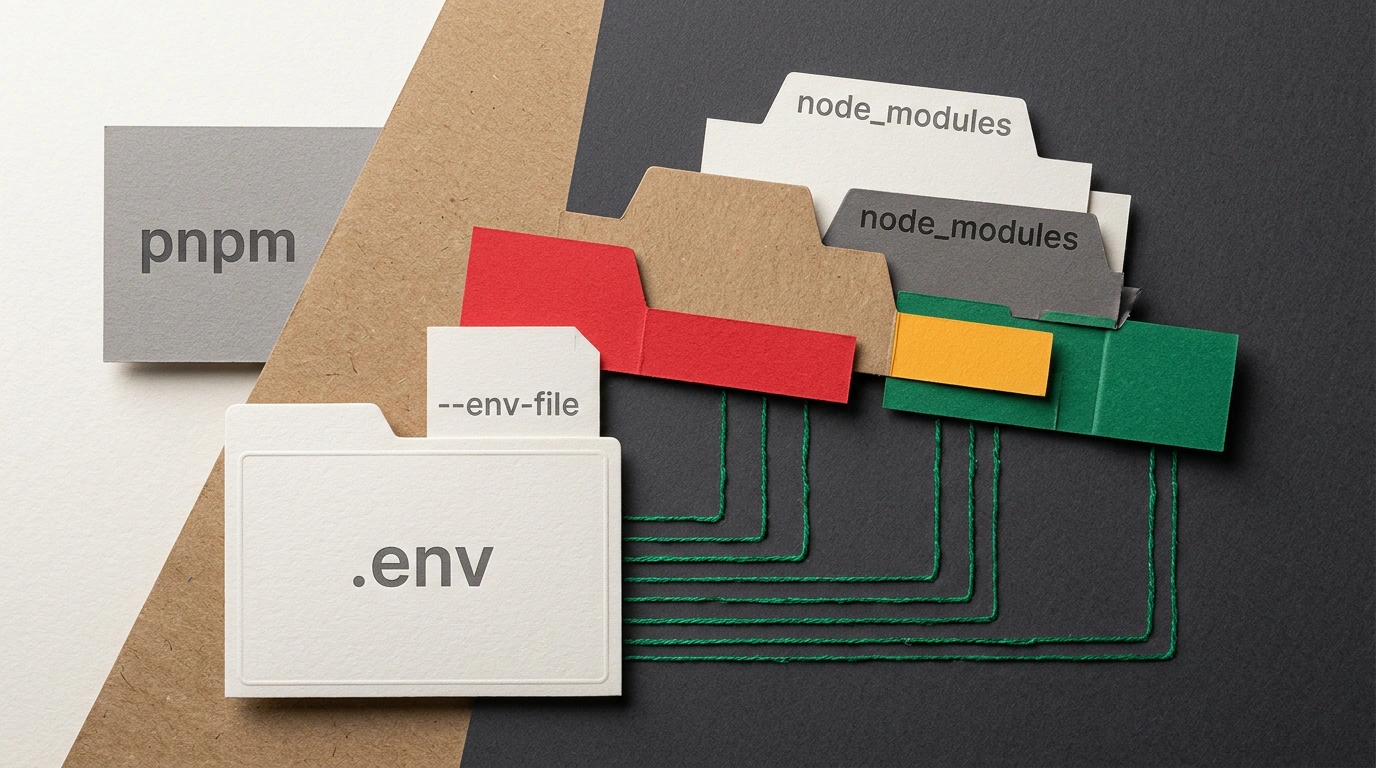
The headline practical addition in v12.16 and v11.28 is native --env-file support for pnpm run and pnpm exec.
The package manager can now load variables from one or more environment files automatically before spawning the child process:
# Run a script with explicit environment configuration files
pnpm run --env-file=.env --env-file=.env.local dev

# Execute any CLI tool with environment variables injected
pnpm exec --env-file=.env.staging prisma migrate deploy
Loading follows a strict cascade: variables declared in later --env-file flags override earlier ones. If a variable is already set in the host environment (such as on a CI runner), pnpm preserves the host value by default so local defaults never accidentally clobber production secrets.
Here is a typical local .env layout:
# Base service configuration
DATABASE_URL="postgres://postgres:secret@localhost:5432/app_dev"
REDIS_PORT=6379
API_GATEWAY_TIMEOUT_MS=5000
For hundreds of monorepos, this means dropping extra wrapper dependencies and keeping package.json scripts clean.
Virtual Store Architecture and Dependency Isolation
To see why these refinements matter, it helps to remember why pnpm caught on in enterprise teams in the first place. Unlike classic npm, which duplicates the same packages across every project's node_modules, pnpm keeps a single content-addressable global store and uses hard links.
Every package lives once on disk inside .pnpm-store. When a project needs a dependency, pnpm creates a hard link from the global store into node_modules/.pnpm/ and places a symlink in the root node_modules. That saves massive disk space and blocks phantom dependencies—situations where code imports a package never declared in package.json simply because a transitive dependency pulled it in.
In v12.16 and v11.28, link-integrity checks get a noticeable speed boost on both APFS (macOS) and ext4/btrfs (Linux).
CI/CD Security and the New pnpm setup Flag
The second major change targets installer safety in automated environments like GitHub Actions, GitLab CI, and Docker builds.
Previously, running pnpm setup tried to edit user shell profiles (~/.bashrc, ~/.zshrc) by appending PNPM_HOME exports. Inside containers and ephemeral CI runners, that often triggered permission errors or unexpected layer-caching side effects.
Version 12.16.0 introduces an explicit --no-modify-path guard flag:
# Install pnpm inside a container without touching shell profiles
pnpm setup --no-modify-path

# Export the binary path explicitly inside the current build script
export PNPM_HOME="/root/.local/share/pnpm"
export PATH="$PNPM_HOME:$PATH"
This keeps builds predictable: pnpm places its binaries in the target directory while leaving PATH management strictly under your pipeline config's control.
We tracked the earlier stages of this hardening in the dual pnpm release: CI token isolation in 11.28.6 and native package caching in 12.14.0, and --no-modify-path fits right into that trajectory.
Dynamic Worker Sizing Under cgroups Limits
The third—quieter, yet crucial—improvement hits the parallel task execution engine.
Inside Kubernetes pods and Docker containers, pnpm often read the physical host's total CPU core count instead of the container's Linux cgroups v2 quota. On a 64-core host where a container was only allocated 2 cores, pnpm would cheerfully spawn 64 parallel build workers, causing severe CPU throttling and OOM crashes.
In v12.16, the scheduler reads cpu.cfs_quota_us limits properly and scales concurrent worker count to match the container's actual quota.
Altogether, this update makes pnpm even more dependable for enterprise frontend stacks—and strips out one more layer of tooling glue.
