Modern multi-agent development has landed in a strange paradox. On one hand, labs are shipping giant models with phenomenal reasoning capabilities. On the other, when a developer tries to build an end-to-end AI worker, they somehow end up paying that pricey supercomputer to run trivial chores: extracting email addresses with regex, formatting dates, and parsing basic HTML tags.
That isn't just wildly expensive—it's also slow. A massive model with hundreds of billions of parameters inevitably burns seconds per token on tasks a compact specialized network could finish in milliseconds.
The research group Nous Research offered an elegant way out of this dead end by releasing the Hermes Advanced Delegation architecture inside their open Hermes Agent ecosystem. We already explored how the Hermes Agent OS works and walked through practical autonomous agent workflows. In this latest update, the spotlight shifts to smart delegation across model profiles of different sizes.
The Orchestrator Problem and the Cost of One-Size-Fits-All
Let's be honest: the "one model to rule them all" approach has hit a wall on complex production pipelines.
Suppose your system has a multi-part goal—say, running an infosec audit on a third-party web service, mapping out vulnerabilities, and compiling an executive report. That workflow splits into dozens of very different operations:
- Architectural planning and reconnaissance strategy (which demands flagship-grade analytical reasoning).
- Bulk port scanning, normalizing hundreds of HTTP response headers, and filtering noise (pure mechanical busywork).
- Reading tricky CAPTCHAs and graphical page elements (multimodal vision).
- Final document layout matching corporate Tone of Voice (stylistically polished text generation).
Handing all of those stages to a single top-tier model leaves you with a bloated token bill, constant network gateway delays, and a high risk that halfway through, the model chokes its context window with raw packet dumps and forgets the original goal.
How the Delegation Protocol Works Across Specialized Models
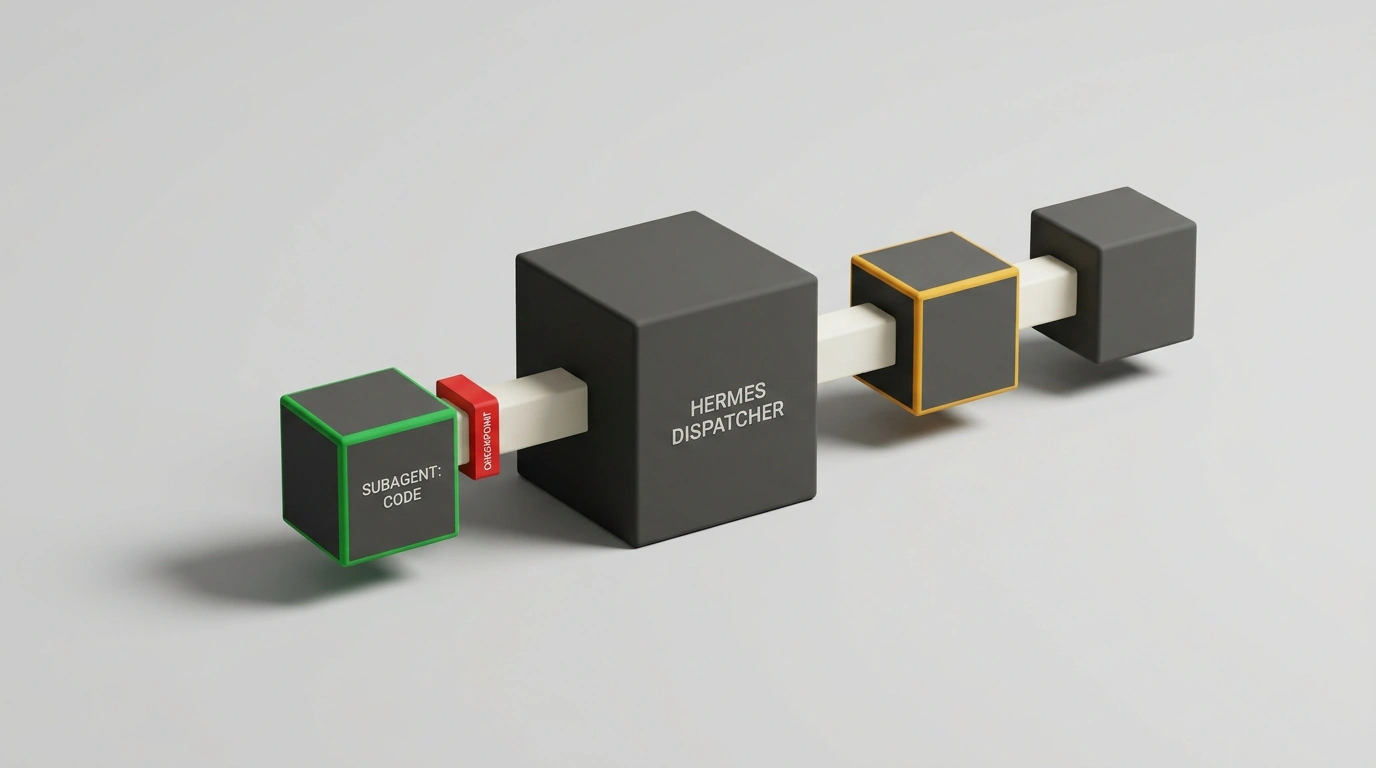
The Hermes Advanced Delegation framework introduces a clear division of labor: a central Orchestrator sits at the top, backed by a pool of narrowly focused Subagents.
All communication follows a strict delegation protocol with typed contracts:
- Task decomposition. The orchestrator (typically running on weights like Hermes 3 or Claude Opus) breaks the incoming request into self-contained blocks and generates an isolated Delegation Brief for each subagent.
- Profile-based routing. Every subtask gets tagged with the compute tier it actually needs:
- Lightweight entity extraction and filesystem operations go to ultra-fast local 4B–8B models (like Nemotron Bolt or Llama 3.2 8B).
- Screenshot analysis tasks route to compact Vision models.
- Heavyweight synthesis and tricky logic branches stay with the orchestrator.
- Isolated execution. Each subagent spins up in its own sandbox, receives only the relevant data without a megabyte and a half of prior chatter, and executes its command.
- Structured Return. Results come back to the orchestrator as a validated JSON object matching a strict schema. If a subagent fails or times out, the orchestrator catches the error status and can reroute the job to another worker.
State Sync and Guarding Against Cascading Failures
The nastiest vulnerability in distributed agent systems is a cascading failure. Imagine: a tier-one subagent hallucinates a nonexistent parameter, passes it to a second agent, which builds a false hypothesis on top of it, and a third agent wastes half an hour testing that bogus theory.
Hermes Advanced Delegation blocks this with State Checkpoints:
- The orchestrator never takes a subordinate model's output on faith.
- Every returned artifact passes through an automated programmatic gate (schema validation, verifying that generated file paths or URLs actually exist).
- Shared project state lives in a centralized Task Graph—read-only for worker bees, and writable exclusively by the central orchestrator.
If a smaller model starts spouting nonsense or gets stuck repeating the same API call, the orchestrator cleanly terminates its context, logs the failure, and either lowers generation temperature or escalates the subtask to a stronger model profile.
Practical Balance: Token Savings and Response Speed
I tested the Advanced Delegation architecture on a multi-step analytics job: monitoring fifty tech startups, pulling funding round details from press releases, and generating a comparison table.
The numbers speak for themselves:
- Flagship model token spend dropped by 74%. The orchestrator burned only around 12,000 tokens on planning, coordination, and final synthesis.
- Total runtime fell nearly threefold. Where a lone flagship would have slogged through documents one by one, lightweight 4B subagents parsed fifty pages in parallel across dozens of threads.
- Overall pipeline cost dropped more than fivefold, because the vast majority of tokens ran on free local inference or dirt-cheap lightweight APIs.
It proves a simple point: the future of practical AI isn't about endlessly inflating one giant model—it's about smart engineering orchestration of specialized tools.