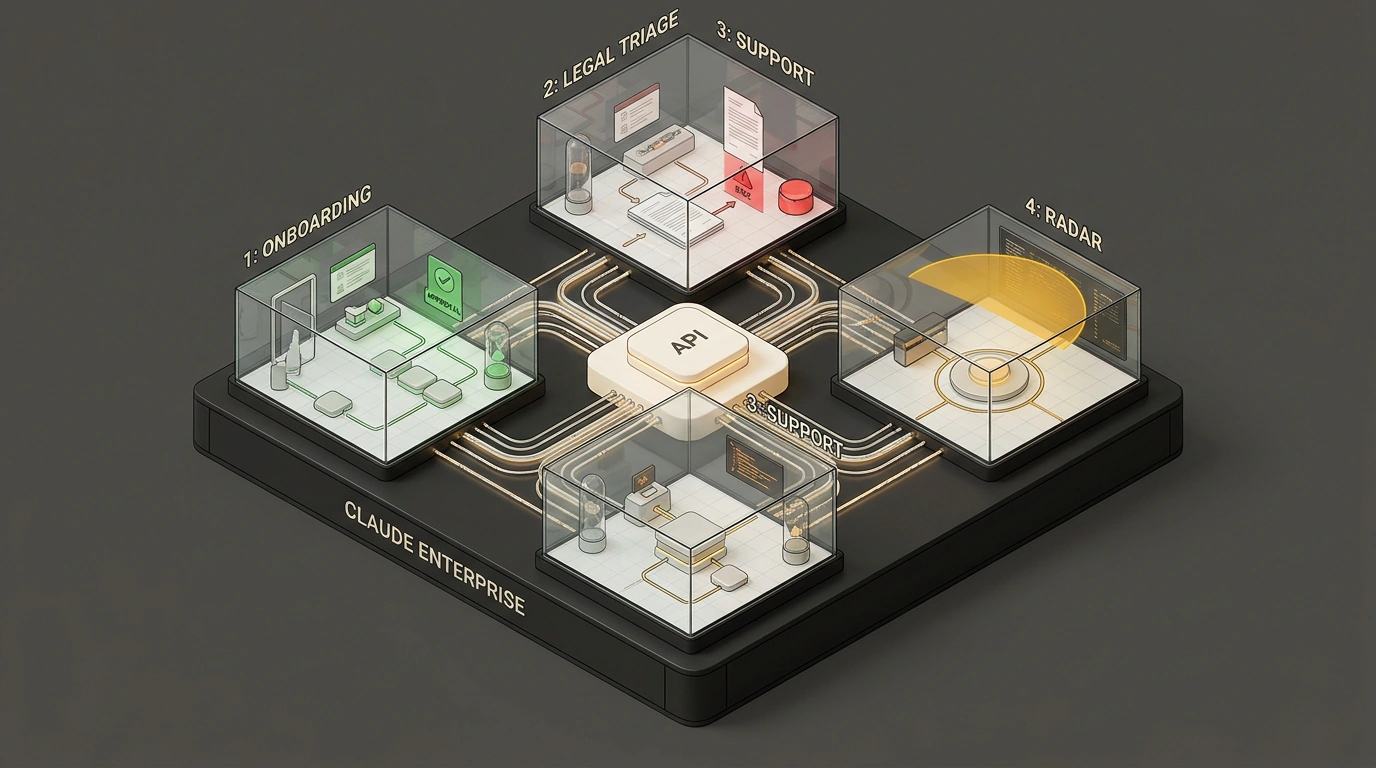
Whenever deploying AI in a real business comes up, entrepreneurs picture a monstrously complex, expensive project. Visions of six-month approvals, hiring pricey machine learning researchers, buying GPU servers, and endless custom model training immediately pop up. As a result, 90% of initiatives die right on the PowerPoint slide.
Modern practical AI works completely differently. With the Claude 3.5 and Claude Opus APIs, the barrier to entry for automation has collapsed. To launch a reliable system that delivers measurable ROI, you don't need to reinvent transformers. You just connect a proven model cleanly to standard infrastructure: webhooks, task queues, and databases.
We already explored how to build million-dollar businesses on the Claude stack and looked at lessons from designing multi-agent systems. Let's break down four standard commercial systems integrators are selling to clients for hefty retainers right now—and see how they are actually wired under the hood.
System 1: Automated Client Onboarding and Brief Scoring
Every B2B agency or service company shares the same headache: a slow, painful intake process. A prospect fills out a long brief form on your website, and a manager spends two days reading replies, scoring the lead manually, and drafting a proposal. By the time it lands, the prospect has cooled off or signed with a faster competitor.
An automated onboarding pipeline knocks this out in 90 seconds:
- Event trigger. The client submits a Typeform or Tally form. A webhook immediately sends the raw payload to a middleware server (built with FastAPI or n8n).
- Claude processing. The model receives a system prompt containing your Ideal Customer Profile (ICP) and scoring rubric. It extracts key parameters: budget size, project urgency, industry, and tech stack.
- Artifact generation. If the lead qualifies (Score > 75), Claude automatically drafts a tailored Project Scope, spins up a private Notion board from a company template, and prepares a draft contract.
- Team notification. The account manager gets a deal card in Slack with a ready-made risk analysis and an "Approve & Send Proposal" button.
Response time drops from forty-eight hours to two minutes, lifting lead-to-deal conversion by nearly a third.
System 2: Legal Contract Triage and Risk Flagging
In mid-sized companies, the legal department often becomes the main bottleneck. Account managers bring in dozens of routine vendor contracts, NDAs, and service agreements for review. Lawyers drown in reading boilerplate clauses, stalling signatures for weeks.
A Claude-powered legal triage system turns that slog into a transparent pipeline:
- An incoming contract PDF is parsed by a text-extraction utility and split into logical sections.
- Claude compares each clause against the company's Legal Playbook.
- The model performs automated redlining: flagging risky liability caps, excessive penalties, vague IP transfer terms, and unfavorable dispute jurisdictions.
- Instead of a raw contract, the lawyer receives a concise executive memo as a Markdown table: clause number, vendor's original wording, risk level (High / Medium / Low), and the playbook's recommended counter-language.
Initial contract review drops from an hour and a half to five minutes.
System 3: Tech Support Escalation and Log-Based Bug Localization
In IT services and SaaS platforms, users constantly file vague tickets: "nothing happens when I click," "got a 500 error," or "payment won't go through." Tier-one support agents burn huge amounts of time prying out details, then forward blurry screenshots to developers—pulling expensive engineers away from shipping features.
An intelligent escalation system builds a bridge between the customer and engineering:
- When a ticket arrives, an agent queries an internal API for the user's recent system logs and session ID in Sentry.
- Claude analyzes the error stack trace alongside the customer's description and UI action history.
- The model localizes the bug: pinpointing the offending microservice, finding the exact line of code in the GitHub repo that threw the exception, and checking whether any recent deploys touched that part of the system.
- A technical bug report lands in Linear or Jira with clear reproduction steps, the relevant log snippet, and a preliminary fix hypothesis for the engineer.
The customer gets a fast, polite update confirming the issue is isolated, while engineers save dozens of hours of manual log diving.
System 4: Competitive Radar and Product Update Monitoring
In fast-moving industries, tracking what competitors do is a matter of survival. Yet manually checking dozens of websites, reading changelogs, watching pricing grids, and scanning trade press is practically impossible.
A Competitive Radar system runs continuously on autopilot:
- A scheduled cron script crawls competitors' public pages (Changelog, Pricing, News) and pulls text updates.
- Claude compares the fresh page snapshot against the previous version via semantic diffing.
- The model strips out marketing noise (typo fixes or swapped hero images) and highlights only strategic moves: new integrations, quiet price hikes, plan limit changes, or new promos.
- Once a week, the system compiles a crisp executive digest for the CEO and department heads: what shifted in the market, where competitors pulled ahead, and what countermoves to consider.
All four systems share one core engineering principle: AI acts as an intelligent compressor and information router, while dependable backend infrastructure delivers the output straight into the tools your team already lives in.