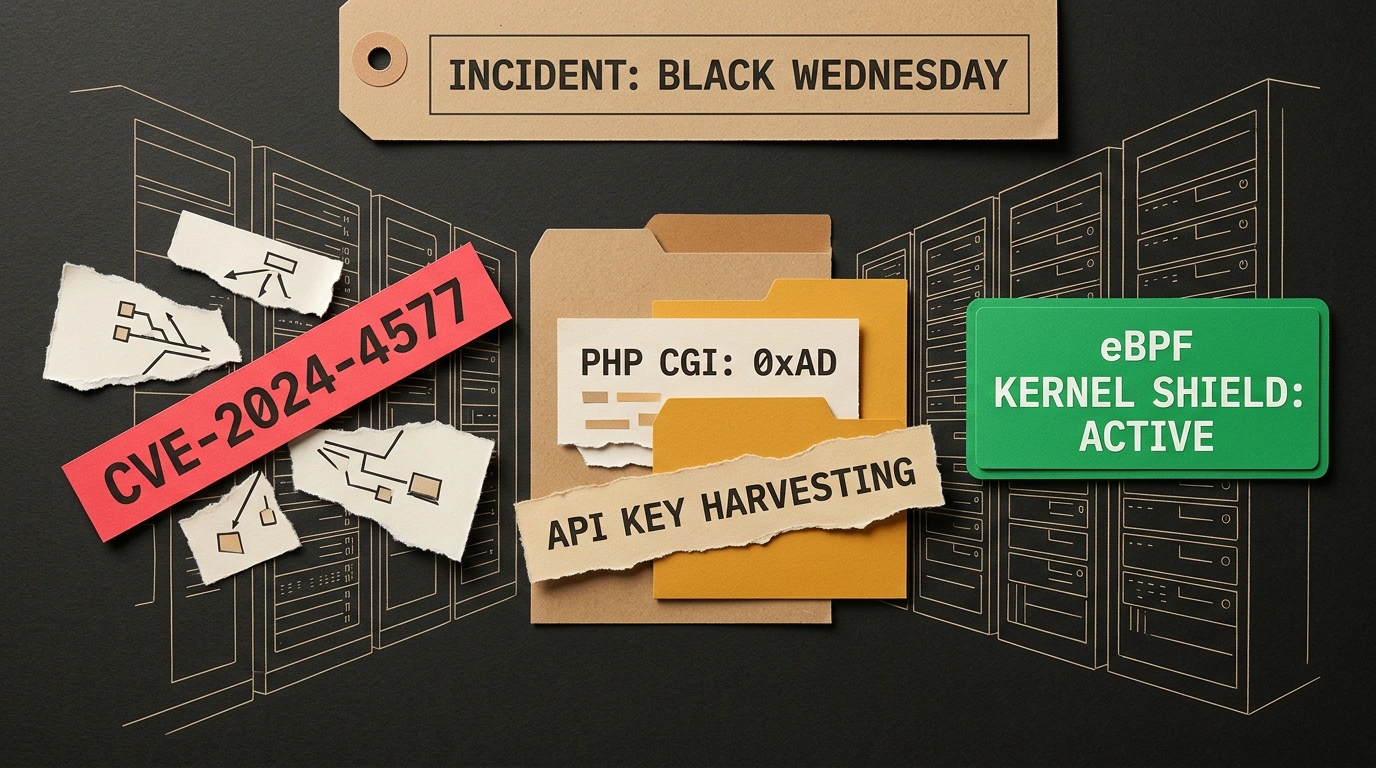
Practical cybersecurity has a few turning points after which the old rules stop applying forever. In the nineties, it was the Morris Worm exposing how fragile the early internet was. In the two-thousands, it was distributed botnets and zero-day exploits. In October 2026, the industry hit a new tectonic shift that security circles grimly dubbed "Black Wednesday."
A major investigation by researchers Riley Brown and Ansh Nanda (CEO of the Vibecode platform) uncovered an unsettling reality: the barrier between elite hacking crews and mass automated aggression has collapsed completely. Armed with ultra-cheap language models costing pennies per million tokens, cybercriminals spun up a fully autonomous pipeline to hunt, adapt, and exploit server vulnerabilities with zero human hand-holding.
We already warned about how autonomous AI agents are rewriting the rules of mass attacks and analyzed the "Black October" vulnerabilities in agent systems. Now let's dissect the Black Wednesday incident piece by piece: reconstruct the hour-by-hour timeline, trace the low-level exploit mechanics, and see how to defend your infrastructure in an era of machine-speed attacks.
Timeline of Events: How the Attack Unfolded in the First 24 Hours
Black Wednesday moved at a pace that rendered classic SecOps incident-response playbooks useless:
- 02:00 UTC. Global networks logged an anomalous spike in scanning traffic. Unlike standard scripts firing fixed HTTP requests across millions of IPs in sequence, the attacking nodes showed smart behavior—routing requests through thousands of residential proxies and mimicking ordinary browsers.
- 06:30 UTC. The first breach reports surfaced on private Y Combinator founder forums. Startup teams noticed their OpenAI and Anthropic balances suddenly wiped out: tens of thousands of dollars in API charges racked up in just a few hours.
- 11:00 UTC. By midday, the scope was global. Hosting providers, SaaS apps, ad trackers, and small e-commerce shops were all hit. No ransom banners demanding Bitcoin appeared on sites; servers kept running normally, yet their internal memory and config files had been gutted clean.
- 18:00 UTC. Vibecode security engineers isolated the shared entry vector: mass exploitation of PHP CGI vulnerability mutations paired with autonomous AI agents generating polymorphic payloads in real time.
In under twenty-four hours, tens of thousands of public servers worldwide were compromised—without the attackers spending a single minute manually analyzing targets.
Anatomy of the Vulnerability: PHP CGI Exploitation and Polymorphic Payloads
The battering ram behind the campaign was a well-known command-line argument injection flaw in PHP CGI modules (tracked as CVE-2024-4577, along with a wave of modern architectural mutations).
Infographic exploded diagram of the CVE-2024-4577 attack mechanism with soft-hyphen byte and WAF filter
Let's look at the low-level mechanics of this bug, because it is a textbook case of a harmless OS quirk turning into a catastrophe:
- Character conversion in OS locales. On certain Apache and Nginx setups running FastCGI/PHP-CGI, the incoming URL gets translated into command-line flags for the PHP executable. Under specific system locales, the OS treats the soft hyphen character (hex byte
0xAD) as a standard ASCII hyphen (-). - Config directive injection. That allowed attackers to slip hidden PHP CLI flags straight into the query string:
?%ADd+allow_url_include%3D1+%ADd+auto_prepend_file%3Dphp://input - Remote Code Execution (RCE). The
auto_prepend_filedirective forced the interpreter to execute the raw HTTP request body (php://input) as PHP code before the main web app even loaded.
What turned this into a nightmare for defenders was how AI agents behaved after hitting their first error. A classic scanner sees 403 Forbidden or a WAF block and moves on. The AI agent acted like a live researcher: it read the web server's error response, figured out which signature rule blocked the request, re-encoded payload bytes using alternate UTF-8 sequences, wrapped the code in multi-layer base64 containers, and punched through the perimeter by the third attempt.
The Economics of Machine Aggression: Why Attacks Now Cost Pennies
The biggest shift revealed by this incident isn't about hacking techniques—it's about the basic unit economics of cybercrime.
Think back to what a targeted corporate breach took just three years ago:
- A skilled security researcher or hacker spent days mapping the network perimeter, hunting for odd entry points, and hand-crafting an adapter for a specific server.
- Paying for that level of human talent made targeted attacks on small and mid-sized businesses economically pointless. Hackers either chased giant corporations for multi-million-dollar ransoms or ran dumb mass botnets for spam and DDoS.
With cheap lightweight models—whose inference costs fractions of a cent per million tokens—the math flipped upside down:
- Renting servers and API access for a swarm of autonomous agents cost the campaign operators a laughable couple hundred dollars.
- The cost of full-blown targeted recon, payload tuning, and database exfiltration per compromised server came out to under three cents.
- At that price, attacking literally any server on the internet turns a profit—even a forgotten WordPress blog getting ten visitors a day.
The Autonomous Kill Chain: From Perimeter Scan to Infrastructure Persistence
What did the autonomous kill chain look like once inside a compromised host? Vibecode researchers reconstructed the agent worm's step-by-step playbook:
- Recon and perimeter breach. The agent fires mutated soft-hyphen requests until it achieves in-memory execution of a short PHP script.
- Fileless secret harvesting (In-Memory Harvesting). Without dropping binaries onto disk (to stay invisible to traditional antivirus), the script scans system environment variables, reads
.envfiles, inspects Docker configs, and dumps memory strings from active processes. - Hunting for AI credentials. Top priority went to scanning for key patterns:
sk-ant-*(Anthropic API access tokens);sk-proj-*(OpenAI corporate project tokens);- Credentials for Pinecone and Qdrant vector databases and AWS S3 buckets.
- Validation and exfiltration. Discovered keys were immediately tested for validity with a quick official API call and shipped off to the attackers' encrypted Telegram channel.
- Covert model distillation. Using stolen corporate accounts with high credit limits, attackers instantly spun up background distillation pipelines—firing millions of requests to generate synthetic training datasets and fine-tune their own open models on someone else's dime.
Victim companies only found out they had been breached when accounting got a bank alert for $20,000 or $50,000 in API overage charges.
Vibecode's investigation notes that stolen keys weren't wasted on trivial spam—they powered industrial-scale distillation. Once inside paid corporate accounts allowing hundreds of thousands of daily requests, attackers ran an automated data-synthesis factory:
- Expensive frontier models (Claude 3.5 Sonnet, GPT-4o) were fed millions of unlabeled prompts demanding deep reasoning, complex code generation, and vulnerability analysis.
- The flagship models' gold-standard outputs were neatly packaged into JSONL training datasets.
- Using those synthetic datasets, attackers trained compact 7B and 14B open models in days, bringing their performance on specialized offensive tasks up to commercial-grade levels.
In effect, breach victims didn't just pay someone else's token bills—they subsidized the creation of the next generation of specialized cyberweapons aimed straight back at defenses like their own.
Bypassing Built-In Guardrails: How Attackers Neutralized Model Safety Filters
One question in Brown and Nanda's report deserves special attention: why didn't the much-touted safety filters (Guardrails and RLHF) of commercial models block the generation of malware and exploits?
Attackers used a technique of decomposing malicious intent into neutral, atomic steps:
- Instead of asking directly, "Write an exploit for the PHP CGI vulnerability," the agent broke the job into bland engineering questions: "How do I configure
auto_prepend_fileto debug a local server?", "How do I convert a hex string into a byte stream viaphp://input?", and "Write a script for routine auditing of server environment variables." - Not a single one of those prompts violated Anthropic's or OpenAI's usage policies on its own. Each model dutifully produced clean sysadmin code, assuming it was helping an engineer with normal debugging.
- Final exploit assembly and target-specific tuning were handled by a local, lightweight orchestrator running uncensored open weights.
This precedent proved beyond doubt that relying on a "smart model refusing to hack servers on its own" is futile. A model can't see the broader operational context and is easily steered through clean role separation.
The Collapse of Classic WAFs: Why Signature Matching Failed
Black Wednesday sounded the death knell for traditional web application firewalls (WAFs) built on static signature rules.
For decades, the industry leaned on regex databases: if a query string contains php://input or suspicious special characters, block it. Put a generative model on the other side of the barricade, though, and signature matching falls apart:
- AI mutates exploit syntax on the fly—splitting commands, concatenating strings through obscure functions, swapping character encodings, and obfuscating code so no static rule triggers.
- To a signature analyzer, every incoming request looks like a brand-new, never-before-seen snippet.
- Tightening signature rules only triggers an avalanche of False Positives, locking out legitimate users.
Perimeter security can no longer be static. Real-time behavioral analysis has to take its place.
Next-Gen Defense: Kernel Behavioral Monitoring with eBPF and Agent Audits
How do you build a defense when the attacker operates with machine intelligence? The only reliable answer is dropping down to the OS kernel level and monitoring actual process behavior rather than incoming text strings.
Leading security teams are deploying defense stacks built around Extended Berkeley Packet Filter (eBPF):
- Kernel-level syscall tracing. eBPF-powered tools (like Tetragon or Falco) intercept
execve,socket, andopenatsyscalls directly inside the Linux kernel. - Instant anomaly blocking. If a standard
php-fpmornginxworker suddenly tries to spawn/bin/sh, read/root/.env, or open an outbound socket to an unknown external IP, the eBPF module kills the process in microseconds—before any key leaves the network. - Dynamic secret isolation. Moving to centralized secret vaults (HashiCorp Vault, AWS Secrets Manager) with short-lived tokens (15-minute TTLs) makes static
.envexfiltration pointless: a stolen key expires before anyone can use it. - Agentic perimeter auditing. Running your own defensive AI agents that continuously probe your codebases and network perimeter using the same techniques attackers use, catching flaws before criminals do.
Strategic Takeaways: Security Hygiene in the Era of Cheap AI
Black Wednesday drew a sharp line under the era of casual security at startups and small businesses. The mantra "we're too small to be a target" is officially a dangerous myth.
Every engineer and CTO needs to lock in three lessons right now:
- Enforce hard caps on API keys. Never run master tokens without daily Usage Limits, and set alerts for unusual token spikes overnight.
- Keep keys inside isolated boundaries. Environment variables granting access to external models should be injected strictly into the specific microservice runtime—never left sitting in
.envfiles inside a web server's root directory. - Patch core system packages. No AI on earth can exploit CVE-2024-4577 if an admin has already updated PHP to a patched release and configured proper virtual host isolation.
We have entered an era of cyberwarfare at machine speed. The winners will be the teams that use automation not just to ship features and content, but to build deep, resilient defenses around their digital assets.