When you talk to another person, the pause between turns rarely lasts more than a couple hundred milliseconds. The human brain catches intonation on the fly and starts framing a reply before the other person even finishes their sentence.
Hook up a voice interface powered by modern neural networks, though, and natural conversation trips over itself immediately. You finish speaking, fall silent—and get hit with an awkward two- to three-second void. In that gap, the audio stream is digitized, transcribed to text, shipped to a heavy transformer, pushed through layers of attention, and only then do the first audio tokens come out.
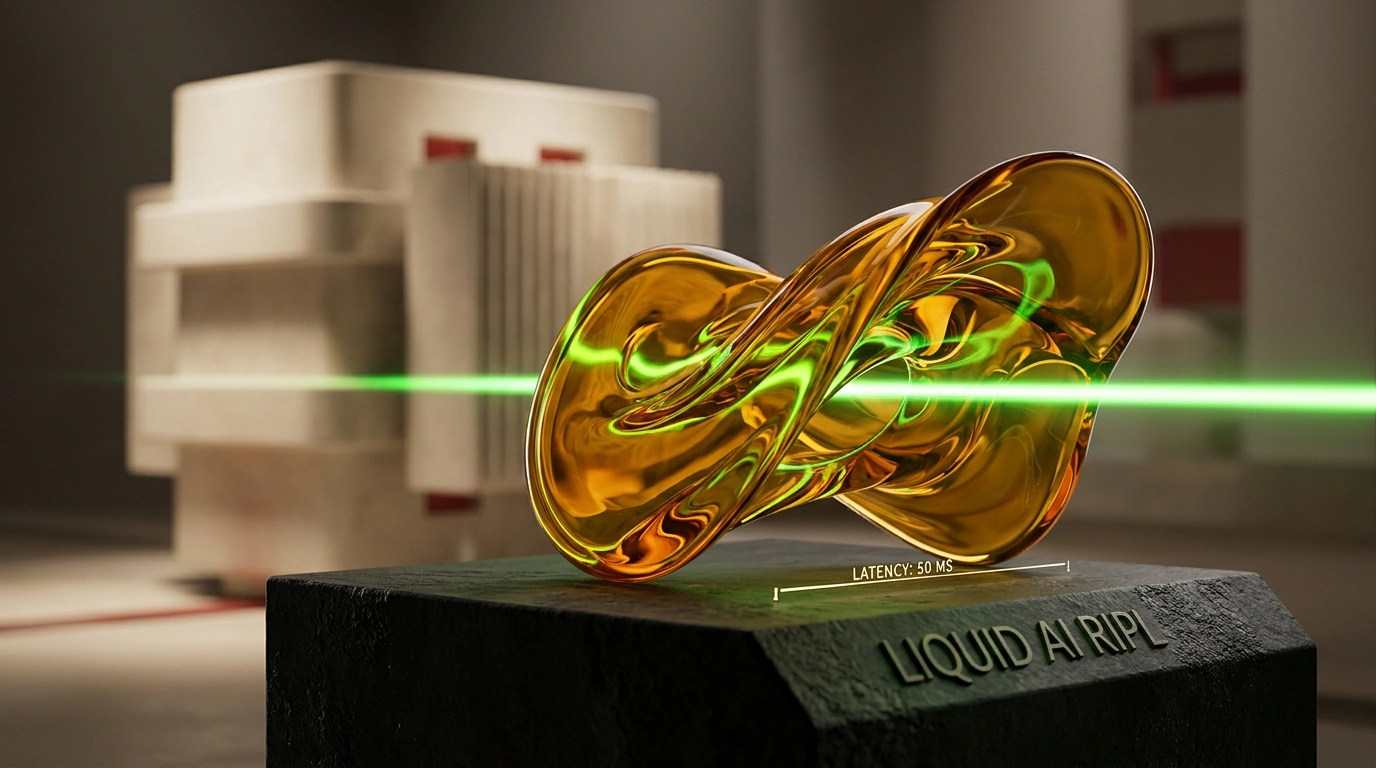
Liquid AI, a startup spun out of MIT's labs, has long argued that the classic Transformer architecture is fundamentally ill-suited for real-time work. To back that up, they released the RIPL (Real-time Inference Processing Layer) inference engine, capable of delivering responses with latency under 50 milliseconds.
We previously tracked architectural breakthroughs in Liquid AI's dynamic models and looked at the practical limits of ultra-fast generative systems. Let's unpack how engineers bypassed transformer physics—and what it changes for the industry.
The Transformer Bottleneck: Why KV-Cache Latency Grows
To appreciate the elegance of Liquid AI's solution, you have to recall the original sin of classic transformers: self-attention.
In a standard LLM, every newly generated token has to be compared against every previous token in the context. To avoid recomputing those matrices from scratch on each step, GPU VRAM allocates a massive buffer called the KV-cache (Key-Value Cache):
- The longer the conversation, the more VRAM the KV-cache eats up.
- Attention compute scales quadratically with sequence length.
- At long contexts, the bottleneck isn't even tensor core math—it's Memory Bandwidth: the chip simply can't pump gigabytes of key and value matrices fast enough on every step.
As a result, Time-To-First-Token (TTFT) inevitably creeps upward, turning any attempt at fluid voice chat or instant robotic reflexes into an agonizing wait.
The Physics of Liquid Networks: Constant State Instead of Quadratic Cost
Liquid Foundation Models (LFM) are built on completely different math, rooted in dynamical systems theory and continuous-time differential equations.
Instead of keeping an ever-growing snapshot of every past token in a bloated KV-cache, a liquid neural network maintains a compact, fixed-size hidden state that evolves smoothly over time as new data arrives:
- Memory required for context stays constant: $O(1)$ instead of $O(N)$ or $O(N^2)$ in transformers.
- The model doesn't care whether ten tokens or ten thousand just came in; the RAM footprint needed to predict the next step stays flat.
- Each incoming signal—a sound wave, a camera frame, or a word—simply nudges the phase trajectory of the dynamical system.
That is a fundamental paradigm shift. Instead of flipping through an archive of the past, the network reacts to a live data stream much like biological neural circuits do.
RIPL Architecture: 50 Milliseconds to First Token on Live Streams
Liquid AI's engineers designed the RIPL inference engine specifically around this math, tuning it for continuous streaming of multimodal signals.
In real-world tests processing live audio and video feeds, the LFM + RIPL combo hits a TTFT between 35 and 50 milliseconds on standard server hardware. That is 10 to 20 times faster than optimized versions of GPT-4o or Claude 3.5 Sonnet.
Even better, the architecture shows remarkable power efficiency on edge devices:
- Because there is no massive KV-cache being dragged across the memory bus, LFM models can run on embedded drone processors, automotive chips, and consumer smartphones without overheating or draining the battery in minutes.
- Inference runs steadily even on modest boards with just 4–8 GB of RAM.
Where LFMs Beat Transformers—and Where Pure Reasoning Still Wins
Does the arrival of RIPL and LFM spell the imminent death of familiar transformers? Of course not. Every engineering trade-off has a flip side.
Liquid models hold an overwhelming edge in real-time workloads:
- Interactive voice assistants with zero awkward pauses.
- Autonomous drone and robotics control systems, where a 100-millisecond delay means a crash.
- Monitoring time series, server telemetry, and high-frequency financial feeds.
However, in heavy symbolic reasoning—formal mathematical proofs, multi-layer refactoring of tangled codebases, or deep legal contract audits—classic transformers with huge context windows and full attention still lead the pack. An LFM's fixed hidden state, for all its elegance, is inevitably subject to compression loss: you cannot pack every fine detail of five hundred pages into a compact vector without losing subtle nuances.
That is why the industry is heading toward a hybrid future: liquid models handle instant sensing, hearing, and reflexes, while heavy transformers step in on the second beat whenever deep thought is required.