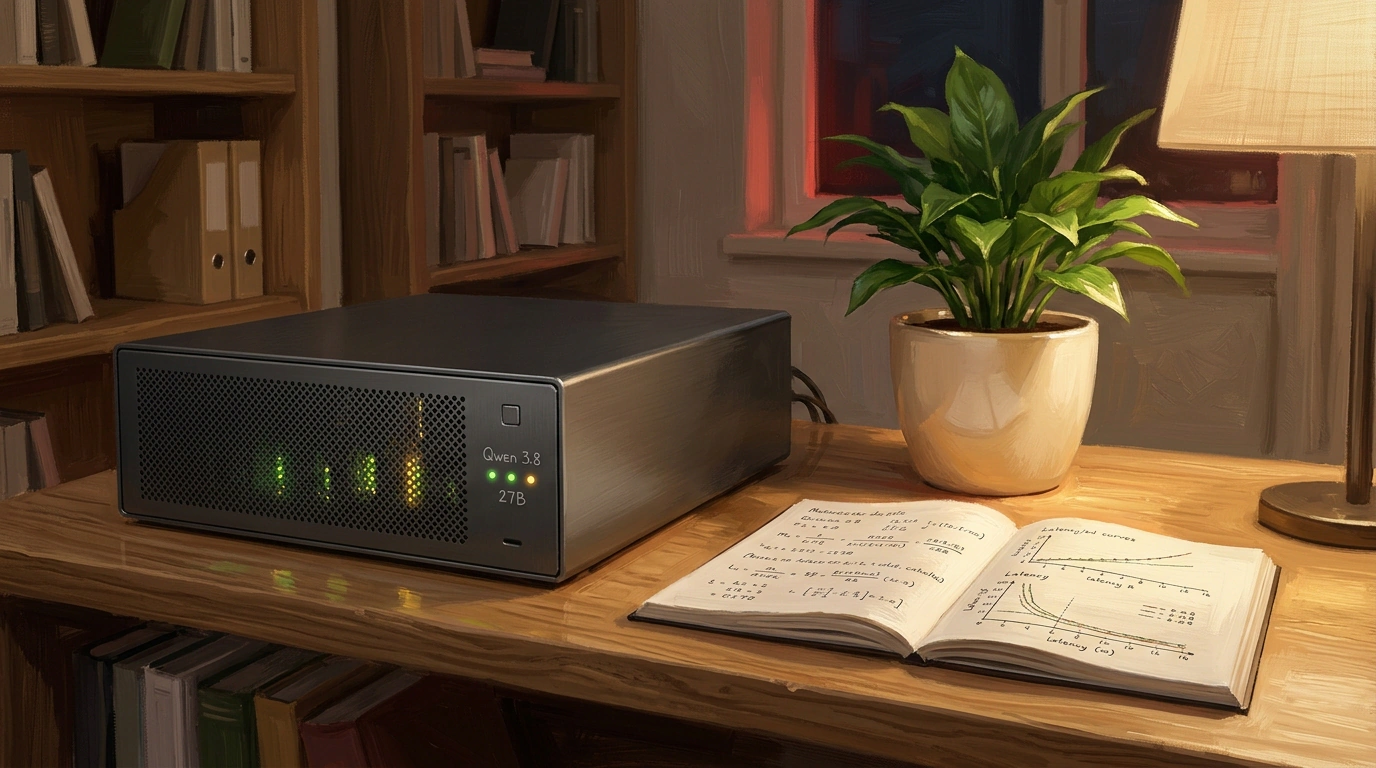
Just a year ago, talking about running a serious coding LLM locally on your own desk would get you a polite, skeptical smile from experienced engineers. 7B–8B models were fine for completing simple functions, sure—but ask them to design a non-trivial architecture or untangle a multi-file race condition, and they'd hallucinate and lose the thread. Meanwhile, running 70B heavyweights meant buying two or three workstation GPUs for the price of a used car.
Alibaba's Qwen 3.8 release changes that math. On independent benchmarks from Artificial Analysis, the mid-sized Qwen 3.8 27B model scored in coding (HumanEval, MBPP) and reasoning (MATH, GSM8k) right alongside last year's proprietary cloud flagships—early revisions of Claude 3.5 Sonnet and GPT-4o.
Even better: with modern 4-bit quantization (AWQ or GGUF Q4_K_M), a 27-billion-parameter model fits comfortably inside 16–24 GB of VRAM. That puts it within reach of a single consumer GPU (Nvidia RTX 4080, RTX 3090, or RTX 4090) or an Apple Silicon Mac.
What Changed in Qwen 3.8: The Secret Behind 27B Accuracy
Let's look at how a relatively compact model pulled off such a jump in engineering tasks.
The Qwen team bet on three core architectural and training choices:
- Heavily curated synthetic coding datasets: Rather than training only on raw GitHub dumps, the model learned from curated refactoring sequences, debugging traces, and "failing test -> fixed code" pairs. It grasps cause-and-effect in bug fixing instead of just guessing the next plausible token.
- 32,768-token context window: Modified base frequencies in RoPE (Rotary Position Embedding) keep attention sharp across long source files and documentation without logic degrading midway.
- Grouped-Query Attention (GQA): GQA cuts KV Cache VRAM requirements several-fold compared to classic Multi-Head Attention, making long-context prompts practical on consumer hardware.
Running Locally with Ollama in Two Minutes
For solo experiments and wiring into editor extensions (Continue, Cline, Cursor), Ollama is the fastest path. Getting Qwen 3.8 27B running takes two terminal commands:
# Pull and start an interactive chat with the quantized 27B model (Q4_K_M)
ollama run qwen3.8:27b

# Run as a background server with a 32k context window and parallel slots
OLLAMA_NUM_PARALLEL=2 OLLAMA_FLASH_ATTENTION=1 ollama serve
Pay attention to OLLAMA_FLASH_ATTENTION=1: enabling FlashAttention-2 nearly halves the VRAM needed for the KV Cache, letting you feed in large source files without tanking inference speed.
Production Inference: Deploying High-Throughput vLLM
If you need to serve a whole engineering team or an automated CI code-review pipeline, Ollama hits its ceiling—you'll want a multi-threaded scheduler with continuous batching.
That's where vLLM shines. Here is a production-ready Docker command to launch vLLM with an OpenAI-compatible API and AWQ quantization:
# Start a vLLM server with an OpenAI-compatible endpoint
docker run --gpus all \
  -p 8000:8000 \
  --ipc=host \
  vllm/vllm-openai:latest \
  --model Qwen/Qwen3.8-27B-Instruct-AWQ \
  --quantization awq \
  --max-model-len 32768 \
  --gpu-memory-utilization 0.92 \
  --enforce-eager \
  --port 8000
This exposes a standard API on port 8000. Any coding tool or agent that speaks OpenAI's API can be pointed at http://localhost:8000/v1 with any dummy API key.
We covered the broader open-weights wave earlier in open AI models break through: Qwen 3.8 at 2.4 trillion parameters shifts the balance of power, and the 27B variant brings that capability down to an ordinary office server.
Economics and Privacy: Where the Trade-Offs Sit
Let's weigh the upsides and limits of self-hosting honestly:
- Complete data privacy: Your source code, proprietary algorithms, and trade secrets never leave your local network—a must for fintech, healthcare, and regulated industries.
- Zero token billing: Running a million-token monorepo refactor only costs the electricity your GPU draws (around 250–350 W), saving hundreds of dollars a month in cloud API fees.
- Remaining limits: A local 27B model still trails top closed cloud giants on deeply nested multi-step reasoning and subtle cross-system context.
For roughly 90% of day-to-day engineering work—writing unit tests, tracking down bugs, documenting APIs, and refactoring—a local Qwen 3.8 + vLLM setup hits the sweet spot of speed, privacy, and independence.