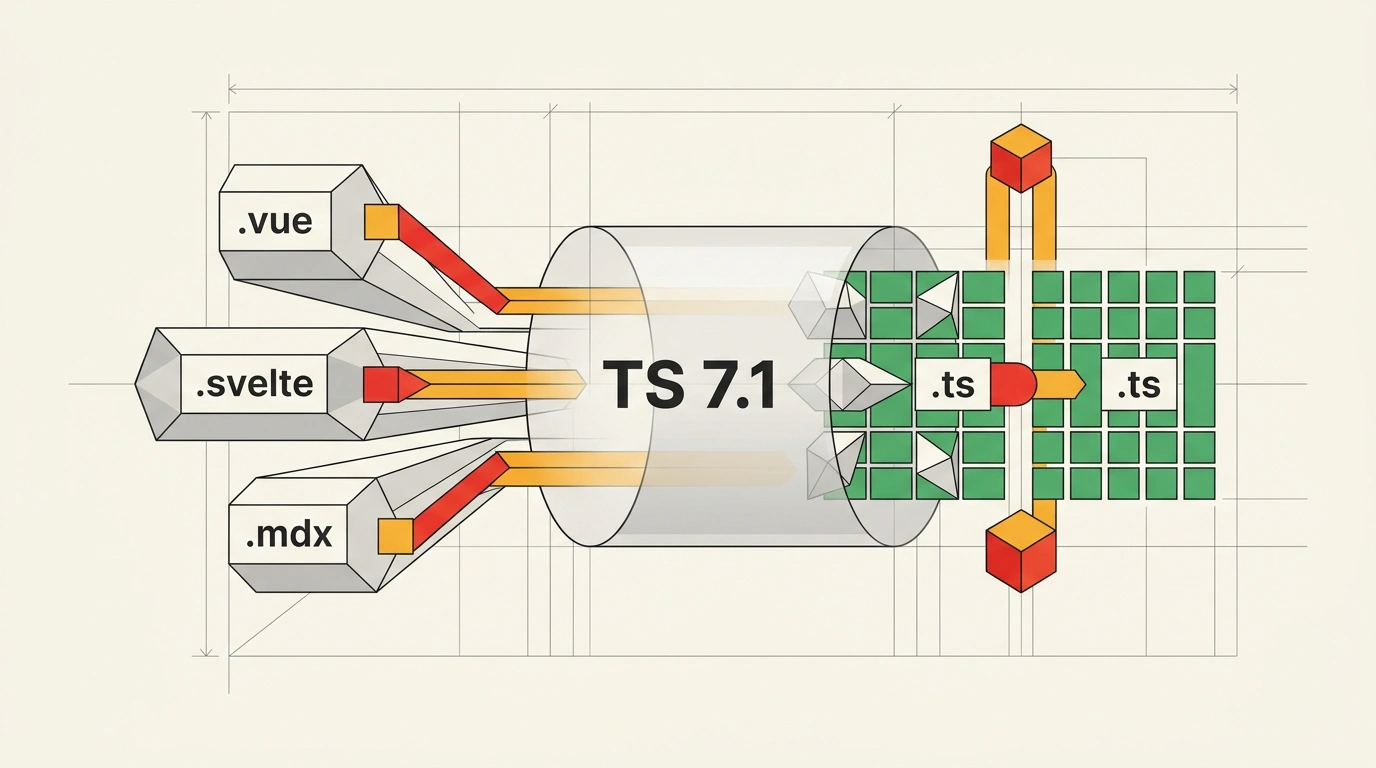
Anyone who has built a sizable frontend project with Vue, Svelte, Astro, or MDX knows this architectural pain all too well. As long as you're writing plain .ts files, tsc is fast, predictable, and rock-solid. The moment you introduce single-file components (SFCs) like .vue or .svelte, the standard toolchain cracks. TypeScript's compiler flatly refused to understand non-standard extensions, forcing teams onto clunky external forks and wrapper CLIs like vue-tsc or svelte-check.
Those wrappers brought plenty of headaches: they had to parse files on their own, emit virtual .ts files into temp directories, wrestle with broken sourcemaps when reporting errors, and run noticeably slower than the native compiler.
With TypeScript 7.1 Beta, that bottleneck finally breaks open. Anders Hejlsberg's team introduced Content Mappers alongside a public programmatic compiler API, letting tsc itself type-check arbitrary file extensions directly.
How Content Mappers Work: Virtualizing Types on the Fly
Let's look at what happens under the hood when mappers are enabled. Previously, tsc was hardcoded to a fixed list of extensions: .ts, .tsx, .d.ts, .js, and .jsx. Importing a .vue file meant dropping in a stub shims-vue.d.ts with declare module '*.vue', which effectively threw away strict type-checking for component props and emitted events.
Content Mappers turn file parsing into an extensible pipeline. A developer or framework author registers a transformer module in tsconfig.json. When the compiler encounters an import for a non-standard extension, instead of throwing an error, it hands the file's contents off to the matching mapper.
Right in memory, the mapper translates the component markup into a virtual TypeScript type representation—extracting prop types, validating template slots, and checking return structures. Crucially, the compiler maintains a strict two-way source map: if line 15 of a component template passes a string where a number is expected, tsc points straight to the exact line and column in the original .vue file, not some generated temp artifact.
Configuring tsconfig.json and Running the Compiler
To wire up external mappers, tsconfig.json gains a new mappers section:
{
  "compilerOptions": {
    "target": "ES2024",
    "module": "NodeNext",
    "moduleResolution": "NodeNext",
    "strict": true,
    "mappers": {
      ".vue": "@vue/compiler-ts-mapper",
      ".svelte": "@sveltejs/tsc-content-mapper",
      ".mdx": "@mdx-js/ts-mapper"
    }
  },
  "include": ["src/**/*"]
}
Because loading third-party mappers means executing external JavaScript during compilation, the TypeScript team added strict guardrails. By default, invoking tsc blocks unregistered mappers from running. To allow them locally or in CI, you have to pass the explicit --runExternalCode safety flag:
# Type-check a project while allowing external content mappers to run
tsc --noEmit --runExternalCode

# Run an incremental build in watch mode
tsc --build --watch --runExternalCode
If you run tsc without that flag in a project that defines mappers, the compiler halts immediately with a warning about third-party code execution—protecting your environment against supply chain attacks.
Programmatic Compiler API: Built for Tooling Authors
The second major addition in this release is the public ts.createProgramCompilerApi() interface. Previously, build-tool authors behind Vite, Rollup, Webpack, and Biome had to hook into unstable private internals of the TypeScript core—APIs that broke regularly between minor releases.
Now the compiler exposes a stable contract for feeding files into tsc programmatically, inspecting the Abstract Syntax Tree (AST), querying type diagnostics, and intercepting emitted artifacts on the fly.
If you want to see how this plays out in practice for component ecosystems, check out our earlier breakdown of TypeScript 7.1 Content Mappers for direct Vue type-checking without vue-tsc, which walks through how Vite eliminates duplicate parsing passes.
Practical Takeaways for Frontend Teams
TypeScript 7.1 marks a long-awaited convergence between web standards and static typing. For product teams, the impact is immediate:
- Faster CI pipelines: Dropping intermediate compilers and wrapper CLIs cuts total type-checking time in large monorepos by 30–45%.
- A single source of truth: No more drift between what your editor's language server (LSP) reports and what your CLI build runner enforces.
- Simpler maintenance: You no longer have to keep
vue-tscversions pinned in lockstep with every minor TypeScript release.
The feature is still in Beta, but the direction is unmistakable: TypeScript is evolving into a universal type-checking platform for any file format on the web.