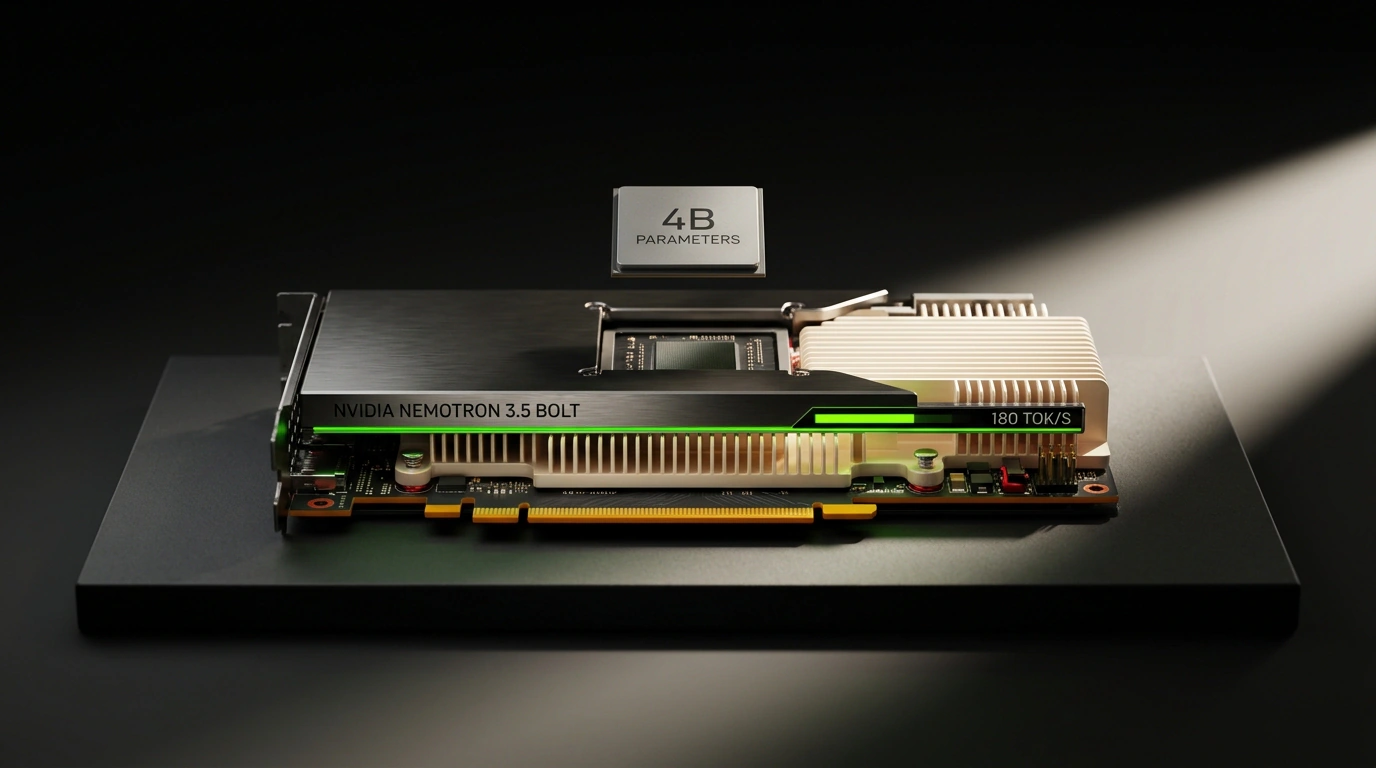
For a long time, the generative AI world suffered from megalomania. Tech giants raced to see who could pack the most zeros into a parameter count: 70 billion, 400 billion, three trillion. Yet the moment a developer steps down from marketing keynotes into real product engineering, reality hits hard: running your own cluster of H100s is ruinously expensive, while public cloud APIs suffer from network latency, queues, and regular outages.
What if most everyday agent tasks—routing commands, function calling, parsing JSON, and classifying incoming data—simply don't need a giant model at all?
NVIDIA answered that question with Nemotron 3.5 Bolt, a compact 4-billion-parameter (4B) model engineered specifically for ultra-fast local inference on consumer GeForce RTX GPUs. We previously analyzed the multimodal capabilities of the Nemotron 3.5 Super VL lineup and tested hybrid local architectures. Let's see what this little 4B contender can actually do in the field.
A Small Model with Big-Model Habits: The 4B Architecture
Building a good small model is much harder than training a giant. In a 70B model, weight redundancy can forgive messy dataset flaws; at 4B, every single parameter has to carry maximum semantic weight.
For Nemotron 3.5 Bolt, NVIDIA engineers used multi-stage knowledge distillation from their flagship proprietary Nemotron Ultra models, reinforced by targeted reinforcement learning on synthetic tool-calling traces (Tool Calling RL):
- Instead of fiction or rambling chat logs, the model trained on millions of strict API interactions, valid code generation, and system-instruction following.
- Its tokenizer vocabulary was expanded and tuned for popular programming languages (Python, TypeScript, Go, Rust, Bash).
- Native context length sits at 64,000 tokens—more than enough to hold medium-sized documentation files or database schemas.
Running on Consumer RTX Cards: Quantization and 180 Tokens/Sec
The best news for enthusiasts and indie developers is how modest the hardware requirements are. Running Nemotron 3.5 Bolt doesn't take liquid-cooled server racks:
- In 8-bit format (FP8), the model occupies roughly 4.5 GB of VRAM.
- Under tight 4-bit quantization (INT4 / AWQ), the weights shrink to an astonishing 2.6 GB, letting it run even on budget laptop GPUs like an RTX 4050 or RTX 4060 with 6–8 GB of VRAM.
- Powered by NVIDIA's TensorRT-LLM engine, generation speed on a desktop RTX 4070 or RTX 5070 tops 180 tokens per second.
When text pours onto your screen that fast, it stops feeling like you are talking to a remote server. Replies appear instantaneously, with barely any Time To First Token delay (TTFT is literally 15–25 milliseconds).
Request Routing and Function Calling on Local Hardware
Where does the compact Bolt shine at 100% capacity? Its signature role is acting as a local Router & Function Caller.
Picture a busy enterprise automation setup:
- Thousands of varied user requests hit the system every minute.
- Forwarding every single one to an expensive cloud model like Claude Opus or GPT-6 is pure financial suicide.
- Instead, you spin up a local instance of Nemotron 3.5 Bolt.
The little model reads incoming text in a flash, classifies user intent, pulls out named entities (dates, amounts, order IDs), and builds a strict JSON payload to trigger internal business logic. On the Berkeley Function-Calling Leaderboard (BFCL), Nemotron 3.5 Bolt cleared 88% argument-generation accuracy, beating plenty of models in the 14B–32B weight class.
If a request is routine—a quick lookup or standard action—Bolt handles it on the spot. Only when a task calls for deep synthesis or complex system planning does Bolt neatly escalate it to an external cloud flagship.
Where 4B Hits a Wall: Physical Limits of Depth
It would be dishonest to gloss over the limits of compact networks. Semiconductor physics allows no miracles: four billion parameters have a hard ceiling on memory capacity.
Nemotron 3.5 Bolt is definitely not built for:
- Writing multi-page creative prose that needs subtle tone, subtext, and rich literary metaphors.
- Multi-step mathematical reasoning or proving complex theorems, where the model quickly tangles logical links and produces plausible-sounding wrong steps.
- Deep architectural refactoring across dozens of interconnected microservices.
Nobody is asking it to do that, though. Nemotron 3.5 Bolt is a razor-sharp workhorse for local terminals, smart homes, and fast serverless microservices—proving that smart local AI can be fast, compact, and completely free to run.