If you have ever tried automating software development or deep analysis with language models, you know the exhaustion of constant babysitting. You sit in front of your terminal, write a prompt, wait for a reply, spot an error in the codebase, paste it back into the chat, re-explain the context—and repeat that loop twenty times in an evening. Sure, the AI is writing the code, but you are still stuck acting as the main relay and dispatcher.
With Anthropic's release of Claude Opus 5.5, that manual ping-pong is finally becoming history. The model gained native support for holding the logic of continuous agentic loops, working without human intervention across dozens of consecutive iterations.
We already examined how reasoning effort tiers in Claude Opus 5.5 perform under different loads, and watched the rise of proactive AI colleagues like Claude Duet and Open Duet. Now let's pull apart how to build a reliable autonomous loop that doesn't get stuck spinning forever or burn through your company budget for nothing.
The Four-Stroke Loop: Why Linear Chat Is Outdated
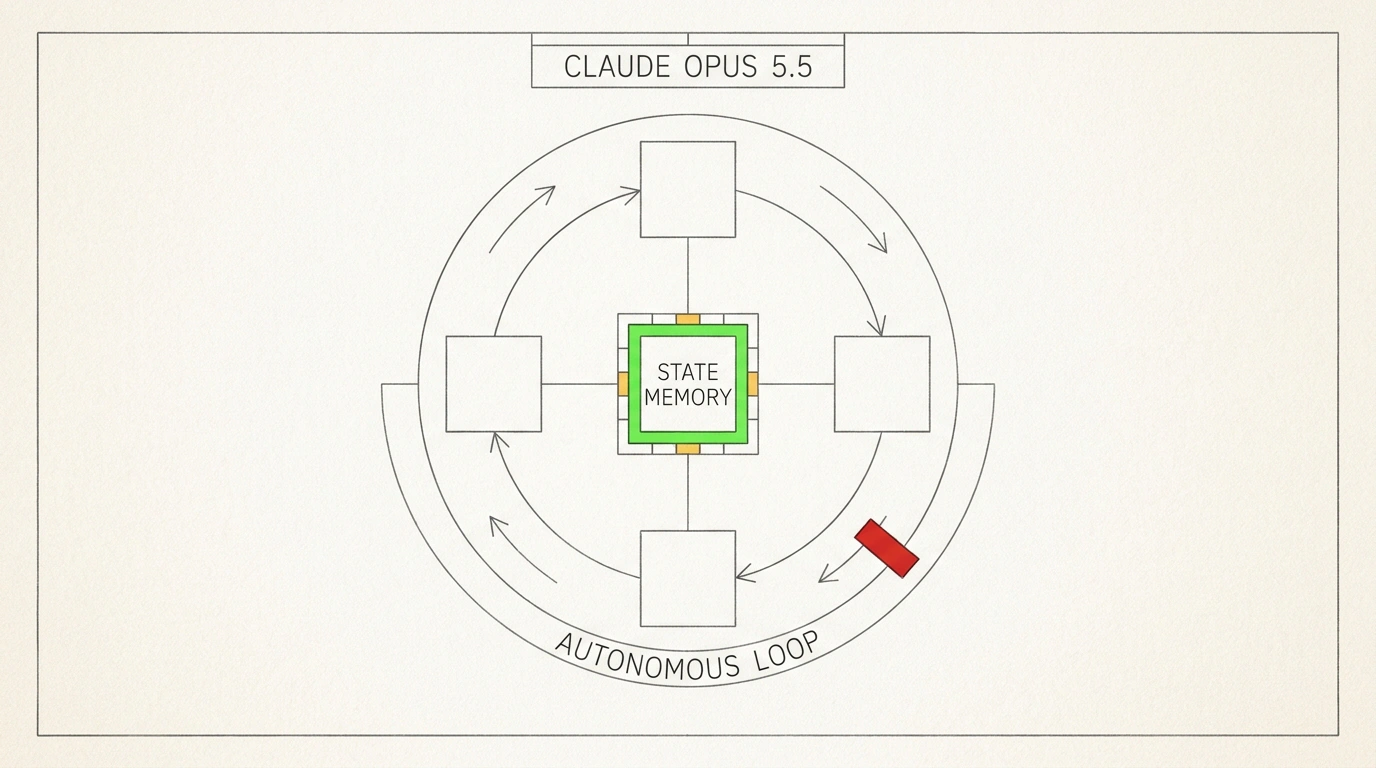
In classic LLM workflows, interaction is strictly linear: a user question produces an assistant answer. In an autonomous loop, that pattern turns into a four-stroke engine:
- Plan. Given a high-level goal (say, "find and fix the memory leak in the auth microservice"), the model breaks it down into a list of verifiable subtasks and defines success criteria.
- Act. The model picks an appropriate tool from its system manifest—running grep across the code, reading a file, launching a memory profiler, or compiling a binary—and issues a structured command.
- Evaluate. Once the tool output lands back in context, the model compares it against expected results. If tests fail, it doesn't give up; it pivots to analyzing the stack trace.
- Refine. Based on real feedback, the algorithm updates its plan or edits source lines, and the loop starts over.
This shifts the whole nature of working with a model. You set the direction and go grab a coffee while the agent methodically tests hypotheses, isolates the bug, and runs unit tests until it gets a clean green report.
Structured Memory and Tool-Calling Protocols
The number one enemy of any long loop is context drift. If you dump raw terminal output, build logs, and intermediate thoughts into one unbroken stream, within 15 steps the model loses sight of the original goal and starts wandering in circles.
With Claude Opus 5.5, external structured memory—often implemented as a working scratchpad—makes all the difference:
- At the start of each step, the agent updates a
<current_state>block noting what has already been checked, which hypothesis failed, and which step is running right now. - Verbose CLI logs get trimmed down to key error lines, while source files are read in targeted chunks via line-based paging.
- Tool calls are standardized through strict JSON schemas (tool definitions), eliminating syntax hallucinations in command-line flags.
Backed by Opus 5.5's strong reasoning engine, the model keeps cause-and-effect chains intact even when a task demands 30 to 40 consecutive tool calls.
Fighting Hallucinations and Infinite Loops: Stopping Criteria
Every builder of autonomous systems has lived through the nightmare of the infinite loop: the model finds a bug, tries to patch it, breaks an adjacent module, reverts the change, hits the first bug again—and dances in circles until your API balance hits zero.
To prevent that, your architecture needs hard programmatic guardrails (stopping criteria):
- No-progress iteration counter. If the hashes of modified files match earlier states over the last three cycles, or if the failing test count hasn't dropped, the loop halts and requests human intervention.
- Per-task token budget. Every autonomous run gets a strict cap on total consumption (for example, no more than 500,000 tokens per session).
- External verifier. The final call on whether a task is done isn't made by the agent ("I fixed everything!"), but by a deterministic system process—running the full integration test suite inside an isolated container.
Token Economics: Prompt Caching and Cost Control
If you run an autonomous loop naively, API bills can shock even a well-funded startup. Think about it: on every single one of those forty steps, you are re-sending the entire system prompt, tool definitions, and accumulated step history. That is hundreds of thousands of tokens multiplied by flagship model rates.
Prompt Caching, natively supported in Anthropic's API, is the lifesaver here. The static part of your context—system architecture, project docs, system rules, and tool descriptions—gets tagged with a cache flag:
- On repeat hits within 5 minutes, reading cached context costs 90% less than the base rate.
- Time To First Token (TTFT) drops from 8–10 seconds to a fraction of a second.
As a result, the cost of a complex thirty-minute autonomous debugging session falls from tens of dollars down to a couple hundred cents. That turns autonomous loops from a neat demo toy into a commercially viable tool for real production.