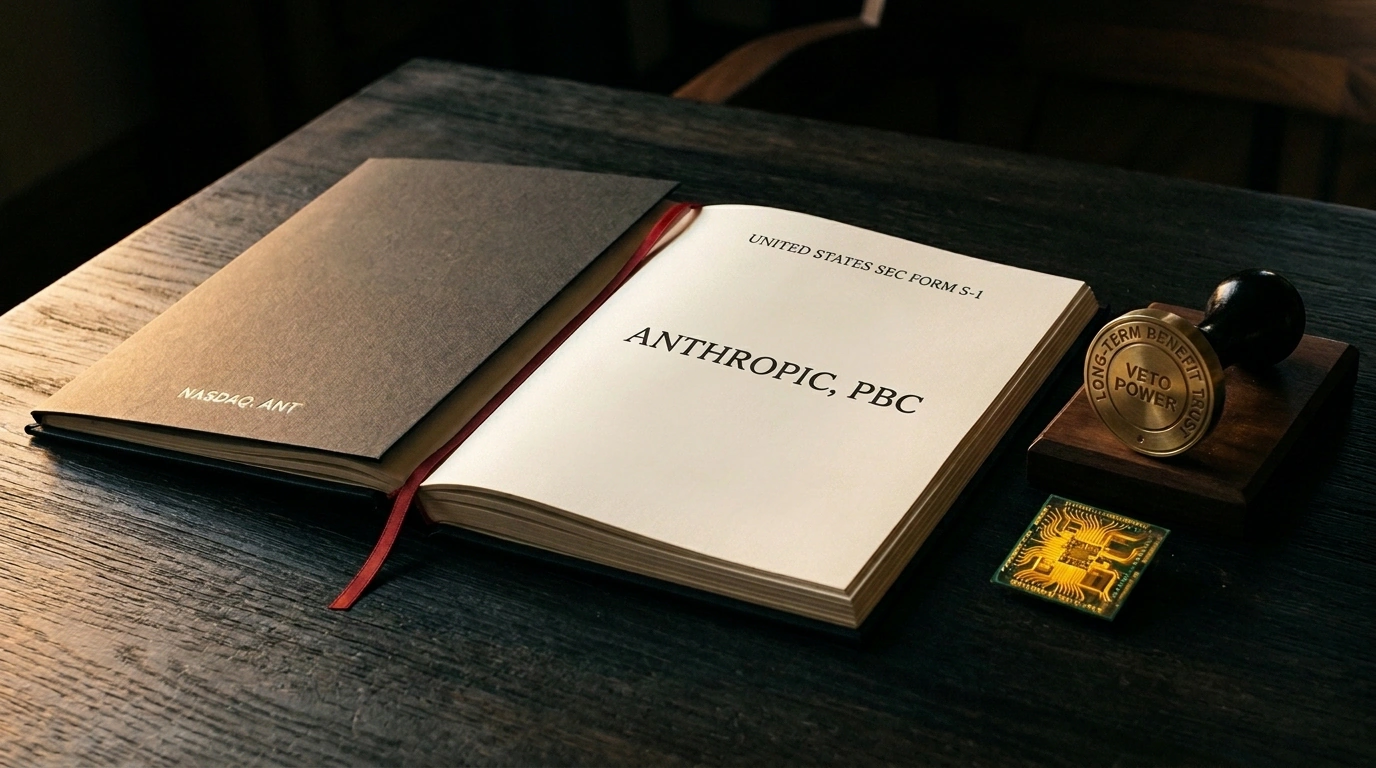
Taking a tech giant public is always a moment of truth. As long as a company stays private, it can tell investors rosy stories, juggle fuzzy metrics, and hide true unit costs behind glossy press releases. The moment an official Form S-1 registration statement lands at the U.S. Securities and Exchange Commission (SEC), the curtain drops. Any half-truth, massaged figure, or hidden conflict of interest puts top executives at risk of criminal liability.
The arrival of Form S-1 from Anthropic, PBC—creator of the Claude model family—became the most anticipated financial event of the year in AI. The upcoming listing on the Nasdaq Global Select Market under the ticker ANT offers unprecedented visibility into the private financial and corporate machinery of Dario and Daniela Amodei's lab.
We already watched the cyber capabilities of autonomous AI agents grow alongside new corporate risks, but the S-1 filing reveals the other side of the coin: the cold economics of compute, the battle for control over AGI, and a fierce collision between safety ideals and the laws of raw capitalism. Let's peel back this three-hundred-page document layer by layer.
Architecture of Absolute Control: Long-Term Benefit Trust vs. Wall Street
The central drama of any major Silicon Valley IPO is founder control. Everyone remembers the Sam Altman upheaval at OpenAI in late 2023, when a nonprofit board abruptly fired the CEO, only to fold under pressure from furious investors and staff. At Anthropic—founded by former OpenAI leaders—they drew hard legal lessons from that episode.
The company is incorporated in Delaware as a Public Benefit Corporation (PBC). Legally, that obligates the board of directors to balance shareholder financial returns against a stated public benefit: the safe development and deployment of artificial general intelligence (AGI).
Still, PBC status alone wouldn't shield leadership from Wall Street institutional funds demanding profit growth at any price. So Anthropic's legal team engineered an unusual superstructure—the Long-Term Benefit Trust (LTBT):
- The LTBT is a fully independent trust staffed by recognized global experts in national security, bioethics, law, and technological safety.
- Trust members are barred from owning Anthropic shares or options, removing any financial incentive to juice the stock price.
- The trust holds an inalienable veto over board actions if they threaten core safety protocols or risk the uncontrolled release of dangerous systems.
It is a direct slap in the face to classic venture orthodoxy. Investors are told upfront: your capital is welcome, but if a model shows signs of posing a threat to society, the trust will freeze the release—even if that tanks the stock by 80%.
Four Share Classes and Protecting the Safety Mission
To make that legal machinery run like clockwork, Form S-1 details an intricate capital structure split across four share classes:
Four monolithic geometric pedestals representing Anthropic share classes with a gold accent on Class F
- Class A Common Stock. Standard shares offered to public investors on Nasdaq. One share carries one vote at shareholder meetings.
- Class B Common Stock. Shares held by early institutional funds and key employees. Each share carries 10 votes, guarding against hostile takeovers in early public life.
- Class F Common Stock. The most exotic instrument in the filing. Exactly one Class F share exists, issued to Founder LLC—an entity controlled by Dario Amodei and the core co-founders. Under the corporate charter, that single share locks in 50.1% of voting power on all strategic forks: charter amendments, dissolution, major acquisitions, or mergers.
- Class T Common Stock. A special non-voting governance instrument held by the LTBT. It activates oversight mechanisms enforcing the Responsible Scaling Policy (RSP).
This setup makes a hostile takeover by tech conglomerates or activist hedge funds legally impossible. The founders and the independent trust keep a firm grip on the wheel no matter how the market cap swings.
Financial Reality: Explosive Revenue Growth and Billions Burned on Compute
If the legal section of the S-1 earns respect for sheer ingenuity, the financial statements (Statement of Operations) make even seasoned analysts whistle.
Here is a company posting breathtaking commercial expansion alongside staggering cash burn:
- Explosive ARR growth. At the end of 2023, Anthropic's annual recurring revenue stood at a modest $100 million. By fall 2026, that figure crossed the astronomical mark of $3.5 billion. Venture capital history has never seen organic enterprise software growth at that pace.
- Net Dollar Retention (NDR). The metric tops 145%. Enterprise customers who signed up a year ago aren't just sticking around—they are expanding their token consumption by nearly 1.5x every year.
- Net loss. Over the trailing 12 months, losses topped $4.2 billion. Virtually every dollar earned—plus billions in venture funding—goes straight into the furnace of compute rentals and compensation packages for elite researchers.
Training each successive generation of models scales exponentially in cost. Training a hypothetical Claude Opus 6 will demand compute power comparable to the electricity consumption of a small European city, and Anthropic lays that risk out plainly for prospective public shareholders.
Infrastructure Lock-In: Cloud Commitments to AWS and Google Cloud
One of the most striking sections of Form S-1 covers contractual obligations to cloud partners (Cloud Commitments), pulling back the curtain on Anthropic's alliances with Amazon and Google.
Those multi-billion-dollar investments from cloud giants were anything but charity:
- Anthropic's total non-cancellable contractual commitments for compute infrastructure exceed $10 billion over the next 4–5 years.
- The company is legally bound to reserve and pay for massive server pools on Amazon Web Services powered by custom Amazon Trainium and Inferentia silicon.
- In parallel, huge agreements with Google Cloud Platform lock in utilization of Google TPU tensor processor clusters.
This dual-track commitment to alternative Trainium and TPU chips is no accident—it is a deliberate strategic bet by Dario Amodei. NVIDIA's dominance in GPUs means pure H100 and Blackwell server rental margins eat up the lion's share of any AI lab's revenue. By shifting a large share of inference onto AWS Inferentia chips and tuning training runs for Google's TPU v5p and v6e, Anthropic aims to undercut rivals' token generation costs by 30–40%.
The price of that diversification, however, is immense engineering complexity. Maintaining codebases optimized simultaneously for CUDA, AWS Trainium Neuron compilers, and Google's TPU XLA stack requires an army of specialized systems engineers and slows down rapid adoption of new open architectures.
Anthropic has effectively become the world's largest corporate compute tenant. That creates massive financial leverage: if generative AI demand suddenly cools, billions owed for reserved server racks will hang over the balance sheet like a lead weight.
Inference Unit Economics: Subscriptions vs. Enterprise APIs
How does model monetization actually work under the hood? Form S-1 breaks down revenue by sales channel for the first time:
- Enterprise API — over 75% of revenue.
This is the healthiest, highest-margin slice of the business. Major tech platforms, banks, law firms, and software companies pay per token consumed. Gross Margin holds steady around 65–70%, boosted by Prompt Caching and algorithmic request-queue optimization. - Consumer subscriptions (Claude Pro and Team) — under 25% of revenue.
Here the unit economics look far tighter. A flat $20/month fee forces the company to walk a razor-thin margin line. Power users running Claude Code on complex repositories all day burn hundreds of dollars' worth of tokens a month. To keep the consumer tier in the black, Anthropic has to enforce strict dynamic rate limits and aggressively compress inactive chat contexts.
The company's long-term financial engine clearly isn't hobbyist subscriptions—it is deep integration into corporate IT pipelines through AWS Bedrock and Google Cloud Vertex AI.
Risk Factors: Copyright Suits, Silicon Access, and Open-Model Price Dumping
The Risk Factors section of Form S-1 reads like a top-shelf industrial thriller. Anthropic's lawyers laid every existential threat on the table:
- Open-model price dumping. Labs like DeepSeek, Moonshot AI, and Meta are releasing open-weight models reaching trillions of parameters at rock-bottom prices. If the quality gap between closed Claude flagships and free open networks closes to zero, enterprise buyers will struggle to justify Anthropic's premium API rates.
- Copyright and licensing. Lawsuits from author guilds, book publishers, and record labels create ongoing legal uncertainty. An adverse ruling could force the company to pull and retrain core foundation models.
- Silicon bottlenecks and geopolitics. Concentrating leading-edge chip manufacturing at TSMC fabs in Taiwan creates a single point of failure. Any escalation around the island would freeze next-gen accelerator shipments overnight, halting infrastructure scaling.
Responsible Scaling Policy: ASL Safety Levels and the Veto
For the first time in public tech history, an internal AI safety framework—the Responsible Scaling Policy (RSP)—has moved from a voluntary research pledge into a legally binding part of a securities prospectus.
Form S-1 spells out a graduated scale of AI Safety Levels (ASL), modeled after biological lab biosafety levels (BSL):
- ASL-1. General-purpose models with no autonomous harmful capabilities. Basic text generators needing minimal standard oversight.
- ASL-2. The current industry baseline, covering models like Claude 3.5 Sonnet and Haiku. Requires reliable safeguards against generating instructions for explosives, chemical weapons, or basic malware.
- ASL-3. Models capable of meaningfully assisting in biological weapon development, zero-day cyberattacks, or autonomous multi-step sabotage. To train and deploy ASL-3 systems, the S-1 obligates Anthropic to air-gap server clusters, enforce multi-factor physical access controls on model weights, and encrypt parameters with specialized cryptographic keys split among independent custodians.
- ASL-4. A hypothetical threshold toward AGI where a model exhibits autonomous self-improvement, self-replication, and covert evasion of developer safeguards.
If monitoring systems detect a training run approaching the critical ASL-4 threshold, an emergency legal mechanism kicks in: the LTBT holds an unconditional right to impose a mandatory veto halting training or public release until an independent international audit board confirms mathematically verified containment guarantees. No amount of Wall Street analyst protests or stock-price drops can override that call.
What Anthropic's IPO Changes for the Entire AI Industry
Anthropic's IPO marks a turning point for the entire tech sector. Until now, the AI market has operated inside a venture bubble, where startup valuations floated on founder hype and slick demos.
By going public, Anthropic sets a hard market benchmark for every rival, including OpenAI:
- Public market valuation will reveal what investors are truly willing to pay for pure-play AI technology without the safety cushion of a search monopoly or enterprise OS like Google or Microsoft.
- If the hybrid Public Benefit Corporation structure succeeds, it will prove ethics and safety can serve as an institutional moat rather than an annoying drag on business.
- Wall Street gains its first pure-play instrument for direct investment in frontier AI.
Form S-1 makes one thing unmistakable: the romantic era of lab experiments is over. Artificial intelligence has grown up into a ruthless, capital-intensive global business—one where every generated token sits atop billion-dollar commitments and a high-stakes battle over the safety of what comes next.