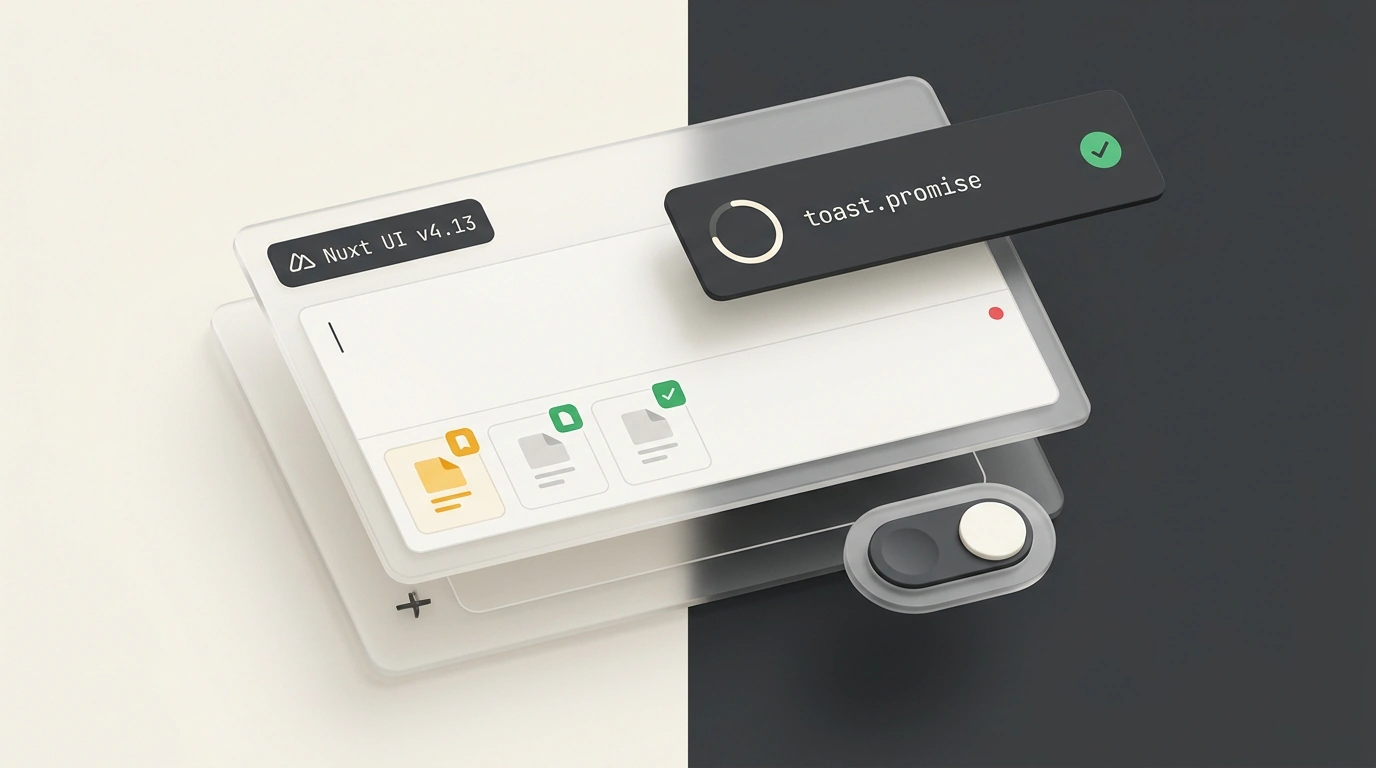
On November 18, 2026, Nuxt UI v4.13.0 shipped as a minor release for Nuxt (>=4.1.0) and Vue 3 on Tailwind CSS v4 with zero breaking changes. Inside are 13 new features and around fifty fixes, but the real win is closing four recurring pain points that usually eat up evenings with custom workarounds.
AI Chat with Files and Queuing, Plus Toggle Buttons
If you've built an AI chat UI, you know the drill: the input box works, and then users ask to paste images, drag and drop files, and send a follow-up while the model is still streaming. In v4.13.0, <UChatPrompt> gains v-model:files (with paste and drag-and-drop), while a new <ChatAttachment> component renders the attachment list.
<template>
  <!-- Files can be pasted from clipboard or dropped with a mouse -->
  <UChatPrompt
    v-model="input"
    v-model:files="files"
    v-model:queue="queue"
    @submit="onSubmit"
  >
    <UChatPromptSubmit :status="status" />
  </UChatPrompt>
</template>
For the Vercel AI SDK (ai ^6 || ^7), @nuxt/ui/utils/ai adds a toFileUIParts helper that converts browser File objects into message parts for the model. v-model:queue helps during streaming: a new prompt joins the queue and fires once the stream finishes. UChatPrompt also stops double-submitting mid-stream, and ChatMessages preserves scroll position and adds an ARIA live region.
For toolbars and filters, <UToggle> and <UToggleGroup> finally arrive so you don't have to fake toggle buttons with <UButton>.
<script setup lang="ts">
const bold = ref(false)
const align = ref('left')

// Toggle group items
const items = [
  { value: 'left', icon: 'i-lucide-align-left', 'aria-label': 'Left' },
  { value: 'center', icon: 'i-lucide-align-center', 'aria-label': 'Center' },
  { value: 'right', icon: 'i-lucide-align-right', 'aria-label': 'Right' }
]
</script>

<template>
  <!-- Single toggle button -->
  <UToggle v-model="bold" icon="i-lucide-bold" aria-label="Bold" />
  <!-- Add type="multiple" for multi-select -->
  <UToggleGroup v-model="align" :items="items" />
</template>
Both components accept standard Button props plus active-color and active-variant for the pressed state. Fewer conditional classes in templates means cleaner code.
One-Line Async Toasts and Faster Rendering
Previously, async notifications meant showing "Saving...", storing the toast id, and updating it manually inside try / catch. Now useToast() includes promise().
const toast = useToast()

// One call replaces manual try/catch and id updates
await toast.promise($fetch('/api/save', { method: 'POST' }), {
  loading: 'Saving...',
  success: { title: 'Saved', color: 'success' },
  error: (error: any) => ({ title: error.message, color: 'error' })
})
If the request succeeds, the toast turns green automatically; if it fails, it pulls the message from your callback. Rendering also got faster across the board: tv is memoized by theme and identical props, tailwindcss/colors lazy-loads during hydration, redundant reactiveOmit/reactivePick calls are gone, and Table stops re-rendering virtualized rows on every scroll. Large admin dashboards feel noticeably smoother.
Linting Against Hardcoded text-gray-500
The built-in @nuxt/ui/eslint config from PR #7329, built on eslint-plugin-better-tailwindcss (^4.10), catches a common habit of developers and AI agents alike: writing raw palette colors like text-gray-500 instead of semantic Tailwind tokens (text-muted, bg-error-500) that adapt to light and dark modes. Install the plugin in devDependencies and turn on the option in your config (plain Vue setups without Nuxt have a factory helper in the ESLint integration docs):
// nuxt.config.ts
export default defineNuxtConfig({
  modules: ['@nuxt/eslint', '@nuxt/ui'],
  css: ['~/assets/css/main.css'],
  ui: {
    // Validate Tailwind classes via @nuxt/ui/eslint
    eslint: true
  }
})
The config reads your CSS and app.config.ts, checking class, :ui props, and <UTheme>. By default, no-palette-colors (suggesting semantic tokens over raw palette colors) and no-conflicting-classes (catching clashes like p-2 p-4) run at warn level with autofix disabled so it doesn't guess your intent. Through ui.eslint.rules, you can also enable no-unknown-classes and enforce-logical-properties for RTL (which does support autofix).
If eslint-plugin-better-tailwindcss is already loaded indirectly via a shared config, Nuxt UI's auto-detection misses it and ESLint crashes with 'Different instances of plugin'. That's why v4 keeps the check opt-in.