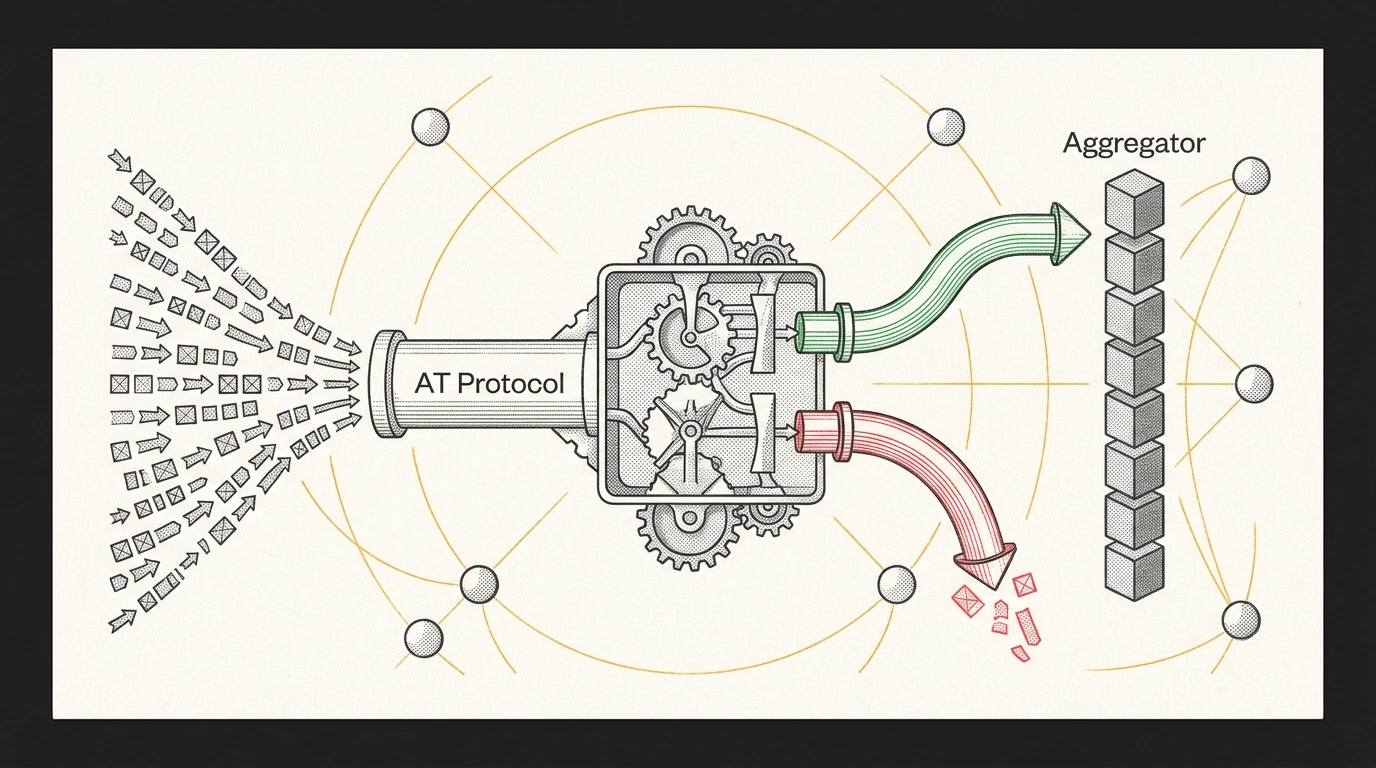
In October 2026, Johanna Larsson published a breakdown of her link aggregator shelf.cafe, later featured in Frontend Focus #767. On the surface it looks like a familiar Hacker News clone: 7,000+ links, hand-written Elixir SSR (no AI agents), an uncached ~170 KB homepage, and ~250 ms load times. Here's the twist: if you delete shelf.cafe's database, the site can rebuild itself from the network without losing a single link.
Why Hand the Database Back to Users
On a typical CRUD site, everything is locked in: posts and votes sit in your PostgreSQL database, and if the site shuts down, the data disappears. AT Protocol (the protocol behind Bluesky) splits those responsibilities into three layers.
The source of truth is a PDS (Personal Data Server), the user's own data server. When you submit a link, it writes to your repository rather than the site's private table. shelf.cafe itself acts as an AppView—a storefront and local index. It listens to the network firehose, ranks entries using Score = Votes ^ 0.8 / (Age + 2) ^ 1.8, and renders HTML. Anyone else can build a competing client over the exact same data.
Johanna solved the cold-start problem with two smart moves. Initial links come from curated RSS blogs (borrowed from bubbles.town, starting with their blogs.opml). Instead of empty comment sections, shelf.cafe maintains a live backlink index: it catches Bluesky posts referencing aggregator URLs in real time and backfills older threads via Constellation.
She didn't reinvent moderation either. AT Protocol supports labelers—independent services that flag spam and scams. shelf.cafe subscribes to four of them (Bluesky, Blacksky, Northsky Moderation, and Skywatch Blue), layered with local bans against bots mirroring the Hacker News feed.
Lexicon Schemas and Submitting Links from the Terminal
To make sure different clients agree on data shapes, AT Protocol uses Lexicon, a schema language akin to a mix of JSON Schema and OpenAPI. The aggregator's schemas live under cafe.shelf.* (browsable on pdsls.dev). A cafe.shelf.item link record is straightforward:
{
  "$type": "cafe.shelf.item",
  "url": "https://example.com/post",
  "title": "Some post",
  "source": "example.com",
  "createdAt": "2026-10-03T18:00:00Z"
}
Because the format is open, you don't even need a browser. You can push a link straight to your PDS from the terminal using the official Go CLI goat:
# Install goat (or go install github.com/bluesky-social/goat@latest)
brew install goat

# Log in with a dedicated App Password and post JSON from a file
goat account login -u handle.bsky.social -p xxxx-xxxx-xxxx-xxxx
cat item.json | goat record create -n -
The tool returns the record's at:// URI and cid, and shelf.cafe's AppView picks up the event and lists your link on /new within about a second. You can swap cat for your clipboard too: pbpaste on macOS or xclip -o on Linux.
The goat README warns that it stores your app password and tokens in your home directory in cleartext. Create a dedicated App Password, avoid logging in on shared servers, and clear credentials with goat account logout.
Subscribing to Jetstream and the Public Widget
To spare every AppView from decoding the heavy binary network firehose, Bluesky provides Jetstream. This Go service streams compact JSON over WebSocket and filters by collection with no auth required:
// npm install @bsky/jetstream
import { Jetstream } from '@bsky/jetstream'

const stream = new Jetstream('https://jetstream.us-east.bsky.network')

// Listen only for new links in the cafe.shelf.item collection
for await (const evt of stream.live({ collections: ['cafe.shelf.item'] })) {
  console.log(evt)
}
Ten lines with @bsky/jetstream give you a live feed of new links (or app.bsky.feed.post entries for your own backlink index). You can also inspect the stream without code via websocat using xrpc.v1.json, though heavy workloads should run their own Jetstream instance.
Data is served outward over XRPC—HTTP endpoints shaped like /xrpc/<name>. shelf.cafe exposes a public CORS endpoint at /xrpc/getItems?url=<url> (rate-limited to 60 requests/min per IP, so cache responses on your backend) along with a widget.js vote-counter script for blogs.
There are honest caveats: the cafe.shelf.* schemas haven't gone through community standardization and may change, and Johanna hasn't published the Elixir backend source or OAuth details yet—saving those for upcoming posts on ingestion, backlinks, and fast SSR.