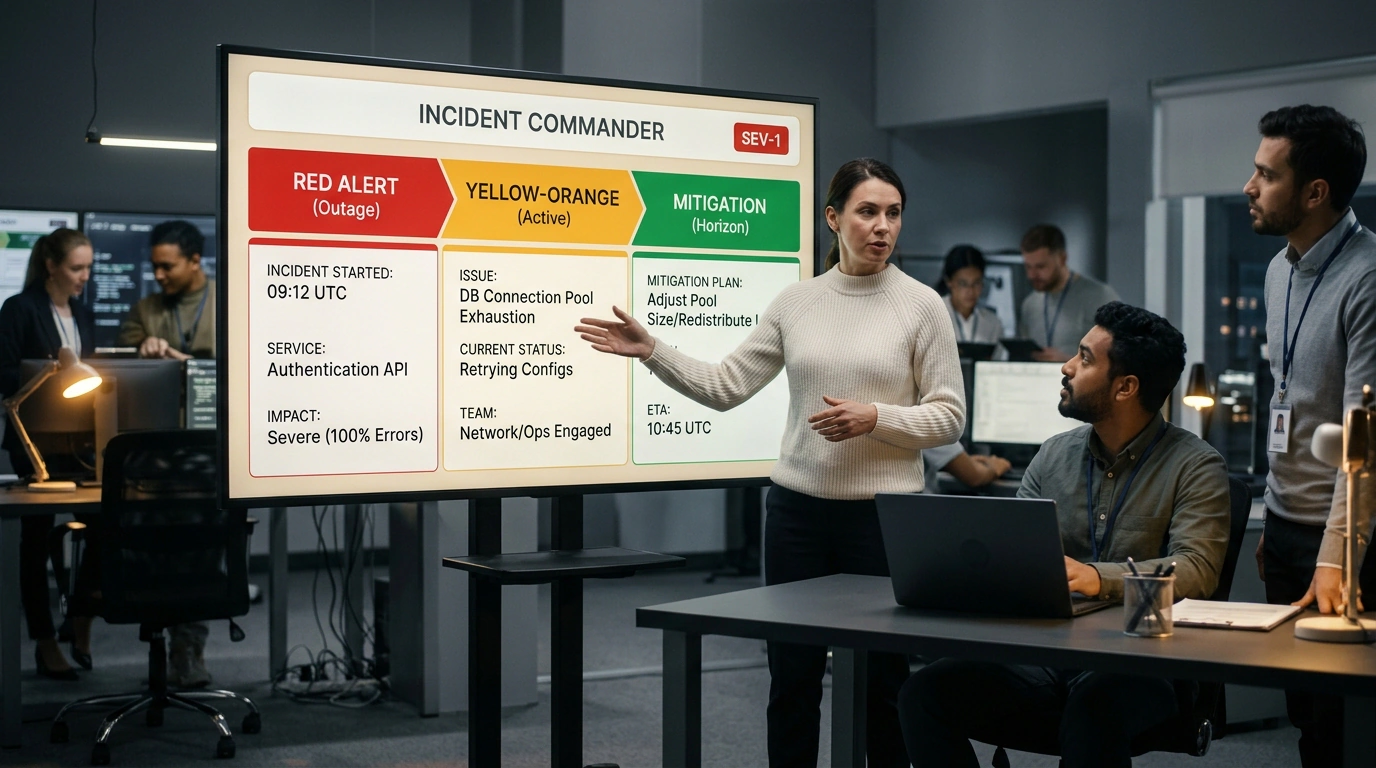
Production goes down at 2 a.m. Alerts flood Slack, support tickets pile up, and the team jumps on a call. Who should run the room? The gut reaction is to pick the engineering manager: they're in charge, and they know the system inside out.
In practice, that bet often backfires. In a November 4, 2026 post, Brent Chapman—who helped shape incident response at Google and Slack—explains why restricting the Incident Commander role to engineering managers is a bad habit.
Why Deep Code Knowledge Gets in the Way During an Outage
An Incident Commander (IC) coordinates everything during an outage: delegating tasks, tracking status, updating leadership, and weighing business priorities. The IC does not fix the bug themselves.
Doing that job well doesn't require knowing every line of code—a high-level grasp of the architecture is enough. An IC's real superpower is an accurate mental map of the company: which team owns what, who to page, and how escalation (pulling in decision-makers or adjacent teams) actually works, not what an outdated wiki says. They also bring contacts in legal and support plus the week's business context, like a major customer conference or contract renewal.
Knowing the broken service too well often backfires. Picture a call with the Tech Lead and SMEs (subject-matter experts), and the IC—who used to own that module—spots a suspicious log line. It's almost impossible to resist: seconds later, they're debating timeouts and caching. Just like that, command vanishes. Status updates stall, executives wait in the dark, and newcomers have no idea who's steering.
That trap leads to a simple rule: you can't hold the hose and command the fire at the same time. Chapman points to firefighting (where tech borrowed the ICS model): the commanding officer always stands back from the hose line to keep the whole building in view.
An IC from outside the codebase brings another edge. They ask basic questions: "How does this normally work?", "What changed recently?", "Have we seen this before?", "Who else should we page?". Experts skip those as obvious, yet they expose hidden assumptions and bring everyone in the channel up to speed.
Who to Bring Into the Pool Instead of Only Managers
"Wait," you might say. "If not an engineering manager, who can handle that pressure? You can't just put anyone in charge."
Of course not. An IC needs facilitation skills, clear communication, the ability to juggle parallel tracks, and calm decision-making under stress. Companies already have people doing that every day:
- PMs and TPMs (Technical Program Managers) connect teams, coordinate parallel workstreams, and keep stakeholders informed. They often know the org chart better than developers do.
- Customer Care leads see escalations from the customer's perspective, feel the real business impact, and write clearer status updates than adrenaline-soaked engineers.
- Individual-contributor engineers with strong organization and meeting-facilitation skills. Org-chart rank doesn't matter here, and their calendars are often freer.
Engineering managers still belong in the pool—many are great ICs. The mistake is locking the rotation to them out of habit, burning them out on-call while overlooking strong non-coding leaders.
Two Conditions Without Which This Won't Work
Inviting TPMs and support leads isn't enough on its own. Chapman names two strict prerequisites.
First, clearly separate Incident Commander from Tech Lead ahead of time. In a 2018 post, Chapman drew the line cleanly: the Tech Lead works "heads down, hands on the keyboard" guiding specialists toward a fix, while the IC stays "heads up and looking around." In a 2026 follow-up, he adds that in microservices no single person holds the whole system in their head, so the Tech Lead also stitches together the technical picture. As long as your IC makes technical calls, non-engineers can't step in. A two-person startup can combine roles at first, yet as soon as calls grow, split them.
Second, keep the rules fair. New ICs must join a real on-call rotation with training, drills, and regular shifts. The company must compensate them for on-call time and count IC work in performance reviews and promotions on par with engineering on-call—otherwise the role quickly turns into thankless extra work.